Friday, April 17, 2009

Good Friday, East and West

Here are my observations from 2007:
In Holy Week, perhaps more than any other time, the unity of the Orthodox Church is manifest. The words, emphases, and actions of both Byzantine and Western Rite Orthodox could not be more clearly of-a-piece. I write in haste (I often do on this blog) and cannot give more than a cursory overview, but consider:

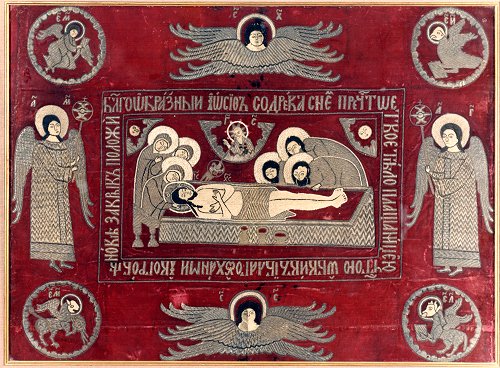
In the Western Rite on Maundy Thursday, the priest consecrates a second Host, to be consumed during the Presanctified Liturgy of Good Friday. He then processes with the presanctified Eucharist from the altar to a side chapel and "buries" It. Upon arriving at the altar, the priest and servers kneel in adoration (as did the people as It passed in procession). In the Byzantine Rite, on the Great Vespers service of Holy Friday ("Good Friday" in the West), the priest removes the icon of Christ affixed to the Crucifix and "buries" it. He and the clergy process around the church with the epitaphios (a cloth with the icon of Christ being prepared for burial), then places it and the Gospel (cross-side up) on a bier. The people often kneel as it passes. Then the clergy and people kneel and venerate the epitaphios and Gospel.

On Good Friday, in the Western Rite of the Orthodox Church, the people pray the Great Intercessions, so reminiscent of the Byzantine litanies. The priest then unveils the Cross, as the people kneel. As the Reproaches (Improperia) are sung, the clergy and people then prostrate and adore the Cross. In the Byzantine Rite, in Orthros of Holy Friday (anticipated on the evening of Holy/Maundy Thursday; this service is also known as the "12 Passion Gospels"), the priest processes with the Cross about the church, as the people kneel. The clergy then prostrate and adore the cross.

The Byzantine Prokeimenon (Tone 4) before the 7th Gospel, during this service celebrated on Maundy Thursday evening, is: "They parted my garments among them, and upon my vesture they cast lots." This is the same verse the priest chants in the Western Rite on Maundy Thursday before the stripping of the altar.

Moreover, the content of the Western Rite Reproaches (Improperia) are closely echoed by the words of the Byzantine services for the same liturgical day:

BYZANTINE RITEWESTERN RITE
Today the Jews nail on the Cross Him Who did cleave the sea with a rod, and made them to pass through the wilderness. Today they pierce with a spear the side of Him Who scourged Egypt with curses for their sake; and will give Him bitterness to drink who rained down manna for their nourishment.

(Sixth Antiphon, Orthros of Holy Friday - 12 Passion Gospels.)

Why doth the law-transgressing people of false worship meditate in falsehood? Why was he condemned to death Who is the life of all?
(Stichera Verse, Tone 2, Great Vespers of Holy Friday.)
O My people, what have I done to thee? Or wherein have I afflicted thee? Answer Me. Because I led thee out of the land of Egypt, thou hast prepared a Cross for thy Savior.

(Good Friday Reproaches)
Say ye, O transgressors of the law, what heard ye from our Saviour? Is it not that He appointed a law and the teachings of the Prophets? How then did ye think to deliver to Pilate the Word, God of God, and the Deliverer of our souls?

They who benefited always by Thy gifts, O Christ, were crying: Let Him be crucified. And the killers of the Righteous sought to free an evildoer in place of the Benefactor. But Thou wast silent, enduring their arrogance, wishing to suffer and to save us, since Thou art the Lover of mankind. (8th Antiphon, Orthros of Holy Friday.)

In place of the good things that Thou didst for the Hebrew people, O Christ, they condemned Thee to be crucified, giving Thee vinegar and gall to drink. (11th Antiphon, Orthros of Holy Friday.)

Thus saith the Lord to the Jews: My people, what have I done unto Thee, and wherewith have I harmed Thee? Thy blind have I lighted; thy lepers have I cleansed, and the man on his couch have I raised.

O My people, what have I done unto thee, and wherewith hast thou rewarded Me? Instead of manna, gall; and in place of water, vinegar; and instead of loving Me, thou didst nail Me to the Cross. (12th Antiphon, Orthros of Holy Friday.)

My firstborn, Israel, hath done double evil, having forsaken Me, the Fountain of the waters of life, and shaped himself a broken cistern, crucifying Me on a a Tree...thou O Israel did not refrain but delivered Me unto death. O Holy Father, forgive them, for they know not what they have done. (Praises, Tone 3, following 9th Gospel, Orthodos of Holy Friday.)

When Thou wast led to the Cross, O Lord, Thou didst say, "For what act do ye wish, O Jews, to crucify Me? Is it because I have strengthened your cripples? Is it because I raised your dead as from the sleep, healed the woman of her issue of blood, and showed mercy upon the Canaanitish woman? For what act, O ye Jews, desire ye my death?" But ye shall behold Him whom ye pierced, O law-transgressors, and know that He is Christ. (Idiomela Hymns, Tone 5, 3rd Hour of Holy Friday.)

Thus saith the Lord to the Jews: My people, what have I done unto thee; and wherewith have I harmed thee? Thy blind have I lighted; thy lepers have I cleansed, and the man on his couch have I raised. In my food they gave me gall, and in my thirst they gave me vinegar to drink. (Idiomela Hymns, Tone 8, 6th Hour of Holy Friday.)

When the lawless nailed Thee upon the Cross, O Lord of glory, Thou didst cry unto them, "Wherein have I caused you sorrow? Wherein have I angered you? And who before Me delivered you from sorrow? And now wherewith do ye reward Me? Instead of goodness, evil; for the pillar of fire, ye nailed Me on the Cross; for the clouds, ye dug Me a grave; instead of water, ye gave Me vinegar to drink. (Idiolmela Hymns, Tone 2, 9th Hour of Holy Friday)

Oh, how the assembly of the law-transgressors condemned to death the King of creation, not being ashamed nor abashed by His benevolences, of which He had assured them formerly, calling them to their remembrance, saying, "My people, what have I done to thee? Have I not showered Judaism with wonders? Have I not raised the dead by only a word? Have I not healed every sickness and every weakness? With what, then, hast thou rewarded Me? And why forgetest thou Me? For healing, thou hast inflicted wounds upon Me; and for raising the dead, thou dost cause Me, the Benevolent, to die suspended upon a Tree as an evil-doer; the Giver of the Law, as a law-transgressor; and the King of all as One Who is condemned." (Stichera Verse, Tone 6, Ibid.)
Because I led thee out through the desert forty years: and fed thee with manna, and brought thee into a land exceeding good, thou has prepared a Cross for thy Savior.

What more ought I to have done for thee, that I have not done? I planted thee, indeed, My most beautiful vineyard: and thou has become exceeding bitter to Me: for in My thirst thou gavest Me vinegar to drink; and with a lance thou hast pierced the side of thy Savior.


For thy sake I scourged Egypt with its firstborn: and thou didst deliver Me up to be scourged.

I led thee out of Egypt having drowned Pharaoh in the Red Sea: and thou to the chief priests didst deliver Me.

I opened the sea before thee: and thou with a spear didst open My side.

I went before thee in a pillar of cloud: and thou didst lead Me to the judgment hall of Pilate.

I fed thee with manna in the desert; and thou didst beat Me with blows and scourges.

I gave thee the water of salvation from the rock to drink: and thou didst give Me gall and vinegar.

For thy sake I struck the kings of the Canaanites: and thou didst strike My head with a reed.

I gave thee a royal scepter: and thou didst give My head a crown of thorns.

I exalted thee with great strength: and thou didst hang Me on the gibbet of the Cross.

(Good Friday Reproaches)

UPDATE: How could I forget: After Maundy Thursday, the Western Rite faithful keep vigil before the "tomb" containing the presanctified Eucharist (the "40 Hours Devotion"). On Good Friday, it is traditional for Byzantine Orthodox to keep vigil at the "tomb" of Christ. In both cases, it is to undo the disobedience of the sleep-ridden Apostles and arouse a sense of watchfulness over our souls.

Also, on Good Friday in the West, during the Presanctified Liturgy (the only one of the year in the WR), the people recite the Trisagion...in Greek, no less. -- BJ.

Again, at the risk of sounding like a broken record, "The Eastern and Western Rites are merely different ways of doing the same thing."(TM) Though a certain school of Orthodox obscurantism rejects us, let's all humble ourselves, prostrate before whatever our particular Orthodox rite proffers, and meditate upon the life-giving Death necessitated by our numberless sins and transgressions - the truth so clearly driven home by both rites. And then let us embrace one another as fellow inheritors of that grace-bestowing Life. If we are to, in the words of the Paschal stichera, "call brothers even those that hate us," certainly we should do so for Orthodox brethren worshiping according to approved Rites of our Holy Mother the Church. Especially when we are praying the same things to the same Lord in the same Church.

Labels: , ,

Friday, March 06, 2009

Lent: You Call This a Fast?

Herewith, a sermon by the late Fr. Charles Dinkler, RIP:

No topic is more preached upon during Lent than is fasting. As we approach the end of Lent (Easter is April 30) and the heightened fasting period of Passiontide (Passion Sunday, April 17 through Easter), consider these words from Isaiah 58: 4-8:
Behold, ye fast for strife and debate, and to smite with the fist of wickedness: ye shall not fast as he do this day, to make your voice to be heard on high.

Is it such a fast that I have chosen? A day for a man to afflict his soul? Is it to bow down his head as a bulrush and to spread sackcloth and ashes under him? Wilt thou call this a fast, and an acceptable day to the Lord?

Is not this the fast that I have chosen? To loose the hands of wickedness, to undo the heavy burdens, and to let the oppressed go free, and that ye break every yoke?

Is it not to deal thy bread to the hungry, and that thou bring the poor that are cast out to thy house? When thou seest the naked, that thou cover him; and that thou hide not thyself from thine own flesh?

Then shall thy light break forth as the morning, and thine health shall spring forth speedily: and thy righteousness shall go before thee; the glory of the Lord shall be thy reward.

There is always a danger that Lenten fasts can be perverted in to mere obedience to the rules. One example is scrupulously following dietary rules which address the ingredients of food - no meat, for example. Another is symbolically giving up one thing, which can devolve into mere tokenism.

Lenten fasting is not a mere change of diet, as in “meat and chicken are forbidden but lobster and clams are not.” Fr. Schmemann once called this “all that superficial hypocrisy.”

We must take care that our fast, our whole Lent, does not become an occasion for our condemnation. We don’t fast for strife or debate, to make a fuss about what food is served, or the ingredients in it. We don’t fast to make our voice heard on high. We don’t fast to afflict our soul.

We fast to loose the bands of wickedness; to undo the heavy burdens; to let the oppressed go free; to break every yoke.

This article is not going to address any dietary restrictions. It does contain guidelines and suggestions inspired by Fr. Schmemann.

St. John of the Ladder speaks in Step 14 of gluttony and moderation. Nobody can go the 40 days of Lent without food or water. So how much fasting is enough? How much is merely minimalistic? Each Christian must judge this for himself, for her own circumstances.

Fasting means to be hungry. We have to push ourselves a little. We should go further, go beyond that state which is comfortable to us. We want to go toward the limit of our human condition, which depends entirely on food. In our hunger, we hope to find that our dependency on food is not the whole truth about us. Hunger is first of all a spiritual condition. And is is first of all a hunger for God.

It has been suggested that we exist in a half-hungry state throughout Lent. Not ill or incapable of functioning. But never full, satisfied, replete.

We should feel that twinge of hunger and remember that we are not the independent, self-subsisting personages we suppose our selves to be. We are not the masters of our fate. We are not the captains of our souls. Use the twinge of hunger to remember that all this self-centered, self-referential, solipsistic life is an imposture. It’s a fantasy, a delusion, a hallucination. Feel the hunger and remember: We are not our own. We have been bought with a great price and belong to God. Remember who we are and what we are about. Remember God and remember to pray to him, to know His will and to do it.

During Lent, strive for a “drastic reduction in the amount of food.” (Unseen Warfare, 1.1., p. 21.) But what about spiritual effort? But remember: The mere physical state of fasting will be rendered meaningless - and can become positively dangerous - if it is disconnected from this spiritual effort.

Spiritual effort does not just occur in church. Even in Lent, a person can only spend so much time in church. Those of us who are in the world, even if we make earnest attempts to attend all Sunday and extra Lenten services and on Maundy Thursday, Good Friday, and Easter, may face insurmountable problems of distance or family emergencies or employers’ lack of support for frequent time off for church. Even in a Monastery, the monks only spend three-and-a half to five hours a day in the chapel.

What about the rest of our day? We spend most of our day at work, school, running errands, or at home. What can we practically do to increase spiritual effort?

Western Orthodoxy has an ideal and practical approach. Everyone should be equipped with the Ordo, which contains the Lectionary of what Old and New Testament passages should be read each day at home. Are you saying the offices of Morning Prayer and Evensong using the Ordo? These are totally doable. They are lovely and inspiring. They put us in touch with what we are about. One can say the offices at home, either as a family or each member individually. You don’t need a priest to do it. The English Office of Morning and Evening Prayer enables each member of the body of Christ to participate spiritually and practically in this worship.

What if you’re not at home or don’t have your Ordo and books? You may be walking to work, or in the car, on a train, waiting in a checkout line at the grocery store, on hold with your HMO, sitting at the bus stop, on your way to the Post Office. Pray where you are. At any time of the day, in any place, we can stop and pause and silently pray.

Remember the direction to pray without ceasing. We can’t start out with praying 23 hours a day. The saints and the church direct us to start with prayers at various hours of the day. On arising, at mid-morning, noon, early evening, just before bed, and any time we waken in the middle of the night - each of these times, pray. Even a short prayer is a good start: the Our Father, for example, or another prayer that resonates with you.

Once we master this, it is easier to expand prayer into the rest of the day, and to get closer to the command to pray without ceasing.

Lent should be different from the rest of the year. Lent looks different - the liturgical colors or lack of colors in the shroud-like Lenten array; the covering of crosses and images with veils.

Lent tastes different. What we eat is different. We may not, like some medieval monks, eat “tainted victuals” but we should certainly eat more modestly. Eat less food. Eat simpler food, humbler food, perhaps less tasty food. Spend less time on food. Avoid dinner parties and restaurant meals; eat modestly at home. Avoid unnecessary or “frill” foods like dessert.

Lent should sound different. We hear a difference in Church services with the different music and chant used during Lent. In olden times, you could hear the difference outside the church. In London, the theatre would close down for the Lenten season. Can you imagine going down to the cineplex today and asking them to close down for the season? Even socially, in times past the sounds of merriment were muted for Lent. Parties were postponed until Easter. We’re hardly able to obtain this situation today, with the torrent of sounds going around us.

Nowadays we are surrounded, engulfed, drowning in sound - much of it noise. We are bombarded everywhere, at all times. In elevators. On hold. The two biggest culprits are radio and television. And we don’t have to go outside to find the world; it’s there, invading our homes, crashing through the gates of our minds. Children do homework with earphones on. People go through the day with radio or TV on every minute. Radio stations advertise which one is best to keep on all day at work.

In former days people listened to music. Now, music is reduced to a ubiquitous background to other activities.

So what?

Silence matters. If we are never silent, if we are always distracted, focused on the outside, thinking and planning and hearing sounds all the time, how are we going to know what God is saying to us?

In “Ash Wednesday” T.S. Eliot wrote:

Where shall the word be found, where will the word
Resound? Not here, there is not enough silence.
Not on the sea or on the islands, not
On the mainland, in the desert or the rain land,
For those who walk in darkness
Both in the day time and in the night time
The right time and the right place are not here
No place of grace for those who avoid the fact
No time to rejoice for those who walk among noise and
deny the voice.

During Lent, consider: Are we using noise to avoid His face? To deny His voice? To stifle God’s Word? To shut up God’s grace?

The Roman Catholic saint John of the Cross speaks of a resounding silence, a sonorous silence. God is seen and heard in every one of us.

God is speaking within us. But how can we hear it if we are amused, distracted, consumed by all the noise going around us.

The Fathers of the church have a saying: “He who is never silent must never speak, for he has nothing to say.”

1 Kings 19: 9-13:

And he came thither unto a cave and lodged there; and, behold, the word of the Lord came to him, and he said unto him, What doest thou here, Elijah?

And he said, I have been very jealous for the Lord God of hosts: for the children of Israel have forsaken thy covenant, thrown down thine altars, and slain thy prophets with the sword; and I , even I only, am left; and they seek my life, to take it away.

And he said, Go forth, and stand upon the mount before the Lord. And, behold the Lord passed by, and a great and strong wind rent the mountains, and brake in pieces the rocks before the Lord; but the Lord was not in the wind: and after the wind an earthquake; but the Lord was not in the earthquake.

And after the earthquake a fire; but the Lord was not in the fire: and after the fire a still small voice.

And it was so, when Elijah heard it, that he wrapped his face in his mantle, and went out, and stood in the entering in of the cave. And behold there came a voice unto him, and said, What doest thou here, Elijah?

During Lent we work on anything that distracts us from God. But sound is primary; it is more pervasive and intrusive than the visual. We can always avert our eyes. But think of what we encounter on the streets. Ever try to ignore one of those cars using a sound system with an exaggerated bass response? Or a car alarm going off? Or a truck backing up? The whole area around them vibrates with noise. Our lives tend to be like those pounding, throbbing cars.

Like praying frequently in order to learn to pray without ceasing, we have got to have some silence in order to hear what the Lord God is saying to us. We need some silence to learn how to concentrate our attention and energies on God and doing his will.

How about drastically reducing the amount of radio and television we watch during Lent? You choose which - you know your own poison. And let’s be honest with ourselves. What can we live without? What distractions should we be giving up? Maybe reduce TV shows only to news programs or those of some genuine merit and depth.

By all these actions, Lent in our lives can start looking, sounding, smelling, tasting and being different.

Labels:

Sunday, February 01, 2009

The Book of Hours and the Little Office of Our Lady

From the archives of the website WesternOrthodoxy.com.

The Christian Church, following both Jewish tradition and Roman secular practice, established rules or canons for recital of certain prayers and devotions at specific times of the day. These formed the Canonical Hours in which daily liturgy or Divine Office of the Church was celebrated. As the Psalmist cried, “Seven times a day do I praise thee b/c of thy righteous judgments.” [Psalms 119:164]

In medieval times, devout laymen followed the example of the professed religious (i.e. monks and nuns). The lay people wished to have their prayer books and to follow, in their own way, the Church’s program of daily devotion. The Books of Hours, though originating in the Church’s liturgy, were the first commonly popular prayer books used by men and women who lived secular lives.

“The world can be likened to books written by the hand of the Lord.” The Saxon-born monk Hugh, Prior of the Augustinian monastery of Saint-Victor in Paris wrote this in 1133. His statement is an arresting reminder of the gulf that divides our scientific, technological age from the religiously oriented world of the Middle Ages. Books then possessed a mystique which had little to do with personal expression. Books were valued because they revealed the purposes of God and enabled man to know and worship the Creator. Books of Hours were thus, in a sense, the original self-help books - a genre that remains huge today.

The most important books were those in which Christ’s saving work, His redemption of mankind, was remembered and honored in the liturgy of the Church. In both the Orthodox Church of the Byzantine Empire and the Catholic Church of Latin Christendom, this liturgy was ceaselessly celebrated, in accordance with the texts in the Missal and the Breviary. The missal contains the texts necessary for the celebration of the Mass. The Breviary and the Divine Office (Divinum Officium or “godly work”), hymns, prayers, and other texts were sung by monks and nuns in choir at the Canonical Hours. They were also read daily, under the breath, by all ordained deacons and priests.

The Hours were made up of seven services. The night Hours of Matins and Lauds (usually taken together) were recited between midnight and dawn. These were followed at approximately 3 hour intervals during the day by the Hours of Prime, Tierce, Sext, and None, and the evening Hours of Vespers and Compline.

The Divine Office of the day takes an hour or two to read through privately. For the monastic community who sing the Office every day of the year, it takes much longer. The composition of the Breviary has changed little since the 11th century, when it was last expanded at the request of the Cistercians and other reformed Orders. First comes a calendar, essential for making sure that the right devotions are performed on each day in the year. The calendar is necessary because the content of each service varies according to the season, the day of the week, the Saint’s days and other feasts, both fixed and movable The Ordinary, with which the Breviary proper begins, sets out the constant elements of each Hour, with certain seasonal variations. The Ordinary is mainly a list of instructions and has been called “a prompter’s script.” Next follows the Psalter containing the psalms, canticles, and hymns to be used for every Hour for every day of the week. The Proper of Time which follows contains the Office (i.e. the text) of the various prayers to be recited on each day of the liturgical year; the Proper of the Saints contains the texts for the major Saint’s days; and the Common of the Saints contains the texts for categories of Saints (e.g., apostles, martyrs, confessors) and such as do not have an individual office.

The Breviary - despite the suggestion in its title of brevity - contains the whole text of the Divine Office, with the Psalter forming an essential constituent. It also contains a number of additional prayers and devotions to be recited in choir at regular times. These were introduced by St. Benedit of Aniane, (c. 750-821), reformer of the French monasteries and counselor to Louis the Pious, son of Charlemagne. Among these devotional accretions is a short service in honor of the Virgin Mary, which first appeared in the 10th century. Its recitation was made obligatory in the Benedectine monastery of Monte Casino in central Italy at an early date, but the widespread popularity in clerical circles of this extra devotion to the Virgin has been attributed to the piety of St. Ulric (d. 973) Bishop of Augsburg and of Berenger, Bishop of Verdun (d. 962). Urban II ( 1108-99) gave Papal approval by ordering the service to be recited by clerics for the success of the First Crusade.

The devotional practice of reciting this “Little Office of Our Lady” spread from the religious orders to the clergy, and from the clergy to the laity. What had started as an accretion to the Breviary became the favorite prayer book of lay people everywhere. Until the 13th century the Little Office of Our Lady was usually attached, as a kind of appendix, to the Psalter, the only prayer book normally used by lay people. During the 13th century it became detached, like fruit falling off a tree, and became a separate prayer book: The Book of Hours.

The fact that the Little Office of Our Lady was, from the first, concentrated on the Virgin Mary is of great significance. With no martyrdom or miracles associated with her during her lifetime, she became, through the mystery of the Incarnation, the central figure in an unprecedented devotion in which many of the deepest emotions of men and women were involved. It was to the Virgin Mary, Mother of God, that they turned most often. Through the intensity and multiplicity of her following she became the most popular expression of faith and devotion in the Middle Ages. She was the mother-substitute of all, the new Eve, the intercessor with God. Mary was more powerful than the Saints and less awful than God. As His mother she has peculiar influence with Christ; and her position between man and his Maker, as the Middle Ages pictured it, is exactly expressed by St. Bernard, Abbot of Clairvaux (1090-1153) when he said that Christ desires us to have everything through Mary.

Frank M. Lewis
at Walnut Creek, CA
May 2, 1984, revised April 5, 2000.

It is good to see the website's archives finally unblocked, so we can read its articles.


Labels: ,

Sunday, January 11, 2009

Saint Ambrose Prayer Book Now Available

The Saint Ambrose Prayer Book, a Western Rite prayer book now available from Lancelot Andrewes Press

It's here: a handbook of private devotions specifically for Western Rite Orthodox Christians. Lancelot Andrewes Press has announced the release of The Saint Ambrose Prayer Book. The 450-page-long book contains prayers and devotional material for morning and evening prayer, confession, the Eucharist, prayers for the departed, and much more. A partial review of its contents includes:
  • The Christian's Obligations and Spiritual Outlines. This includes such things as rules for fasting and worship, as well as the Ten Commandments, the nine Beatitudes, the seven deadly sins, the spiritual and corporal works of mercy, etc.;
  • Common Prayers. The prayers every Orthodox Christian should memorize, including the Lord's Prayer; the Confiteor; and prayers for morning, evening, and midday;
  • Occasional Prayers for various needs;
  • Devotions for Holy Mass. In addition to prayers and offices of preparation for and thanksgiving after Holy Communion, this section includes the entire text of both the Liturgy of St. Gregory and the Liturgy of St. Tikhon, and counsels for communicants
  • Confessional Devotions. This includes an examination of conscience, a form of Confession, and the seven penitential Psalms;
  • Prayers for the Dead, including the Requiem Mass and prayers at graveside; and
  • Various Devotions, including litanies to the saints, a Visit to the Christmas Creche, and short prayers.
This is merely an overview, not a comprehensive Table of Contents, nor a review. One can take heart that the volume has been edited by the Very Rev. Fr. John Winfrey, Archpriest, who compiled the beautiful Antiochian Archdiocese's Holy Week Service Book for the Eastern Rite.

The Saint Ambrose Prayer Book is now available for $30 from Lancelot Andrewes Press. A trade discount on bulk orders of 10 or more are available for churches and book stores.

Labels: ,

Thursday, September 11, 2008

9/11: Seven Years On

In remembrance of the seventh anniversary of 9/11, we offer these humbles thoughts and prayers:
Into paradise may the angels lead thee:
At thy coming may the Martyrs receive thee,
And bring thee into the holy city Jerusalem.
May the Choir of Angels receive thee,
And with Lazarus, one poor, mayest thou have eternal rest.

In paradisum from The Orthodox Ritual
Rest eternal grant unto them, O Lord, and let light perpetual shine upon them.

And for those who perpetrated this act of terrorism in the name of their God, here's one bit from a portion of Evening Prayer of the "Forms of Prayer to be Used in Families," which the Holy Synod of Russia decreed needed no changes on doctrinal grounds (although I would recommend adding invocation of the saints and angels to the prayers, even in the short form):
Accept, O Lord, our intercessions for all mankind. Let the light of thy Gospel shine upon all nations; and may as many as have received it, live as becomes it. Be gracious unto thy Church; and grant that every member of the same, in his vocation and ministry, may serve thee faithfully. Bless all in authority over us; and so rule their hearts and strengthen their hands, that they may punish wickedness and vice, and maintain thy true religion and virtue. Send down thy blessings, temporal and spiritual, upon all our relations, friends, and neighbours. Reward all who have done us good, and pardon all those who have done or wish us evil, and give them repentance and better minds. Be merciful to all who are in any trouble; and do thou, the God of pity, administer to them according to their several necessities; for his sake who went about doing good, thy Son our Saviour Jesus Christ. Amen.
May God be with us all, lay to rest those who perished, comfort those who continue to mourn, pacify the anger and hatred of those who rejoice, turn the hearts of those who wish or plan to perpetrate similar deeds, and reign in the hearts and minds of all His children, to our benefit and our glory. Through Jesus Christ His only Son, our Lord, Who liveth and reigneth with God the Father and the Holy Spirit, now and ever, world without end. Amen.

(Yes, it's early here; no, I couldn't sleep.)


Labels: ,

Tuesday, September 02, 2008

St. Nikolai (Velimirovich) on Eastern Orthodox Statues: St. Veronica

That story on the ancient Portmahomack monastery in Scotland mentioned sculptures/statues. Here's a tidbit from the Prologue of Ochrid by St. Nikolai of Zhica/South Canaan, which can be found on the website of Archangel Books, a conservative book seller affiliated with ROCOR. It quotes St. Nickolai in this entry:

St. Veronica with Holy Napkin (Russian Silk)

Commemorated on July 12/25

According to Bishop Nikolai Velimirovich in The Prologue from Ohrid:

This is the woman with the issue of blood, whom the Lord healed (Matt. 9:20). In gratitude to the Lord her healer, Veronica caused a statue of the Lord Jesus to be made, before which she prayed to God. By tradition, this statue was preserved up to the time of Julian the Apostate, when it was altered to become a statue of Zeus. This is one of the very rare occasions that a holy statue has been used in the Eastern Church. As is known, this later became a common custom in the Western Churches. St Veronica remained faithful to Christ till death, and entered peacefully into rest.

Veronica / Veroniki literally translates "true image" or "true icon."

You can also see the full day's saints here. You can also skip to any given day in the Prologue through the ROCOR archdiocese of Australia and New Zealand website. Both are according to the Old Calendar. Of course, we've found (and continue to find) that Orthodox statues were not as rare as perhaps he thought.

Labels: , ,

Friday, August 29, 2008

Unearthing Orthodox Scotland

Archeologists are analyzing a dig of Portmahomack, a pre-Schism monastery in Scotland possibly founded by St. Columba. The British media has reported a number of their surprised findings, including the realization that the Picts were not exactly vicious savages:

A study of one the most important archaeological discoveries in Scotland for 30 years, a Pictish monastery at Portmahomack on the Tarbat peninsula in Easter Ross, has found that they were capable of great art, learning and the use of complex architectural principles.

The monastery – an enclosure centred on a church thought to have housed about 150 monks and workers – was similar to St Columba's religious centre at Iona and there is evidence they would have made gospel books similar to the Book of Kells and religious artefacts such as chalices to supply numerous "daughter monasteries".

And, in a discovery described as "astonishing, mind-blowing" by architectural historians, it appears that the people who built the monastery did so using the proportions of "the Golden Section", or "Divine Proportion" as it became known during the Renaissance hundreds of years later. This ratio of dimensions, 1.618 to one, appears in nature, such as in the spiral of seashells, and the faces of people considered beautiful, such as Marilyn Monroe. It can be seen in Notre Dame Cathedral in Paris, the Alhambra palace of Granada in Spain, the Acropolis in Athens and the Egyptian Pyramids, but was thought to have been too advanced for the Picts.

Martin Carver, Archeology professor at York University, adds, "They were the most extraordinary artists....Even the Anglo-Saxons didn't do stone-carving as well as the Picts did...The most important piece had a Latin inscription. That's as common as muck in the Mediterranean, but extremely rare in Scotland."

The story continues:
The monastery at Portmahomack suffered a major fire in the ninth century and several stone sculptures were smashed, suggesting it was sacked by an invading force, likely to be Vikings intent on expanding their territories in northern Scotland. The site continued to be occupied but at this point evidence of a monastic settlement disappears.
So, sculptures were an Orthodox part of the Pictish Church and the pagan Viking iconoclasts did the work of Satan by smashing them.

Carver adds, "Portmahomack got burnt down pretty definitively round about 820. The idea is they were under new masters. It could be the Norse or the Men of Moray, MacBeth and his family. I think Portmahomack was captured by the Men of Moray. The Norse wanted it badly but they didn't get it. There is no Norse material there. There was no more vellum-making and sculpture and it stopped being a monastery. In the ninth to 11th centuries, they are making metal work, but that's the real Dark Age."

Portmahomack: Monastery of the Picts is published by Edinburgh University Press.

A highly interesting report.

Labels: , , ,

Friday, May 30, 2008

May: Crowning the Virgin Mary in New Zealand

I see Fr. Jack Witbrock's Wellington Mission of St. George, in New Zealand, has the following bulletin on its website:

May 2008 – The Month of Mary, Rosary every Wednesday.

I also find this interesting, as the mission is a bi-ritual mission.

Deo gratias, and may the Blessed Mary, the Ever-Virgin Mother of God, pray for us now and at the hour of our death. Amen.

Labels: , ,

Thursday, May 29, 2008

Audio: Crowning the Queen with the Ethiopian Hail Mary

The Hail Mary, chanted, from EthiopianOrthodox.org.

Labels: , ,

Sunday, May 18, 2008

The Works of Our Hands

Our friend Nathan Lee Lewis from the Journey to Orthodoxy blog posted a reflection from his father, Bill H. Lewis, a Southern Baptist minister in Arkansas. It begins:
The first prayer I utter each morning is “Lord, order my steps.” Actually I am saying, “Lord, you are in charge”...The prayer, “Lord, order my steps today” or “Lord, I really do not know what is best for me today. I will depend on you to order for me” is a “catch all” prayer...

Let’s just praise the Lord. “The steps of a good man are ordered by the Lord.” (Psalm 37:23 NKJV) You don’t need to “watch your steps” if you have already turned them over to the Lord at the beginning of the day and continue to trust Him to guide you throughout the day. God promises to guide [watch] your steps when you give Him the opportunity and commit to follow Him.
His father may be interested to hear in the Benedictine tradition of the canonical Western Rite, we put this devotional into practice most pointedly while praying the office of Prime. (Prime is the first hour, said before everyone goes to work. In monasteries, this is where the day's work assignments were given out.) We pray:
O Lord God Almighty, Who hast brought us to the beginning of this day; Defend us in the same with Thy mighty power, that we may not fall into any sin, but that all our thoughts, words, and deeds may be direct to the fulfillment of Thy righteousness. Through Jesus Christ, Thy Son, our Lord, Who with Thee in the unity of the Holy Ghost liveth and reigneth God, world without end. Amen.
Again, following the Martyrology, we pray:
O Lord God, King of heaven and earth, vouchsafe this day to direct and sanctify, to rule and govern our hearts and bodies, our thoughts, words, and deeds, in the ways of Thy laws and in the works of Thy commandments; that by Thy help we may be saved and delivered, both now and ever, O Savior of the world, Who livest and reignest, world without end. Amen.
At the close of the Chapter meeting, the presiding individual prays this blessing: "The Lord Almighty order our days and our doings in His peace." For much of the year, this is immediately followed by the "Short Lesson," taken from II Thessalonians 3:5:
The Lord direct your hearts and bodies into the love of God, and into the patient waiting for Christ.
There is also a plea:
And the glorious majesty of the Lord our God be upon us; prosper Thou the work of our hands upon us, O prosper Thou our handiwork.
In all, it's a wonderful way to start the day, a way that all Christians might find most edifying.

Labels: ,

Thursday, May 01, 2008

Crowning the Queen

Bring Flowers of the Rarest

Bring flowers of the fairest
Bring flowers of the rarest
From garden and woodland
And hillside and vale
Our full hearts are swelling
Our Glad voices telling
The praise of the loveliest
Rose of the vale

O Mary! we crown thee with blossoms today
Queen of the Angels, Queen of the May
O Mary! we crown thee with blossoms today
Queen of the Angels, Queen of the May

Our voices ascending,
In harmony blending
Oh! Thus may our hearts turn
Dear Mother, to thee
Oh! Thus shall we prove thee
How truly we love thee
How dark without Mary
Life's journey would be

O Mary! we crown thee with blossoms today
Queen of the Angels, Queen of the May
O Mary! we crown thee with blossoms today>
Queen of the Angels, Queen of the May

O Virgin most tender
Our homage we render
Thy love and protection
Sweet Mother, to win
In danger defend us
In sorrow befriend us
And shield our hearts
From contagion and sin

O Mary! we crown thee with blossoms today
Queen of the Angels, Queen of the May
O Mary! we crown thee with blossoms today
Queen of the Angels, Queen of the May

Of Mothers the dearest
Oh, wilt thou be nearest
When life with temptation
Is darkly replete
Forsake us, O never
Our hearts be they ever
As Pure as the lilies
We lay at thy feet

O Mary! we crown thee with blossoms today
Queen of the Angels, Queen of the May
O Mary! we crown thee with blossoms today
Queen of the Angels, Queen of the May

Labels: ,

Thursday, April 24, 2008

Egeria on the Via Dolorosa

Egeria's Travels noted how the faithful would gather on Maundy Thursday and follow the Via Dolorosa from Gethsemane to Calvary, "moaning and groaning of all the people, together with weeping."
From that hour they go with hymns to the city on foot, reaching the gate about the time when one man begins to be able to recognise another, and thence right on through the midst of the city; all, to a man, both great and small, rich and poor, all are ready there, for on that special day not a soul withdraws from the vigils until morning. Thus the bishop is escorted from Gethsemane to the gate, and thence through the whole of the city to the Cross...

And afterwards the bishop addresses the people, comforting them for that they have toiled all night and are about to toil during that same day, (bidding) them not be weary, but to have hope in God, Who will for that toil give them a greater reward. And encouraging them as he is able, he addresses them thus: " Go now, each one of you, to your houses, and sit down awhile, and all of you be ready here just before the second hour of the day, that from that hour to the sixth you may be able to behold the holy wood of the Cross, each one of us believing that it will be profitable to his salvation; then from the sixth hour we must all assemble again in this place, that is, before the Cross, that we may apply ourselves to lections and to prayers until night."

After this, when the dismissal at the Cross has been made, that is, before the sun rises, they all go at once with fervour to Sion, to pray at the column at which the Lord was scourged...

Then a chair is placed for the bishop in Golgotha behind the Cross, which is now standing; the bishop duly takes his seat in the chair, and a table covered with a linen cloth is placed before him; the deacons stand round the table, and a silver-gilt casket is brought in which is the holy wood of the Cross. The casket is opened and (the wood) is taken out, and both the wood of the Cross and the title are placed upon the table...And as all the people pass by one by one, all bowing themselves, they touch the Cross and the title, first with their foreheads and then with their eyes; then they kiss the Cross and pass through...

And when the sixth hour has come, they go before the Cross, whether it be in rain or in heat, the place being open to the air, as it were, a court of great size and of some beauty between the Cross and the Anastasis...The chair is placed for the bishop before the Cross, and from the sixth to the ninth hour nothing else is done, but the reading of lessons, which are read thus: first from the psalms wherever the Passion is spoken of, then from the Apostle, either from the epistles of the Apostles or from their Acts, wherever they have spoken of the Lord's Passion; then the passages from the Gospels, where He suffered, are read. Then the readings from the prophets where they foretold that the Lord should suffer, then from the Gospels where He mentions His Passion.

Thus from the sixth to the ninth hours the lessons are so read and the hymns said, that it may be shown to all the people that whatsoever the prophets foretold of the Lord's Passion is proved from the Gospels and from the writings of the Apostles to have been fulfilled. And so through all those three hours the people are taught that nothing was done which had not been foretold, and that nothing was foretold which was not wholly fulfilled. Prayers also suitable to the day are interspersed throughout.

The emotion shown and the mourning by all the people at every lesson and prayer is wonderful; for there is none, either great or small, who, on that day during those three hours, does not lament more than can be conceived, that the Lord had suffered those things for us. Afterwards, at the beginning of the ninth hour, there is read that passage from the Gospel according to John where He gave up the ghost. This read, prayer and the dismissal follow....they go to the Anastasis, where, when they arrive, the passage from the Gospel is read where Joseph begged the Body of the Lord from Pilate and laid it in a new sepulchre. And this reading ended, a prayer is said, the catechumens are blessed, and the dismissal is made.

Labels:

Tuesday, April 22, 2008

Tuesday of Holy Week

As we enter the last week of our preparation for Easter, we see again the many similarities extant between the canonically approved Eastern and Western rites. In an earlier post, I quoted this sermon from St. John Chrysostom:
[L]et us not merely read of these things, but bear them in our mind; the crown of thorns, the robe, the reed, the blows, the smiting on the cheek, the spittings, the irony. These things, if continually meditated on, are sufficient to take down all anger.
St. John Chrysostom, Homilies on the Gospel of St. John (Homily 84)

One would be wise to compare this passage to the Collect for the Day from the 1928 Book of Common Prayer:
O LORD God, whose blessed Son, our Saviour, gave his back to the smiters and hid not his face from shame; Grant us grace to take joyfully the sufferings of the present time, in full assurance of the glory that shall be revealed; through the same thy Son Jesus Christ our Lord. Amen.
1928 BCP Collect for Tuesday in Holy Week.

It seems as if the BCP collect were written after having read this passage. (It may have been, for all I know.)
Now, at the end of Lent, we see that, as with the Sunday of the Publican and the Pharisee, these Byzantine words seem best illustrated by a Western devotion. This is one more reason to give thanks for the canonical Western Rite and her approved liturgies, proven in their Orthodoxy.

(Hat tip: Fr. Peter.)


Labels: ,

Friday, April 18, 2008

A Patristic Poem on the Passion

Maintaining my tradition of posting material about the Passion on Fridays during Lent, here is probably the most graphic of the patristic materials I have found. It is most assuredly not my cup of tea, but here is "A Poem on the Passion," once ascribed to St. Lactantius. Although it is not his work, it is regarded by all authorities as well pre-Schism. As will be clear, it is not significantly different from the words of St. Ephrem the Syrian or St. John Chrysostom, but for some reason I find it more explicit; perhaps because of its first-Person narrative:
if you yourself wish to discriminate these things more fully, and if it delights you to go through all My groans, and to experience griefs with me, put together the designs and plots, and the impious price of My innocent blood, and the pretended kisses of a disciple, and the insults and strivings of the cruel multitude; and, moreover, the blows, and tongues prepared for accusations. Picture to your mind both the witnesses, and the accursed judgment of the blinded Pilate, and the immense cross pressing My shoulders and wearied back, and My painful steps to a dreadful death. Now survey Me from head to foot, deserted as I am, and lifted up afar from My beloved mother. Behold and see My locks clotted with blood, and My blood-stained neck under My very hair, and My head drained with cruel thorns, and pouring down like rain from all sides a stream of blood over My divine face. Survey My compressed and sightless eyes, and My afflicted cheeks; see My parched tongue poisoned with gall, and My countenance pale with death. Behold My hands pierced with nails, and My arms drawn out, and the great wound in My side; see the blood streaming from it, and My perforated feet, and blood-stained limbs. Bend your knee, and with lamentation adore the venerable wood of the Cross, and with lowly countenance stooping to the earth, which is wet with innocent blood, sprinkle it with rising tears, and at times bear Me and my admonitions in your devoted heart. Follow the footsteps of My life, and while you look upon My torments and cruel death, remembering My innumerable pangs of body and soul, learn to endure hardships, and to watch over your own safety. These memorials, if at any time you find pleasure in thinking over them, if in your mind there is any confidence to bear anything like my sufferings), if the piety due, and gratitude worthy of My labors shall arise, will be incitements to true virtue, and they will be shields against the snares of an enemy, aroused by which you will be safe, and as a conqueror bear off the palm in every contest. If these memorials shall turn away your senses, which are devoted to a perishable world, from the fleeting shadow of earthly beauty, the result will be, that you will not venture, enticed by empty hope, to trust the frail enjoyments of fickle fortune, and to place your hope in the fleeting years of life. But, truly, if you thus regard this perishable world, and through your love of a better country deprive yourself of earthly riches and the enjoyment of present things, the prayers of the pious will bring you up in sacred habits, and in the hope of a happy life, amidst severe punishments, will cherish you with heavenly dew, and feed you with the sweetness of the promised good.
You can read it all here. As with the film The Passion of the Christ, this is not "everyday reading"; it is stirringly emotional and may be too much for those of more delicate sensibilities. Even this excerpt is nearly too much; I merely posted it to show, perhaps to the surprise of some Orthodox, the depths of meditation the Fathers gave to Christ's suffering. The Fathers did indeed encourage meditation on the Passion, as well as the Resurrection, on the cross as well as on the glory, on His Servanthood as well as His Sovereignty. Again, reading it in context with the other patristic works in this series, one quickly finds it in line with their message: we must bear His wounds in mind to shun worldly fame, acclaim, or consolation and bear the inevitable suffering that comes to all servants of the Master.

Read the previous posts in the series:
St. Ephrem the Syrian: Meditate on the Passion of Christ.
Stations of the Cross: Another Similarity.
A Brief Post on St. Tikhon of Zadonsk on the Passion.
St. John Chrysostom: Meditate on the Sufferings of Christ.

Labels: , ,

Friday, April 11, 2008

St. John Chrysostom: Meditate on the Sufferings of Christ

So far in our Lenten series on the Orthodox saints' who counseled us to meditate upon the sufferings of Chris, we have read the words of St. Ephrem the Syrian and St. Tikhon of Zadonsk. Now let us hear the counsel of the greatest preacher in Byzantine Orthodox history: St. John Chrysostom:
[L]et us not merely read of these things, but bear them in our mind; the crown of thorns, the robe, the reed, the blows, the smiting on the cheek, the spittings, the irony. These things, if continually meditated on, are sufficient to take down all anger.
St. John Chrysostom, Homilies on the Gospel of St. John (Homily 84)

For what could be equal to this insolence? On that face which the sea, when it saw it, had reverenced, from which the sun, when it beheld it on the cross, turned away his rays, they did spit, and struck it with the palms of their hands, and some upon the head; giving full swing in every way to their own madness. For indeed they inflicted the blows that are most insulting of all, buffeting, smiting with the palms of their hands, and to these blows adding the insult of spitting at Him. And words again teeming with much derision did they speak, saying, “prophesy unto us, thou Christ, who is he that smote thee?” because the multitude called Him a prophet.

But another saith, that they covered His face with His own garment, and did these things, as though they had got in the midst of them some vile and worthless fellow. And not freemen only, but slaves also were intemperate with this intemperance towards Him at that time.

These things let us read continually, these things let us hear aright, these things let us write in our minds, for these are our honors. In these things do I take a pride, not only in the thousands of dead which He raised, but also in the sufferings which He endured.
St. John Chrysostom, Homilies on the Gospel of St. Matthew (Homily 85)

And the insults were different, and varied. For that Divine Head at one time they buffeted, at another they insulted with the crown of thorns, at another they smote with the reed, men unholy and accursed!

What plea shall we have after this for being moved by injuries, after Christ suffered these things? For what was done was the utmost limit of insolence. For not one member, but the whole entire body throughout was made an object of insolence; the head through the crown, and the reed, and the buffeting; the face, being spit upon; the cheeks, being smitten with the palms of the hands; the whole body by the stripes, by being wrapped in the robe, and by the pretended worship; the hand by the reed, which they gave him to hold instead of a sceptre; the mouth again by the offering of the vinegar. What could be more grievous than these things? What more insulting?

For the things that were done go beyond all language. For as though they were afraid lest they should seem to fall short at all in the crime, having killed the prophets with their own hands, but this man with the sentence of a judge, so they do in every deed; and make it the work of their own hands, and condemn and sentence both among themselves and before Pilate, saying, “His blood be on us and on our children,” and insult Him, and do despite unto Him themselves, binding Him, leading Him away, and render themselves authors of the spiteful acts done by the soldiers, and nail Him to the cross, and revile Him, and spit at Him, and deride Him. For Pilate contributed nothing in this matter, but they themselves did every thing, becoming accusers, and judges, and executioners, and all.

And these things are read amongst us, when all meet together. For that the heathens may not say, that ye display to people and nations the things that are glorious and illustrious, such as the signs and the miracles, but that ye hide these which are matters of reproach; the grace of the Spirit hath brought it to pass, that in the full festival, when men in multitude and women are present, and all, as one may say, at the great eve of the passover, then all these things should be read; when the whole world is present, then are all these acts proclaimed with a clear voice. And these being read, and made known to all, Christ is believed to be God and, besides all the rest, is worshipped, even because of this, that He vouchsafed to stoop so much for us as actually to suffer these things, and to teach us all virtue.

These things then let us read continually
; for indeed great is the gain, great the advantage to be thence obtained. For when thou seest Him, both by gestures and by deeds, mocked and worshipped with so much derision, and beaten and suffering the utmost insults, though thou be very stone, thou wilt become softer than any wax, and wilt cast out of thy soul all haughtiness.

...Hearing then these things, let us arm ourselves against all rage, against all anger. Shouldest thou perceive thy heart swelling, seal thy breast setting upon it the cross. Call to mind some one of the things that then took place, and thou wilt cast out as dust all rage by the recollection of the things that were done. Consider the words, the actions; consider that He is Lord, and thou servant. He is suffering for thee, thou for thyself; He in behalf of them who had been benefited by Him and had crucified Him, thou in behalf of thyself; He in behalf of them who had used Him despitefully, thou oftentimes at the hands of them who have been injured. He in the sight of the whole city, or rather of the whole people of the Jews, both strangers, and those of the country, before whom He spake those merciful words, but thou in the presence of few; and what was more insulting to Him, that even His disciples forsook Him. For those, who before paid Him attention, had deserted Him, but His enemies and foes, having got Him in the midst of themselves on the cross, insulted, reviled, mocked, derided, scoffed at Him, Jews and soldiers from below, from above thieves on either side: for indeed the thieves insulted, and upbraided Him both of them. How then saith Luke that one “rebuked?” Both things were done, for at first both upbraided Him, but afterwards one did so no more. For that thou mightest not think the thing had been done by any agreement, or that the thief was not a thief, by his insolence he showeth thee, that up on the cross he was a thief and an enemy, and at once was changed.

Considering then all these things, control thyself. For what sufferest thou like what thy Lord suffered? Wast thou publicly insulted? But not like these things. Art thou mocked? yet not thy whole body, not being thus scourged, and stripped. And even if thou wast buffeted, yet not like this.

St. John Chrysostom, Homilies on St. Matthew (Homily 87)
As we see, the Golden-Mouth had a great deal to say about the subject; this is but a sample. It is interesting to note the recurrence of his command to read of Christ's sufferings "continually," to "write [them] in our minds," and to "Consider the words, the actions" when we "seal" our breast by "setting upon it the cross." Read in conjunction with the foregoing counsel of Byzantine saints, we are exhorted to pay heed and homage to Christ's humility by contemplating His eternal glory and those things that in His condescension he voluntarily suffered for our sake.

Read the previous posts in the series:
St. Ephrem the Syrian: Meditate on the Passion of Christ.
Stations of the Cross: Another Similarity.
A Brief Post on St. Tikhon of Zadonsk on the Passion.


Labels: , , , ,

Saturday, April 05, 2008

A Brief Post on St. Tikhon of Zadonsk on the Passion

One of my private intentions for this blog was to try to post more material this Lent that discusses the Orthodox/patristic view of Christ's Passion or contemplation on the same. I wanted to do so, not because this is the only Western Orthodox devotion, or even that it is a primary consideration for Western Rite Orthodox; as I've noted elsewhere, our Western Rite, no less than the Byzantine, presents a balanced picture of Christ's Passion as at once suffering and joy, a rejection and a triumph, a prelude to His most glorious resurrection and the means by which He conquered death. Certainly, at time some in the West have overemphasized the former aspect at the expense of the latter. In the present atmosphere, wherein Orthodox polemicists rail against the West whenever the opportunity presents itself, this balance is in danger of being lost on the other side. All such posts should be taken only in this context.

Of course, the motivation is virtually moot. Thus, I have been far less-than-diligent in this resolution. Of the many things I meant to put online, I've posted only two: St. Ephrem the Syrian's exhortation to meditate on the sufferings of Christ, and a similarity in the prayers of the Stations of the Cross and Byzantine Resurrectional stichera. The first is an outstanding sermon from a Church Father; the other was just a quick observation.

Today's post is just a tiny snippet of St. Tikhon of Zadonsk's views on the subject. Meditation on Christ's Passion played an important role in that saint's spirituality, as Bp. HILARION of Vienna and Austria (Moscow Patriarch) alluded to in an earlier post ("How Orthodox Saints Assessed Western Spirituality"). Here are but a very few of that saint's words:
Try to know yourself, your own wickedness. Think on the greatness of God and your wretchedness. Meditate on the suffering of Christ, the magnitude of Whose love and suffering surpass our understanding.
St. Tikhon of Zadonsk, "A Spiritual Treasure" (Quoted in Orthodox America, ROCOR's official newspaper).
St. Tikhon's devotions to Christ's Passion were so intense, writes one biographer, that they manifest:
loving sorrow; indeed, they sound like the participation in the suffering of a most loved person. One could well illustrate a "kenotic" trend in Russian religious thought by the words of Tikhon. And he stands out among the Russians in the vivid, poignant language he uses when speaking of the sufferings of Christ.
Nadejda Gorodetzky. Saint Tikhon Zadonsk. (Crestwood, NY: St. Vladimir Seminary Press, 1976), p. 167.
May we approach Christ's suffering with balance and attain this saint's tenderness of heart.

Labels: ,

Friday, March 28, 2008

Stations of the Cross: Another Similarity

The prayer used most during the Stations of the Cross, aside from the Our Father and Hail Mary, is this:
V. We adore Thee, O Christ, and we bless Thee.
R. Because by Thy holy Cross, Thou hast redeemed the world.
This Saturday evening, Orthodox Christians of the Byzantine Rite will chant the following prayer as one of the Resurrectional stichera in tone 3 (from the Nassar book, p. 152) :
Thy glorified Cross O Christ, do we worship, and Thy Resurrection do we praise and glorify: for by Thy wounds we were all healed.
I just found the (quite) similar wording interesting.

Labels:

Stations of the Cross - Without the Cross

For those who want to do something for Lent but are scandalized by the Cross, or lack faith in Christ, quasi-Christians have an answer: the Stations of the Cross, without the Cross. Where did this idea come from? Where else? The Episcopal Church (TEC):
The church's Episcopal Relief and Development agency created a liturgy based on the United Nations plan to eliminate extreme poverty and other global ills, and sent e-mail to church leaders encouraging its use "in lieu of the traditional Stations of the Cross service."

...At the end of each station, the group is to pray a modified version of the Eastern Orthodox prayer known as Trisagion in which "Have mercy on us" is changed to "Transform us / That we might transform the world."
Wow, butchering two liturgical traditions at once; only in TEC.

Still, some anti-Western Rite ravers may like this: it doesn't encourage meditation on the Passion of Christ, and it does have (a form of a) Byzantine prayer. Perhaps this is why one writer (and priest) declared the 1979 BCP and Vatican II liturgy were "based on sound liturgical scholarship." (Roll eyes.)

Labels: ,

Thursday, March 27, 2008

Marian Praise, on the Annunciation and Lent

In the post "Annunciation, East and West," I briefly sketched some of the similarities between the prayers and hymns in the Eastern and canonical Western Rite Orthodox liturgies for that great feast. However, the similarities are not confined merely to the Divine Liturgy, nor even to a given feast. For instance, on the Feast of Annunciation, those in the Western Rite following the Benedictine (and AWRV) tradition of the Monastic Diurnal/Breviarium Monasticum sang the 8th century hymn Ave Maris Stella, the common hymn on feasts of the Blessed Virgin Mary. During this season of Lent, Orthodox Christians of the Byzantine tradition frequently sing the hymn "Awed By the Beauty," a verse in honor of the Theotokos clearly tied to the Annunciation. It is worthwhile to examine the two side-by-side as outstanding examples of Marian praise:

Western Rite
Byzantine Rite
Ave Maris Stella

Star of Ocean fairest,
Mother, God who bearest,
Virgin thou immortal,
heaven’s blissful portal,

“Ave” thou receivest,
Gabriel’s word believest,
change to peace and gladness
Eva’s name of sadness.

Loose the bonds of terror,
lighten blinded error,
All our ills repressing,
pray for every blessing,

Mother’s care displaying,
offer him thy praying,
who, when born our brother,
chose thee for his Mother.

Virgin all excelling,
gentle past our telling,
pardoned sinners - render
gentle, chaste, and tender.

In pure paths direct us,
on our way protect us,
till, on Jesus gazing,
we shall join thy praising.

Father, Son eternal,
Holy Ghost supernal,
with one praise we bless thee,
Three in One confess thee.
Awed By the Beauty

Awed by the beauty of thy virginity,
and the exceeding radiance of thy purity,
Gabriel stood amazed, and cried to thee, O Giver of Life:
What grace can I offer thee that is worthy of thy beauty?
By what name shall I call thee?
I am lost and bewildered,
But I shall greet thee as I was commanded.
Hail! Thou who art full of grace!

Both Eastern and Western Orthodox Christians are struck with awe at the Burning Bush that contained the Godhead yet was unconsumed. Both hymns acknowledge her innate sanctity, the beauty of her purity "all excelling, gentle past our telling." Ave Maris Stella features a more prominent supplication for our Mother's intercessions, as well as a concluding doxology to the Holy Trinity. Although the Latin tradition has been criticized as overly rational/logical/moralistic, the Western Rite also possesses, in its canonical integrity, a rich and tenderly poetic devotion. Together, the Church's two approved forms of devotion help us better venerate her through whom God appeared, and thus the Divine Himself.

Labels: , ,

Tuesday, March 25, 2008

The Annunciation, East and West

Sorry I'm late tonight in posting these. Here are the "propers" from the Feast of the Annunciation. As with so much else, the two rites simply say the same thing in different words. This is particularly pronounced in the most distinctive features of the feast's liturgies: the Collect (Western Rite) and the Troparion (Byzantine Rite).

Western RiteByzantine Rite
Collect and Offertory of the FeastTroparion of the Feast (Tone 4)
Collect

O God, Who wast pleased that Thy Word should take Flesh of the womb of the Blessed Virgin Mary at the message of an angel; grant to us Thy humble servants that we, believing her to be indeed the Mother of God, may by her intercession be holpen in Thy sight. Through the same Jesus Christ our Lord, Who liveth and reigneth with Thee in the unity of the Holy Spirit, one God, world without end. Amen.

Offertory

Hail Mary, full of grace, the Lord is with thee. Blessed art thou among women, and blessed is the Fruit of thy womb.
Today is the beginning of our salvation,
And the manifestation of the mystery from the ages.
For the Son of God becometh the Son of the Virgin, and Gabriel proclaimeth grace.
Wherefore do we shout with him to the Theotokos:
"Hail, Thou who art Full of Grace, the Lord is with thee!"
Tract of the Feast
Kontakion of the Feast (Tone 8)

Hearken, O daughter, and consider; incline thine ear; so shall the King have pleasure in thy beauty. The rich among the people shall make their supplication before thee; kings daughters are among thine honorable women. She shall be brought unto the King in raiment of needlework; the virgins that be her fellows shall bear her company. With joy and gladness shall they be brought, and shall enter into the King's palace.

(from The Orthodox Missal.)
I thy servant, O Theotokos, inscribe unto thee the banner of conquest, O Defending Soldier.
I offer thanks to thee as a deliverer from all tribulation.
But as thine is the might invincible, deliver me me from all dangers,
That I may sing unto thee: Hail, O Bride without Bridegroom.


The similarity between the Tract and the Kontakion may be better understood if one takes into consideration the Christian East's flair for innovative poetry and the Western liturgy's somewhat greater reliance upon quotations from the Scriptures. The Tract is taken from Psalm 44 [45]. The same Psalm is read during Orthros of Annunciation.

There's more to say...but it's late. :)

Labels: ,