Friday, April 17, 2009

Good Friday, East and West

Here are my observations from 2007:
In Holy Week, perhaps more than any other time, the unity of the Orthodox Church is manifest. The words, emphases, and actions of both Byzantine and Western Rite Orthodox could not be more clearly of-a-piece. I write in haste (I often do on this blog) and cannot give more than a cursory overview, but consider:

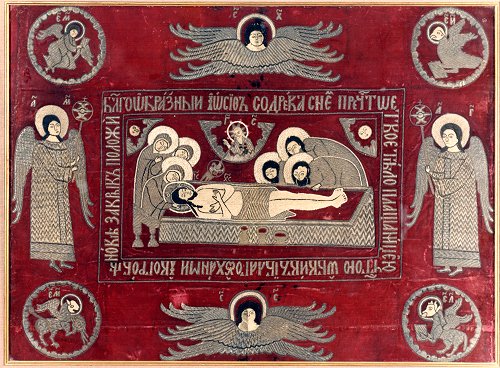
In the Western Rite on Maundy Thursday, the priest consecrates a second Host, to be consumed during the Presanctified Liturgy of Good Friday. He then processes with the presanctified Eucharist from the altar to a side chapel and "buries" It. Upon arriving at the altar, the priest and servers kneel in adoration (as did the people as It passed in procession). In the Byzantine Rite, on the Great Vespers service of Holy Friday ("Good Friday" in the West), the priest removes the icon of Christ affixed to the Crucifix and "buries" it. He and the clergy process around the church with the epitaphios (a cloth with the icon of Christ being prepared for burial), then places it and the Gospel (cross-side up) on a bier. The people often kneel as it passes. Then the clergy and people kneel and venerate the epitaphios and Gospel.

On Good Friday, in the Western Rite of the Orthodox Church, the people pray the Great Intercessions, so reminiscent of the Byzantine litanies. The priest then unveils the Cross, as the people kneel. As the Reproaches (Improperia) are sung, the clergy and people then prostrate and adore the Cross. In the Byzantine Rite, in Orthros of Holy Friday (anticipated on the evening of Holy/Maundy Thursday; this service is also known as the "12 Passion Gospels"), the priest processes with the Cross about the church, as the people kneel. The clergy then prostrate and adore the cross.

The Byzantine Prokeimenon (Tone 4) before the 7th Gospel, during this service celebrated on Maundy Thursday evening, is: "They parted my garments among them, and upon my vesture they cast lots." This is the same verse the priest chants in the Western Rite on Maundy Thursday before the stripping of the altar.

Moreover, the content of the Western Rite Reproaches (Improperia) are closely echoed by the words of the Byzantine services for the same liturgical day:

BYZANTINE RITEWESTERN RITE
Today the Jews nail on the Cross Him Who did cleave the sea with a rod, and made them to pass through the wilderness. Today they pierce with a spear the side of Him Who scourged Egypt with curses for their sake; and will give Him bitterness to drink who rained down manna for their nourishment.

(Sixth Antiphon, Orthros of Holy Friday - 12 Passion Gospels.)

Why doth the law-transgressing people of false worship meditate in falsehood? Why was he condemned to death Who is the life of all?
(Stichera Verse, Tone 2, Great Vespers of Holy Friday.)
O My people, what have I done to thee? Or wherein have I afflicted thee? Answer Me. Because I led thee out of the land of Egypt, thou hast prepared a Cross for thy Savior.

(Good Friday Reproaches)
Say ye, O transgressors of the law, what heard ye from our Saviour? Is it not that He appointed a law and the teachings of the Prophets? How then did ye think to deliver to Pilate the Word, God of God, and the Deliverer of our souls?

They who benefited always by Thy gifts, O Christ, were crying: Let Him be crucified. And the killers of the Righteous sought to free an evildoer in place of the Benefactor. But Thou wast silent, enduring their arrogance, wishing to suffer and to save us, since Thou art the Lover of mankind. (8th Antiphon, Orthros of Holy Friday.)

In place of the good things that Thou didst for the Hebrew people, O Christ, they condemned Thee to be crucified, giving Thee vinegar and gall to drink. (11th Antiphon, Orthros of Holy Friday.)

Thus saith the Lord to the Jews: My people, what have I done unto Thee, and wherewith have I harmed Thee? Thy blind have I lighted; thy lepers have I cleansed, and the man on his couch have I raised.

O My people, what have I done unto thee, and wherewith hast thou rewarded Me? Instead of manna, gall; and in place of water, vinegar; and instead of loving Me, thou didst nail Me to the Cross. (12th Antiphon, Orthros of Holy Friday.)

My firstborn, Israel, hath done double evil, having forsaken Me, the Fountain of the waters of life, and shaped himself a broken cistern, crucifying Me on a a Tree...thou O Israel did not refrain but delivered Me unto death. O Holy Father, forgive them, for they know not what they have done. (Praises, Tone 3, following 9th Gospel, Orthodos of Holy Friday.)

When Thou wast led to the Cross, O Lord, Thou didst say, "For what act do ye wish, O Jews, to crucify Me? Is it because I have strengthened your cripples? Is it because I raised your dead as from the sleep, healed the woman of her issue of blood, and showed mercy upon the Canaanitish woman? For what act, O ye Jews, desire ye my death?" But ye shall behold Him whom ye pierced, O law-transgressors, and know that He is Christ. (Idiomela Hymns, Tone 5, 3rd Hour of Holy Friday.)

Thus saith the Lord to the Jews: My people, what have I done unto thee; and wherewith have I harmed thee? Thy blind have I lighted; thy lepers have I cleansed, and the man on his couch have I raised. In my food they gave me gall, and in my thirst they gave me vinegar to drink. (Idiomela Hymns, Tone 8, 6th Hour of Holy Friday.)

When the lawless nailed Thee upon the Cross, O Lord of glory, Thou didst cry unto them, "Wherein have I caused you sorrow? Wherein have I angered you? And who before Me delivered you from sorrow? And now wherewith do ye reward Me? Instead of goodness, evil; for the pillar of fire, ye nailed Me on the Cross; for the clouds, ye dug Me a grave; instead of water, ye gave Me vinegar to drink. (Idiolmela Hymns, Tone 2, 9th Hour of Holy Friday)

Oh, how the assembly of the law-transgressors condemned to death the King of creation, not being ashamed nor abashed by His benevolences, of which He had assured them formerly, calling them to their remembrance, saying, "My people, what have I done to thee? Have I not showered Judaism with wonders? Have I not raised the dead by only a word? Have I not healed every sickness and every weakness? With what, then, hast thou rewarded Me? And why forgetest thou Me? For healing, thou hast inflicted wounds upon Me; and for raising the dead, thou dost cause Me, the Benevolent, to die suspended upon a Tree as an evil-doer; the Giver of the Law, as a law-transgressor; and the King of all as One Who is condemned." (Stichera Verse, Tone 6, Ibid.)
Because I led thee out through the desert forty years: and fed thee with manna, and brought thee into a land exceeding good, thou has prepared a Cross for thy Savior.

What more ought I to have done for thee, that I have not done? I planted thee, indeed, My most beautiful vineyard: and thou has become exceeding bitter to Me: for in My thirst thou gavest Me vinegar to drink; and with a lance thou hast pierced the side of thy Savior.


For thy sake I scourged Egypt with its firstborn: and thou didst deliver Me up to be scourged.

I led thee out of Egypt having drowned Pharaoh in the Red Sea: and thou to the chief priests didst deliver Me.

I opened the sea before thee: and thou with a spear didst open My side.

I went before thee in a pillar of cloud: and thou didst lead Me to the judgment hall of Pilate.

I fed thee with manna in the desert; and thou didst beat Me with blows and scourges.

I gave thee the water of salvation from the rock to drink: and thou didst give Me gall and vinegar.

For thy sake I struck the kings of the Canaanites: and thou didst strike My head with a reed.

I gave thee a royal scepter: and thou didst give My head a crown of thorns.

I exalted thee with great strength: and thou didst hang Me on the gibbet of the Cross.

(Good Friday Reproaches)

UPDATE: How could I forget: After Maundy Thursday, the Western Rite faithful keep vigil before the "tomb" containing the presanctified Eucharist (the "40 Hours Devotion"). On Good Friday, it is traditional for Byzantine Orthodox to keep vigil at the "tomb" of Christ. In both cases, it is to undo the disobedience of the sleep-ridden Apostles and arouse a sense of watchfulness over our souls.

Also, on Good Friday in the West, during the Presanctified Liturgy (the only one of the year in the WR), the people recite the Trisagion...in Greek, no less. -- BJ.

Again, at the risk of sounding like a broken record, "The Eastern and Western Rites are merely different ways of doing the same thing."(TM) Though a certain school of Orthodox obscurantism rejects us, let's all humble ourselves, prostrate before whatever our particular Orthodox rite proffers, and meditate upon the life-giving Death necessitated by our numberless sins and transgressions - the truth so clearly driven home by both rites. And then let us embrace one another as fellow inheritors of that grace-bestowing Life. If we are to, in the words of the Paschal stichera, "call brothers even those that hate us," certainly we should do so for Orthodox brethren worshiping according to approved Rites of our Holy Mother the Church. Especially when we are praying the same things to the same Lord in the same Church.

Labels: , ,

Sunday, December 07, 2008

Western Rite Slideshow

I've been saving these for...a very long time.

For those unable to attend a Western Rite Mass in a canonical Western Rite Orthodox Church but want to have some idea what it looks like, here is an uplifting sight: a slideshow of Fr. Edward Hughes celebrating the Liturgy of St. Gregory at St. George Antiochian Orthodox Church in Lawrence, Massachusetts.

Of course, this is no substitute for worshiping in a real Orthodox Church, whether Western or Eastern, but it's nice to see. Enjoy.

Labels: ,

Thursday, November 13, 2008

The Other Latin Mass

On the feast day of St. John Chrysostom, here's one for our Latin enthusiasts.

The complete text of the Divine Liturgy of St. John Chrysostom in Latin, as translated by Erasmus, from vol. 63 of Migne's Patrologia. You'll have to scroll down, as the text begins with a (much abbreviated) Kairon, followed by the vesting prayers and Proskomedia. Then the Divine Liturgy begins with the immortal invocation:

Benedictum regnum Patris et Filii et Spiritus sancti, nunc et semper, et in sæcula sæculorum. Amen.

Enjoy.

Labels:

Friday, October 17, 2008

From the Mailbag: Occidentalis Misleads About Dom James Deschene's Office

Q: On the Occidentalis Yahoo Group, the moderator wrote (on October 2, 2008) that Dom James Deschene uses the modern Benedictine office. He wrote that ROCOR approves the:
Tridentine mass. An edition of this service is used at Christminster (Christ the Saviour Monastery) in Hamilton, Ontario, and at the Western rite services done in Oklahoma City. I think the accompanying divine office is the modern Benedictine one, at least in the case of Christminster. (I'm not sure what form of WR divine office Fr. Anthony uses in conjunction with mass).
He contrasted this with "the pre-Reformation Benedictine Office." Does Christminster Monastery really use the modern, post-Novus Ordo Benedictine office?

A: Dom James M. Deschene, hieromonk, certainly does not use the "modern Benedictine" Office, as this individual falsely claims. The Order of St. Benedict in the Roman Catholic Church updated its Liturgy of the Hours following Vatican II and Novus Ordoized them. Neither Hieromonk James Deschene nor anyone else at Christminster Monastery, nor at its attached chapel, has anything whatsoever to do with the "modern Benedictine" office.

This is hardly unknown. I posted on this blog more than two years ago that "in addition to being the unbroken observance of the AWRV, Fr. James Deschene of Christminster Monastery in RI prays these hours." Nor has anyone associated with Christminster been other-than-forthcoming about this fact. Christminster's website notes, "the Hours of the Divine Office - the Work of God as St. Benedict calls it - are sung in chant according to the arrangement he himself set forth in his Holy Rule in the fifth century, and thus the monastic Office is one of the oldest forms of the Hours still in use."

The Breviarium Monasticum is the ancient form of the Benedictine Office, and its structure could be reconstructed by reading St. Benedict's Rule. Somehow, the moderator of the Occidentalis Yahoo Group transformed the most ancient office into "the modern" office and pinned it on Dom James. As noted, the same individual has fibbed on the same group that "Fr. James Deschene of the ROCOR in the U.S. inserts the Litany of Peace (from the Byzantine rite; "In peace let us pray to the Lord," etc.) straight into the middle of his Tridentine Liturgy." (This, too, has been pointed out as false, both here and several times on that group. If this has ever been specifcially retracted, please let me know.)

I also know Dom James does not like the label Tridentine for the simple reason that, for most people, it suggests a late usage, and that is not an accurate view, either of his use or of the Tridentine use. (He is, as usual, correct. See these two posts about attacks on the so-called "Tridentine" Mass's history and liturgics from the same source.) In fact, I know Dom James is a fine traditional Orthodox priest, who has served many long years in ROCOR, and he disdains any form of liturgical modernism or tinkering by self-appointed "scholars."

I am uncertain of the Hours Fr. Anthony Nelson of St. Benedict Orthodox Church (ROCOR) in Oklahoma City celebrates, but we wish him every success, and pray he too is not further maligned or misrepresented by members of this group. (One of its members has implied not so long ago that, due to his bi-ritual church's setup, his Eucharist was invalid and "would seem to make certain implications about the validity of Western Rite Masses in ROCOR." The moderator responded that he was "not so certain anything is implied by this placement of the altar," that Fr. Anthony thought his masses were valid, and this was an "analogue to this placement of the altar (i.e., 'altare' or holy table) in late mediaeval practice on the eve of the R/Deformation" that reflected "the context of the post-mediaeval Roman church.")

Thank you for bringing this misinformation to light. That individual's post displays either ignorance or malice toward canonical Western Rite Orthodox — in this case a long-serving hieromonk — which has long been a hallmark of many of that group's posters (except when it temporarily suits their purposes to tone things down or clam up for awhile). In general, that group is a terrific place to stay away from. As Dom James has written about these provocations, "God save us from 'liturgical wars'!"

This continued misinformation about ROCOR Western Rite monks shows, the "negative campaigning" against other Western Rite Orthodox continues. For shame.

Labels: , , , ,

Sunday, September 21, 2008

The Founding Hierarch of the OCA on the Western Rite

Abp. Platon (Rozhdestvensky), founding hierarch of the OCA.

As many of my readers know, earlier this month the Orthodox Chuch in America (OCA) announced the retirement of Met. HERMAN, with Abp. DMITRI of Dallas acting as locum tenens (assisted by Abp. SERAPHIM). On 9/11, they reported a new Metropolitan will be elected at the upcoming All-American Council in Pittsburgh this November.

As I noted in response to a question from a reader of this blog, the OCA presently has no Western Rite parishes. One knowledgeable source told me the OCA had given a definite (official or unofficial?) no to the idea quite a few years ago. At a minimum, there are some within the jurisdiction who oppose the idea. This is not only at odds with its history within Russian Orthodoxy, but (if true) it is at odds with its own history.

Archbishop Platon (Rozhdestvensky), the founding hierarch of the Metropolia (now the OCA), weighed in on the issue in a different way. Speaking to an Episcopalian audience, he told the group he longed to see a Western Orthodox Church in North America. Although his much later attempts to acquire ROCOR property via lawsuit (and other actions) made him an anti-hero, I present his words here for the benefit of those in the OCA who remain virulently opposed to the Western Rite — and those who would prefer the OCA have a Western Rite like that of the Antiochian Western Rite Vicariate. And this statement has significance for all North American Orthodox (see below). He spoke to the Church House in Philadelphia on February 27, 1911:
As long ago as 1904, the Committee of the Holy Synod for the furtherance of the question of Church Union published its Notes on the American Book of Common Prayer. These Notes may be taken as the Russian Orthodox view of your "wedding garment."

I do not know whether you are acquainted with these Notes. If so, you must certainly know how friendly and sincere is our feeling toward you; you must know what is our view of your "wedding garment," and how eagerly we wish they were not only like ours, but the same as ours; and yet that, at the same time, it should be becoming to your own Christian features.

How I wish that, at this moment, you not only understood me, but that your souls might be close to me. How I wish that we were sheep of the same Orthodox fold, and that it were impossible to apply to us the words oves non audiunt vocem alienorum.

My brethren in Christ, our life is moved by ideas, and not by exterior circumstances and interests, which also include both our national and our individual peculiarities. So our nearness will be realized only when our religious ideas are not only not alien, but are near and akin.

What is most important of all! Christ said: "If ye continue in my word...ye shall know the truth" (John viii, 31-32). In this rests the substance of our faith, and the substance of the question of the Union of the Churches. I find more religious significance in my Church, while you find more in yours. Why is this so? Because in my Church I want to pray, finding there alone the familiar conditions which best correspond to my mood of prayer. Why is this? For the reason that a Russian church is one thing, while an American church is another. You sit in your churches; we stand in ours. And in order to bring about union, it is not necessary to carry the pews from your Church to ours, forcing you to stand and us to sit. We shall not sit, and you, from lack of habit, could not remain standing through such long services as ours.

But Union does not demand this. Otherwise the pews might become the barrier over which the Orthodox could not step into your Church, or you into ours.

...It would be difficult to bring about a union which would enable you and ourselves to feel at home in each others' churches. It would be hard for you to transform yourselves into Russian Orthodox, and for the Orthodox to become Episcopalians.

But is this necessary? If until the eleventh century there existed an Orthodox Eastern Church and an Orthodox Western Church, why should this be impossible now, in our day?

Could we not think of the parallel existence of the two Churches, the Russian Orthodox and the Episcopal, if the former proclaims the latter its beloved sister, whose faith conforms to its own? This can take place, when your Church removes all the dogmatical differences separating it from the Orthodox Church, which has preserved pure, primitive Christianity. Until this happens, though I have friends among your Bishops whom I value highly and for whom I have a profound respect, as a faithful son of my Church, knowing its dogmas and devoted to its ritual with my whole soul, I cannot admit of any compromises which would entail the smallest and seemingly most insignificant belittling of our Orthodoxy. I am sure you yourselves could not wish this.

You will illumine your dogmatical digressions by the light of the science of history, and will see for yourselves what is to be done. When we agree concerning dogmas, there will be no need to speak of rites. They will not prevent us from being one in Christ and having the same belief in Christ. Only the more so, because both among you and among us there are many people who wish to do so.

...You already have an army ready and able to demolish the fortress of disagreement, the division which rends the seamless cloak of the Church of Christ. But this army still needs a fuller knowledge of the breadth and power of the Church of Christ in that epoch when it was not divided into factions. In my eyes, gentlemen, if you really possessed this knowledge, without any doubt you would have confessed in the face of all the world, with one mind and voice, that our Orthodox Eastern Church is the Church founded on earth by our Lord Jesus Christ "for us, men, and for our salvation." It is also beyond doubt that in that case you would have expressed the desire to be members of the Orthodox Western American Church.

May the Lord God grant to us the possibility to see the blessed day when we can give to you, Americans, the same name of Orthodox Christians. That would be a great mercy from God both for ourselves and for you. Let us believe that it will come, and let us pray that it may come soon. (Emphases added above.)

So, the founding hierarch of the OCA, Abp. Platon, prayed for the establishment of a Western Rite; he demanded only that the Episcopalians whom he addressed "remove all dogmatical differences separating it from the Orthodox Church" and modify their liturgy according to the Notes on the American Book of Common Prayer. (This has been accomplished in the Liturgy of St. Tikhon celebrated by some in the Antiochian Western Rite Vicariate.) In this, he is in line with St. Tikhon (Bellavin), St. Nicholas of Japan, St. Raphael of Brooklyn, and others. (Indeed, it appears St. Nicholas of Japan viewed the external rite of ordination as "valid" and merely opposed confused Anglican theology.) Note also Abp. Platon's allusion to the "parallel existence of two churches," meaning when these Western Christians accepted the full Orthodox faith and made necessary changes to their liturgical practice, they would retain their own Western Rite hierarchy.

To those outside the OCA, I note his words were spoken in 1911, during his first term in America, before the Bolshevik Revolution and 15 years before the split of the Metropolia and ROCOR. (In between, he had served as a member of the Holy Synod of Russia.) As such, his words were those of a bishop representing North American Orthodox regardless of later jurisdictional identity.

Now that the OCA is making other needed changes, it is time to follow the example of the 20th century saints listed above, as well as the founding hierarch of their own jurisdiction, and allow for a Western Rite like that already approved by her sister jurisdictions.

Labels: , , ,

Monday, September 08, 2008

St. Augustine on the Nativity of the Blessed Virgin Mary

Dearly beloved brethren, the day for which we have longed, the Feast-day of the Blessed and Worshipful and Alway-Virgin Mary, that day is come. Let our land laugh and sing with merriment, bathed in the glory of this great Virgin's rising. She is the flower of the fields on which the priceless lily of the valleys hath blossomed. This is she whose delivery changed the nature that we draw from our first parents, and cleansed away their offence. At her that dolorous sentence which was pronounced over Eve ended its course ; to her it was never said : In sorrow thou shalt bring forth children. She brought forth a Child, even the Lord, but she brought him forth, not in sorrow, but in joy.

Eve wept, but Mary laughed. Eve's womb was big with tears, but Mary's womb was big with gladness. Eve gave birth to a sinner, but Mary gave birth to the sinless One. The mother of our race brought punishment into the world, but the Mother of our Lord brought salvation into the world. Eve was the foundress of sin, but Mary was the foundress of righteousness. Eve welcomed death, but Mary helped in life. Eve smote, but Mary healed. For Eve's disobedience, Mary offered obedience ; and for Eve's unbelief, Mary offered faith.

Let Mary now make a loud noise upon the organ, and between its quick notes let the rattling of the Mother's timbrel be heard. Let the gladsome choirs sing with her, and their sweet hymns mingle with the changing musick. Hearken to what a song her timbrel will make accompaniment. She saith : My soul doth magnify the Lord, and my spirit hath rejoiced in God my Saviour. For he hath regarded the lowliness of his handmaiden, for, behold, from henceforth all generations shall call me blessed. For he that is Mighty hath magnified me. The new miracle of Mary's delivery hath effaced the curse of the frail backslider, and the singing of Mary hath silenced the wailing of Eve.
St. Augustine of Hippo, from the Second Nocturne of Matins.

Labels: , , ,

Saturday, August 23, 2008

A Question from Finland: "Mass" or "Liturgy"?

I was interested to get this e-mail from a writer in Finland:

Q
: Do the western rite orthodox use the term "mass" or "liturgy"?

It's quite sad that the western rite isn't in wider use. I'm considering joining in the Orthodox Church and I'm accustomed to western masses. I wish the Church of Finland would also have a western rite...

A: Thank you so much for your question! I will try my best to answer you, but let me begin with this: if a Western Rite is not available, please don't let that deter you from joining the Orthodox Church. We are Orthodox first and celebrants of a canonically approved expression of Orthodoxy second. The Orthodox Church is your heart's home; I hope you'll investigate it carefully, whether you have the ability to worship in the Western Rite or not. And you might always prays Western Rite prayers in your home; the Monastic Diurnal and Monastic Breviary Matins are available from this distributor, and you can download St. Tikhon Rite Matins and Vespers (with music) here.

The answer to your question is, yes: the Eucharistic service in the Western Rite is called both "Mass" and "Liturgy." True, the term "Mass" is more common in the Western Rite and "Divine Liturgy" more common for the Byzantine, but one may hear the Western Rite service called the Divine Liturgy — e.g., "The Liturgy of St. Gregory," "St. Tikhon's Liturgy." Technically, the Orthodox Missal is the approved text of the Antiochian Western Rite Vicariate, and it uses the term "The Mass according to the Rite of Saint (Gregory/Tikhon)." My own preference is to call the Western Eucharistic service Mass and the Byzantine Liturgy, but I'm ambivalent either way.

One sometimes finds both terms used for the Byzantine rite, as well. For instance, the Byzantine service book Divine Prayers and Services by Fr. Seraphim Nassar (sometimes lovingly called "the five-pounder") regularly uses the term "Mass" instead of "Liturgy." (It also refers to Lent as "Quadragesima"; confusing, since that term, and all "The Gesima Sundays," have another meaning in Western liturgics.) Yet this book is still used by the Antiochian Archdiocese of North America. Undoubtedly, some Carpatho-Russians, OCA members, and others continue to use the term "Mass" for the Divine Liturgy of St. John Chrysostom.

There should be little concern about which term we use: both are ancient. What no one should countenance is the common misconception that the term "Mass" is some kind of post-Schism Roman abuse that Orthodox Christians should never utter except when adjoined with the word "anathema!" The Catholic Encyclopedia gives some background on the term: "The word Mass (missa) first established itself as the general designation for the Eucharistic Sacrifice in the West after the time of Pope Gregory the Great (d. 604)." In fact, St. Ambrose of Milan used the Latin phrase in a letter to his sister, Marcellina (Letter XX).

I'll let Fr. Michael Keiser have the final word, through this quotation from his book, Offering the Lamb: Reflections on the Western Rite Mass in the Orthodox Church:
The two names that are most commonly used among Orthodox Western Rite to describe the Eucharistic gathering are the Mass and the Divine Liturgy. I do not think one is necessarily more appropriate than the other, but it is important to understand that the Mass is not a late Roman Catholic innovation, but an Orthodox designation that was used by Orthodox Christians for centuries prior to the schism between the East and the West...What a blessing it would be if we could rejoice in the richness and diversity of Holy Tradition, as expressed in the names we used for the holy and common action that forms the center of the Orthodox Christian life: the Mass, the Divine Liturgy, and all the other words and rites that remind us of the rich tapestry that is the experience of the universal and True Faith. (pp. 8-10, 10).
(P.S.: I'm truly sorry it took me so long to answer, and I'm sorry for posting your comment and your question here. Usually, I just post one or the other. I'm humbled that you asked for my poor response. Thank you for stopping by this blog; we hope you'll return regularly. And please keep us informed about the Church in Finland!)

Labels: , ,

Thursday, August 21, 2008

Thursday Within the Octave of Dormition/Assumption

O most prudent Virgin, whither goest thou, shining resplendent like the glowing dawn? Daughter of Sion, thou art all comely and beautiful, fair as the moon, clear as the sun.

Antiphon on the Magnificat from I Vespers of the Feast.


Labels: ,

Wednesday, August 20, 2008

So, Two Pictures Are Worth 2,000 Words....

I know the blog entry was some time ago, but I couldn't forget those pictures of St. Gregory the Great's parish being changed from this to this. The images showing Fr. Alford and his congregation laboring to construct a reverent WR Orthodox church out of a former Pentecostal meeting house got me thinking. You could see these two pictures as graphic representations of the transformation of so many former evangelicals from Protestants into Orthodox Christians. It reminds me of this cartoon, actually. (Or read the archives of this blog.) No one can say how many, but over the last several decades, thousands have become Orthodox, either Eastern or Western Rite. This number includes not a few charismatics, perhaps not unlike the group that formerly owned St. Gregory the Great's building.

One striking aspect of Orthodoxy, both Eastern and Western Rite, is the palpable sense of God's presence that our architecture, our sacred space, conveys. This is not always obvious in the architecture of our souls. Because of our sins, whether "cradle" or "convert," Eastern or Western, we desperately need to change from within. This is not merely rearranging the deck chairs (though some saints had a high level of sanctity from infancy); for most of us, it is a major refurbishing. At various stages in our renovation into the image of Christ, our souls may look like this and even this. Someone may look around at the refuse and think to himself, "Things were better before I started this undertaking; all I've done is destroy the condition of my soul. At least before, everything was in its place." Yet we know if the inner man is to become what our Lord wishes it to be, if we are to persist in following His commandments, more renovation must take place, messy and unfamiliar as things sometimes become.

This difficulty is compounded by the fact that, not only can this stage of growth be mistaken for destruction, but a period of destruction can also confused for this stage of growth. This is most true when one destroys his previous background's tradition and replaces it, not with the Lord's commandments, but with self-confidence and his own wisdom. "There is a way that seemeth right unto a man, but the end thereof are the ways of death." (Prov. 16:25). This person may seek to avoid the clear moral teachings of Orthodoxy, but constructing with a faulty moral blueprint, however well reasoned, will lead only to chaos, artifice, or disfigurement.

More often, he tries to remake the Church in his own image. Such a person knows the Church's teachings but finds he has a much better idea. He has culled ancient (and often long-dead) canons, divorced them from their context, and insisted "true" Orthodox follow them. Or he has strung together a series of liturgical texts that run in a cadence he rather likes and may (or may not) have come from pre-Schism times, and so insists the Church must bless and allow him to use it; after all, he is merely "returning" the Church to her foundations. They begin to ponder: "Perhaps the Church has not considered...Perhaps I was converted for the very purpose of helping the Church discover (or 'rediscover')...." He has been given immense wisdom and insight, engaged in "monumental undertakings," and his light was not made to be hid under a bushel. He cannot! He will not!

However, the Church has a way of shrugging off proud suggestions and self-congratulatory "scholarship" (and often such "scholars" have no scholarly credentials to begin with). Thus, the person becomes angry, frustrated, and his superior canonical or liturgical knowledge (conveniently) allows him to indulge his anger and hatred of the Church herself. He alone (or with a group outside the Church) has preserved the fulness of Church tradition, which the Church has rejected. If She has done this, she must be opposed to...the Church! How apostate, even Satanic, the Body of Christ becomes in their reasoning! Somehow, in making this case, these people cannot understand who might motivate them to attack the Body of Christ in such a way. If such people join a canonical Orthodox Church, they may no longer be members of their former denominations. They become "Orthodox" in name but rejected the Church's plan for constructing their lives. They destroyed their former background and built a self-directed shack in its place, them helpfully placed a plackard advertizing them as "Orthodox" in the front...the better to discredit the rest of us.

There is no place for self-guided morality or canons. And so it is with the Western Rite, as implemented by canonical Orthodoxy. In matters of liturgics, as in matters of our theosis, there is no room for Do-It-Yourself schemes. Following our own preferences will introduce chaos into what should be a well-ordered system. And as those who know construction will attest, problems with one part of a structure affect other parts of the edifice, as well. Soon, our moral, sacramental, and prayer lives are built on self rather than Christ. We turn our churches, and our souls, from this to this.

We have much work to do to turn our soul into an abode worthy of the Lord; or rather, none of us is ever worthy. God has given us the remaining time of our lives to bring these boards, bricks, and mortar into proper arrangement, and the Church has given us the blueprint of our soul's moral, ecclesiastical, and spiritual construction. Rather than debate and gainsay it, exalt our own "scholarship," let's merely, humbly, anonymously go about following it. Yes, we may at times be confused by new doctrines we have learned that contradict our previous affiliations, moral standards higher than our habitual practice, a prayer regimen arranged differently than those we celebrated. But if we persist, we clear away damaged or rotten boards, build an unshakable foundation, and rearrange parts of our building that the blueprint tells us are sound but out of place. In time, this building comes into order. On the way, we would do well to make ours the supplication of that ancient prayer from the Gelasian Sacramentary, which is included in the Orthodox Missal's "Prayers Before Mass":
Purify our consciences, we beseech Thee, O Lord, by Thy visitation: that our Lord Jesus Christ Thy Son, when He cometh, may find in us a mansion prepared for Himself, Who liveth and reigneth with Thee, in the unity of the Holy Ghost, ever one God, world without end. Amen.

Labels: ,

Saturday, August 09, 2008

Ancient Milanese Rite Revived in Milan

It appears the older form of the Ambrosian Mass will soon be celebrated in its former diocese. Although details were not yet fixed, the NLM reports the Roman Catholic hierarchy has granted permission for the older liturgy to be celebrated "at a place within the Archdiocese of Milan, but, as I infer, outside the See city, in addition to the Mass celebrated each Sunday at San Rocco al Gentilino." Tentatively, this will begin this October.

In the Middle Ages, a great proliferation of variants snuck into the celebration of the Mass; often the same nation would have many different forms of the Mass based on diocese. To diminish this chaos, the council of Trent in 1570 specifically authorized all liturgies at least 200 years old at that time to continue, while suppressing medieval innovations. (By the nineteenth century, though, more variant liturgies introduced themselves.) In the years since the 1970 New Order of the Mass, even these retained liturgies have been Novus Ordo-ized. This edict will allow an older tradition to revive. Already, the NLM blog reports, there are requests for a wider usage of the old Ambrosian Mass.

Labels: ,

Wednesday, July 16, 2008

Science Proves: Incense is Good for You

Fr. Barry Jeffries censes the people at a Hierarchical (Western Rite Orthodox, ROCOR) Liturgy in London, 2007.

No visitor to either Eastern nor Western Rite fails to notice the presence of incense in our services, frequently in profuse abundance. Scientists have now confirmed: incense is good for your emotional health. An otherwise sarcastic article on MSN Health entitled "Frankincense and Mirth" reports:

Scientific papers aren’t usually tagged with very exciting titles, but recently I came across a real barn burner: Incensole Acetate, an Incense Component, Elicits Psychoactivity by Activating TRPV3 Channels in the Brain.

Whoa.

Reading between the lines of lab-coat lingo, I realized the report was saying that frankincense—the incense traditionally burned in religious ceremonies—can act on the brain to lower anxiety and diminish depression.

As it turns out: "Researchers from Johns Hopkins University and Hebrew University administered incensole acetate, a component of frankincense, to lab mice and learned that it lit up areas of their little mouse brains that control emotion, including nerve circuits affecting anxiety and depression."

So, breathe deep, relax, and worship the Holy Trinity.

Again, the wisdom of our spiritual Fathers — Eastern, Western, or from the Old Testament Church — shines forth.

Labels: ,

Tuesday, April 15, 2008

From the Mailbag: A Western Rite Liturgical Calendar?

Q: Do you know where I can get a Western Rite liturgical calendar?

A: Yes. The annual Ordo of the Western Rite Vicariate is available for the year 2008. The cost is $12 per copy, and the Ordo can be ordered from:
St. Luke's Priory Press
1325 E. Queen Ave.
Spokane, WA 99207-3371
Materials can also be ordered by calling St. Nicholas Orthodox Church (AWRV) at 509-484-1604. All of us here are proud of Archipriest Bernard Kinnick's attention to the Priory Press.

Otherwise, one can also find a 2008 wall calendar from this website. It is $12.01 (that one cent makes a big difference!) or $8 to download.

I hope this is what you're looking for!

Labels: ,

Wednesday, April 09, 2008

Available Today: Monastic Breviary Matins

It's available today. Monastic Breviary Matins, once the rarest of treasures, is in print again. Lancelot Andrewes Press has made this invaluable volume available for $45, which includes shipping and handling. You can see the details here (PDF). You can order here, if you scroll down far enough.

It's worth noting, this is in no way a new translation or LAP's own compilation. This is the Divine Office according to the Breviarium Monasticum, the Divine Office according to the Rule of St. Benedict. Monastic Breviary Matins is the companion to the Monastic Diurnal and was originally published in 1961 by the Society of the Sacred Cross in Tymawr, Wales. It runs more than 1,200 pages.

While it has always been possible for those so interested to pray the full Divine Office in the ancient Benedictine tradition, these two volumes make the material far more accessible to English-speakers, laymen, and, may the Lord grant it, aspiring oblates and future vocations.

Our proverbial biretta is off to LAP for this.

Labels: , ,

Rare Sarum Missal for Display

A rare edition of the Sarum Missal will soon be on display in England. Here's the story from the London Telegraph:
The earliest-known printed book bearing the stamp of William Caxton, the father of British printing, has been saved for the nation by the National Trust at a cost of almost £500,000.

The book, dated 1487 and printed in Latin, is the only surviving example of the earliest edition of the Sarum Missal, the most commonly used rite for celebrating Mass in pre-Reformation Britain...

"This isn't just rare, it's unique," said Mark Purcell, the libraries curator of the National Trust...

It is a mystery how many copies were printed but the National Trust's volume, bought from the Legh family of Lyme Park, Cheshire - who have owned it since at least 1508 - still has 243 of the original 266 pages.Mr Purcell said: "What is remarkable is that it is the only one that has survived. It is hard to think of another book that has stayed in the same family for 500 years."
Check out the link for a picture of the missal.

Labels: , ,

Wednesday, February 27, 2008

William F. Buckley Jr. (RIP) on Contemporary Liturgical Language

Famed conservative intellectual, columnist, spokesman, and debater William F. Buckley Jr. passed away this morning at the age of 82. Best known for his incisive and erudite political commentary and his felicitous use of the English language, Mr. Buckley also penned an "autobiography of faith," Nearer My God, in which he noted his devotion to the Traditional Latin Mass and lamented the Second Vatican Council's "daffy innovations." In both his capacity as a faithful Christian and as a linguaphile, he had much to say during the heyday of liturgical renovation and relevance. Herewith is an excerpt from one of his commentaries on the compulsion to "improve" upon venerable English translations. All self-appointed liturgists and translators would do well to heed his commentary:

This morning, the Church of England has issued its re-wording of the Lord's Prayer. Now, the head of the Church of England, at least titularly, is the Queen of England. She continues to be addressed with all the euphuistic pomposity of Plantagenet prose, but now they are modernizing the form of address appropriate to God. One continues to refer to the Queen as Your Majesty, and as "Ma'am," but for God, "Thee" and "Thou" are—out. The Lord's head has been placed on the Jacobinical block. He is not quite yet addressed as Comrade, or even Big Brother: but He is definitely made to feel at home in the modern world.

It now goes not, "Our Father, Who art in Heaven, hallowed be Thy name"—but "Our Father in Heaven, hallowed be Your Name." Granted, they have left the capital letter in "Your," which must have been done after grave debate in the relevant councils. But clearly it was felt that "Thy" was simply—too much. Who does He think He is? The Queen of England?

It goes on, "Your will be done on earth as in Heaven." One wonders what has been gained by that formulation over the traditional formulation, which read, "Thy will be done on earth as it is in Heaven." There is transparent here something on the order of a Parkinsonian imperative: A venerable passage will be reworded by a rewording commission insofar as a commission to reword possesses the authority to do so.

...[S]ome would go so far as to say that it is most unlikely that [the Lord's will] is being done by the Royal Commission on the Vulgarization of the Book of Common Prayer when they take such a sentence as "Thy will be done on earth as it is in Heaven" back from the alchemists who worked for the Lord and for King James, and beat it into the leaden substitute which they have now promulgated.

One wishes that were all, but there is no sin of omission for which we might be grateful. "Lead us not into temptation, but deliver us from evil" has been changed to, "Do not bring us to the time of trial, but deliver us from evil." Why? For the sake of clarity? (That is the usual answer.) I know, because every sense in my body informs me, and every misinclination of my mind, what is temptation, from which we seek deliverance. But "the time of trial"? That sounds like the Supreme Court is in session...

Perhaps it was ordained that the Anglicans, like their brothers the Catholics, should suffer. It is a time for weeping, and a time for rage. Do not go gently into the night. Rage, rage against the dying of the light. That would be the advice of this outsider to my brothers in the Anglican Church. They must rage against those who bring upon Christianity not only indifference, but contempt.

(From "His New Prayer," originally published on November 17, 1977. Reproduced in William F. Buckley Jr. A Hymnal: The Controversial Arts. (New York: G.P. Putnam’s Sons, 1978), pp. 287-289.)

Update: This seems worthwhile, too:
Hail Mary, full of Grace, the Lord is with you...The Lord is with who! Thee to you, Buster, I found myself thinking during the retreat when I first learned that it is a part of the current edification to strip the Lord, His Mother, and the saints of the honorific with which the simple Quakers even now address their children and their servants.

...[T]he new liturgy is the triumph, yea the resurrection, of the Philistines.
(Quoted from "The End of the Latin Mass," originally published on November 10, 1967. Reproduced in William F. Buckley Jr. The Jeweler's Eye: A Book of Irresistible Political Reflections. (New York: G.P. Putnam’s Sons, 1968), p. 293.)

William F. Buckley Jr., Requiescat in Pace. You will be are missed.

Labels: ,

Thursday, February 21, 2008

The Confiteor and the Humility of the Publican

Mea culpa, mea culpa, mea maxima culpa....

Our brethren in the Byzantine Rite this past Sunday celebrated the Sunday of the Publican and the Pharisee. The Gospel is taken from St. Luke:
Two men went up into the temple to pray; the one a Pharisee, and the other a publican. The Pharisee stood and prayed thus with himself, God, I thank Thee, that I am not as other men are, extortioners, unjust, adulterers, or even as this publican. I fast twice in the week, I give tithes of all that I possess. And the publican, standing afar off, would not lift up so much as his eyes unto heaven, but smote upon his breast, saying, God be merciful to me a sinner. I tell you, this man went down to his house justified rather than the other: for every one that exalteth himself shall be abased; and he that humbleth himself shall be exalted.
In the Western Orthodox Mass every Sunday during the Prayers at the Foot of the Altar, the priest (and later the servers) inclines profoundly and prays:
I confess to God Almighty, to Blessed Mary Ever-Virgin, to blessed Michael the Archangel, to blessed John (the) Baptist, to the holy Apostles Peter and Paul, to all the Saints, and to thee, brethren, that I have sinned exceedingly, in thought, word, and deed: (He strikes his breast three times while saying:) by my fault, by my own fault, by my own most grievous fault. Wherefore I beg Blessed Mary Ever-Virgin, blessed Michael the Archangel, blessed John the Baptist, the holy Apostles Peter and Paul, all the Saints and thee, brethren, to pray for me to the Lord our God.
How fascinating that this week's Byzantine Gospel pericope is most poignantly, most literally expressed by this Western devotion.

P.S.: Yes, I got up awfully early...a sign of advancing age. :)

Labels: ,

Friday, February 08, 2008

What to Expect in (a Western Rite Orthodox) Church

Here is a nice overview for prospective, non-Orthodox visitors, from the website of St. Paul Antiochian Orthodox Church (Western Rite), Houston, Texas:

What to expect in Church

Orthodox Christians in the United States and Europe have the rare privilege to experience see a variety of Orthodox rites and customs, in both Eastern and Western Rite churches. Most customs are shared in some form by both East and West. All of us make the sign of the cross, light candles, use incense and have our own hymnody. As brothers and sisters in the faith we are united by one and the same faith which we express with customs that we share and with customs that are uniquely our own.

A Processional
In the Western Rite liturgy, the priest and acolytes start at the back of the church and process down the center aisle up to the altar. The acolyte, who carries the cross, is called the crucifer and leads this procession. Following the cross are the torch bearers, the thurifer (the acolyte with the thurible or incense), attending clergy, the celebrant, and the bishop (if present). In some parishes the choir also processes. There may also be a processional when the Gospel book is carried out to the congregation to be read.

Worshipping with our Body, Mind, and Soul
As in the Eastern Liturgies we who use the Western Liturgies worship the Lord with our entire being, both body and soul. The manual or outward physical acts we use express our inward and heartfelt faith. For example, it is customary to show veneration or respect to the cross by bowing slightly as it passes you by. Respect for the celebrant and clergy is shown the same way, by a modest bow when the clergy pass.

Another manual act is that of making the sign of the cross. This act reminds us of the Lord's death and His resurrection and is a custom which all Orthodox share, both East and West.

THE SIGN OF THE CROSS

The Orthodox Christian often inscribes the sign of the Cross on his body. This devotional act is as ancient as the Church and may be considered: a.) a confession of faith in the Holy Trinity; b.) a silent declaration of faith in Christ as the Savior and Redeemer of mankind; c.) as a prayer.

It is a confession of faith in the Holy Trinity because as we cross ourselves we say: "In the Name of the Father, and of the Son, and of the Holy Spirit."

It is a prayer, because by inscribing it on our bodies we bring to mind the fact of the Crucifixion of Christ from which springs up the power of our salvation.

The Orthodox Christian makes the sign of the Cross to begin and end his private devotions, when he enters the church, venerates the icons, the Holy Gospel, or the Holy Cross. He makes the sign of the Cross when the name of the Holy Trinity, the Mother of God, and Saints is pronounced during the Divine Liturgy or any Divine Service. Finally, he makes the sign of the Cross at prayers before and after meals, and at any appropriate times as an act of piety.

St. Kosmas Aitolos, concerning the sign of the Cross, writes the following: "Listen, my brethren, how the sign of the Cross is made and what is means. First, just as the Holy Trinity is glorified in heaven by the angels, so should you join your three fingers of your right hand. And being unable to ascend into heaven to worship, raise your hand to your head (because the head means heaven) and say 'Just as the angels glorify the Holy Trinity in heaven, so do I, as a servant glorify and worship the Holy Trinity. And as the fingers are three separate, and are together, so is the Holy Trinity three Persons but one God." Lowering your hand to your stomach, say: 'I worship You and adore You my Lord, because You condescended and took on Flesh in the womb of the Theotokos for my sins.' Place your hand on your right shoulder and say: 'I beg You, my God, to forgive me and to put me on Your right with the just.' Placing your hand again on your left should say: 'I beg You my Lord, do not put me on the left with the sinners.' This is what the Cross means."

How to Receive Communion
To receive the sacrament, all Orthodox must be properly prepared. However, the method of giving and receiving communion differs between East and West.

At Eastern Rite parishes, the priest stands with the chalice, and the people approach one by one. In Western Rite parishes, the people come to the Altar rail and kneel while the priest moves from person to person distributing communion.

The Host, which is made of leavened bread—baked into a thin round wafer—and has become the Body of Christ is given first, followed by the wine, which has become the Blood of Christ. To receive the Sacrament, you may open your mouth and the priest will place the consecrated wafer on your tongue. To receive the wine, lightly grasp the base of chalice as the priest holds the chalice in his hands and guide it to take a sip. You may notice that after each communicant the priest cleans the lip of the chalice with a white linen cloth.

How to Participate without Receiving Communion
Communion is regarded as the ultimate expression of unity between those who share the faith, discipline and order of the Orthodox Church. Accordingly, it is given only to Orthodox Christians. Other persons attending the service, such as inquirers, visitors, catechumens, or family members who are not Orthodox, may come forward at the time of communion to receive a blessing. Orthodox may also do this when, for whatever reason, they are not taking the sacrament.

To receive a blessing, come up to the altar at the proper time, along with everyone else. Fold your arms across the chest in X-fashion. In the Western tradition, this indicates that you are not receiving the sacrament. When the priest reaches you, he will give you a blessing, making the sign of the cross on your head. After receiving the blessing, you may return to your seat.

It goes without saying that one should pay absolutely no attention to who is receiving the sacrament and who is abstaining. Non-Orthodox may also receive the “Pain Benit.” This is bread which has been blessed, but not consecrated. Eastern Rite parishioners will recognize this as the Antidoron distributed at Byzantine services. Dating back at least to the 6th century, the custom of giving out blessed bread to non-communicants was prevalent in England, France and Germany. The English Sarum liturgy, an inspiration for the Orthodox liturgy of St. Tikhon, contains a specific prayer to bless the bread. Western rite parishes use this prayer today. It is a kind and helpful custom for today, since persons who do not share our understanding of communion might otherwise feel uncomfortable at not being able to receive the sacrament.

One final word about visiting a new parish. Please do not worry at first about whether you are to stand, kneel or cross yourself. We are here to help you learn this, and all of us have been in your situation. Don’t worry or be concerned with externals now; just join in the worship and all else will follow.


Labels: ,

Wednesday, December 12, 2007

Monastic Diurnal E-List Back Up

Benjamin Andersen has announced the Monastic Diurnal E-list, announcing how to use the Monastic Diurnal published by Lancelot Andrewes Press, is back up. The new home is:

groups.google.com/group/diurnal

Sign up and benefit from the wisdom on the list.

Labels: ,

Thursday, October 18, 2007

Feast of St. Luke the Evangelist, East and West

A blessed feast day of St. Luke the Apostle and Evangelist to all. What would Christianity be without his two treatises to the "most excellent Theophilus": his Gospel and the Acts of the Apostles? Without St. Luke's euangelion, we would never have known of:
  • The miraculous conception of St. John the Baptist
  • The Benedictus
  • The Magnificat
  • The Nunc Dimittus
  • The Annunciation
  • The Biblical portions of the "Hail Mary" (or its Byzantine equivalent, "Rejoice....")
  • St. Elisabeth, the mother of St. John the Baptist
  • The Righteous St. Simeon the God-Receiver
  • The Prophetess Anna
  • Finding Christ in the Temple
  • Zacchaeus
  • The Dishonest Steward
  • The Publican and the Pharisee
  • The Prodigal Son
  • The Good Samaritan
  • The Rich Man and Lazarus
  • The widow of Nain
  • The importunate widow
  • The importunate friend
  • Healing ten lepers (the one thankful leper)
  • The Rich Fool
  • The Good Thief
  • Bringing Christ before Herod
  • The Road to Emmaus
As you can see, this would have a major impact on the liturgical observances of both Byzantine and Western Rites. The Western Rite, in addition to some Gospels, would be deprived of two-three of the canticles recited in the Daily Hours, and the Byzantine liturgical calendar would be unrecognizable, especially in the pre-Lenten season (the earliest portions of The Lenten Triodion). And Christendom would be robbed of perhaps the two most tender portraits of God's paternal philanthropia: the Good Samaritan and the Prodigal Son. (The recent "14th Annual Ancient Christianity & African-American Conference" was organized around this theme.)

Of course, without the Acts of the Apostles, we would not have any apostolic history of the primitive Church.

The propers of today's feast, in both the East and the West, underline the importance of St. Luke, the physician who accompanied the Apostle Paul on some of his missionary journeys, having written a Gospel through which the engrafted Holy Spirit may heal our passionate souls.

Byzantine Troparion (Tone 5)
Orthodox Missal (St. Tikhon's Liturgy)
Let us praise with sacred songs the Holy Apostle Luke, the recorder of the Joyous Gospel of Christ, and the scribe of the Acts of the Apostles, for his writings are a testimony of the Church of Christ: He is the Physician of human weaknesses and infirmities. He heals the wounds of our souls, and constantly intercedes for our salvation.Almighty God, Who calledst Luke the Physician, whose praise is in the Gospel, to be an Evangelist and Physician of the soul: may it please Thee that, by the wholesome medicines of the doctrine delivered by him, all the diseases of our souls may be healed. Through the merits of Thy Son Jesus Christ our Lord. Amen.

Holy Apostle and Evangelist St. Luke, the Physician of our souls, pray for us!

Labels: ,

Friday, August 10, 2007

Wisdom from a Failed Liturgical Experiment

Someone had asked my view of the use of "liturgical English," particularly the use of "Thee" and "Thou" vs. "You." For the Western Rite, this is simply not an issue: we use liturgical English (and this is true in both Antioch and ROCOR). I have no trouble with those jurisdictions who have used the pronoun "You" for God; I don't endorse Rev. Peter's Toon's "You-God" theory. For those with a large percentage of people who don't speak English, this also has a pastoral dimension. True, certain modernizations -- especially of the Lord's Prayer -- fall on one's ears like a ton of bricks, were often enacted out of modernist zeitgeist, and I have my strong preferences for tradition. But I don't have much wisdom to impart -- on anything -- and it's not my place to tell jurisdictions how to translate their language.

However, it's prudent to learn from experience, ideally sidestepping the mistakes of others. Therefore, it's worth exploring the experiences of those who have "updated" their liturgical language, and the results they reported. One such case is that of the Melkite Catholics. Abp. Joseph Raya, who translated the mammoth Byzantine Daily Prayer into English, recounts:
In Byzantine Daily Worship I was enticed to use the second person plural form in addressing our God for the fallacious reason that people would be better served. The pretext was “Everybody does it.” Everybody says “You” so I abandoned the formal “Thee” and “Thou” and replaced them by “You”...

This substitution proved to be a step in the wrong direction, a spiritual disaster that added fuel in the laicization of our religion. It re-enforced our carelessness and unconcern before the awesomeness of our God. We already were engulfed in confusion before the sacred and holy. We came to treat God as a next door neighbor. “Hey, you do this…You do that…” The “you” is too casual, too simple and easy. The use of the “Thee” and the “Thou” is more difficult. It requires attention and care and the form of verbs requires, sometimes, a challenge for a tongue twister. But the elegance of it all and the respectability are worth every effort in using them properly. They might open a path for the recovery of sacredness in our relationship with God. We are now so “laicized” that Christ, our Lord and God, became some kind of pragmatic prophet. He became simply “Jesus.” So now we have Buddha, Aristotle, Mohammed, Jesus, Martin Luther King, or any other benefactor of humanity. If the world does not know that “That Jesus” is our Lord and God where would they go to find out if they do not hear it from us? Besides, the “Thee” and the “Thou” have an elegance worth the effort they demand.
Again, I have no trouble with jurisdictions who translate as they feel appropriate. But it's worth hearing the lessons learned from others who have been down the same path to avoid those pitfalls.

Labels: