Sunday, June 21, 2009

The 140th Anniversary of Dr. J.J. Overbeck's Conversion Remembered

According to the Dean of the ROCOR Cathedral in Chiswick, London, today is the 140th anniversary of the conversion of Dr. J.J. (Julian Joseph) Overbeck, the instigator of the modern Western Rite Orthodox movement. Today, his home church is remembering his historical contributions. Fr. Nicholas Savchenko wrote:
Next Sunday there will be a 140th anniversary of doctor Overback [sic.] conversion to Orthodoxy as it is said in our parish registration book (21 June 1869). I'll be making a speach after Liturgy about him. His book was translated to Russian and Holy Synod and Pobedonostsev supported him. He was a member of our parish untill 1905 when he died and his wife and children were members too.

fr. Nikolay
Incidentally, Pobedonostsev was no small supporter and "had connections," as they say. Overbeck pressed for a Western liturgy that resembled that of the Roman Catholic (and, more to the point, Old Catholic) churches of his day, with only the modifications he deemed necessary to bring that living tradition into line with Orthodox theology and practice -- and his plan received widespread support, including that of multiple patriarchates including (temporarily) the Ecumenical Patriarch of Constantinople. Although his attempts to woo the Union of Utrecht failed, the Orthodox Church accepted the concept of a revived Western Rite, specifically one that began by taking the Roman Mass as its starting point.

The idea of Western Orthodoxy did not come to fruition in his lifetime, but it is unlikely it would have come about at all without his actions, all of which began with his conversion to the Orthodox Church 140 years ago today. Our most profound thanks to Fr. Nikolay and the rest for the remembrance. (Hat tip: Hieromonk Michael, for forwarding it.)

Below are links for further reading about Dr. Overbeck:

Dr. J.J. Overbeck and His Scheme for the Reestablishment of the Orthodox Church in the West
by David F. Ambramtsov.

Catholic Orthodoxy and Anglo-Catholicism, by J.J. Overbeck (1866)

A Plain View of the Claims of the Orthodox Church as Opposed to All Other Christian Denominations by J.J. Overbeck, D.D. (1881)

Labels: ,

Thursday, January 01, 2009

Practical Tips for a Move to Western Orthodoxy

From WesternOrthodoxy.com. I have updated some of the information from this original post, written on that website and not by me, to reflect our new Western Rite Vicar General, the Very Rev. Fr. Edward Hughes. This is a helpful, practical guide for those who are looking for a new church home in the new year.
Practical Tips for a Move to Western Orthodoxy

This article is a collection of points to think about for those considering a group move to Orthodoxy. Some are practical - how to make a great altar for a temporary space. Others are legal issues to explore with counsel. Not every point applies to every situation. These thoughts are offered by those who have been through this process, survived and thrived.

Phase 1:
Exploring Your Options

A great move. Here is what one layman, whose father had been an Episcopal priest, wrote after he and his parish completed a move to Orthodoxy:

My wife and I talked, we prayed, we thought about it. 73 years of Episcopal Church worship were ‘on the line.’ To leave was almost inevitable, but filled with fear and trepidation. We went to our first Western Rite Orthodox communion still unsure. Lo and behold we found ourselves at home, and what a homecoming! The liturgy, the prayers, the celebration of the Mass without the contamination of inclusive language, without the intrusion of contemporary political liberalism. We were Home! Surely God was leading us, loving us and guiding us! Home! How else can you say it? Home with Jesus Christ! Free at last to worship as our fathers and their fathers before them. Thanks be to God.
Like any important move - such as to your dream home or a great new job -- a move to Western Orthodoxy takes consideration, planning, and effort. This article makes it easier to think through and complete that process. And here’s the best news: Coming home to Orthodoxy is the last move you’ll ever have to make.

Call with questions! The Archbishop has appointed a Vicar General as the person directly under him to deal with Western Rite issues, inquirers, liturgics, etc. Grab the telephone and call the Vicar General about any issues, concerns, problems, or just to talk about Western Orthodoxy. He can help personally or refer you to someone in the Vicariate. The Vicariate can also arrange speakers -- for example, other priests or lay people who have gone through this and can speak to your people. Here are the address and telephone numbers:

The V. Rev. Edward Hughes
103 Pleasant St
Methuen, MA 01844
(978) 685-4052 or (978) 686-3274
Bricks and Mortar. Most new churches start fresh in a new space. If you are thinking of trying to keep the old church building, get excellent legal counsel far in advance of any move. In the Episcopal church, this has been made very difficult by changes to canon law designed to thwart people changing affiliations. Get solid, independent legal advice. Whatever the advice, think hard before devoting your early years and resources to a custody battle for the building. You may decide, in the words of one parish, to say “You keep the building, and we’ll keep the Church.”

Testing the Waters. Normally, the movement to Orthodoxy begins with a few people. It is of course desirable - both for spiritual and pragmatic reasons -- to bring with you as many people as possible. However, you must be discerning and realistic. You know your parish. Establish your core group before you make any announcement. This is particularly true if it appears that only a portion of the parish will be likely to make the move. Begin cautiously, approaching only those persons you are confident would be interested. After you make your announcement, you may be amazed at the number of people who join you. You may also be surprised by some persons who do not, and who may even become hostile.

Loose Lips. As you explore the possibility of forming a group to join Orthodoxy, be circumspect. This is especially true if a priest or deacon is considering whether he is called to go with you. If the hierarchy of your current denomination discovers your discussions or search before you have finalized your plans and announced your departure, it could make a “pre-emptive strike” against you. Excommunications or suspension of clergy can present difficulties if done before you are ready to move. Such actions can injure the financial position of clergy and their families by creating gaps in retirement packages, group health insurance, etc. While new arrangements will eventually be made, you want such matters to be negotiated and transferred, rather than starting anew or after a lapse in coverage.

Address People’s Concerns. Once you are discussing the possible move, take time to solicit and address any concerns parishioners have about the idea. People may have erroneous ideas, such as that Orthodox services require 3 hours of standing, or aren’t in English. Show people the Western Rite service, so they can be comfortable with it. If people are concerned about joining a church they may perceive to be “ethnic”, address that head on, including by explaining that something like half the members and clergy of the Archdiocese are converts, and that Western Orthodox folks in particular are almost all converts. Offer to put people in touch with similar lay people from other parishes who made the change.

More Orthodoxy Online. Investigate the additional resources and information available on other Western Orthodox websites. Check out our Links page.

Phase 2:
Physical & Legal Preparations for the Move

Once you decide to move, you have two main needs: (1) To gather the vestments, books and other hardware necessary for proper worship, and (2) To establish the legal framework for your new parish. These activities should go on concurrently.

  • Holy Hardware
You will want to make the first liturgy in the new space look and feel like as much like a “real” church as possible. Plan ahead for vestments, acolyte cassocks and surplices, altar items, etc. At the same time, don’t obsess if you don’t instantly own everything you had at the old church.

A Little Leaven. Orthodox communion bread is leavened. For leavened priest’s wafers and people’s hosts, call (931) 836-8089.

Service Books. Order service books in advance. Write to the Vicariate about Western Rite materials available from the Vicariate or the Archdiocese. Depending on how “Novus Ordo” your parish was forced to go, you may no longer have 1940 Hymnals or a proper Anglican altar Missal or the English Gradual. Here are ideas on where to get those:

What’s in the Attic? If the old church has copies of the 1928 Book of Common Prayer or 1940 Hymnals or English Gradual books stored somewhere and never used, consider negotiating to take them with you. (This would be done after your announcement is made.) The BCPs do contain material not used by Western Orthodox, but are handy because they contain the proper version of the psalter. (See also Daily Office, below.)

Bookstores. Second-hand book shops often have inexpensive copies of the 1940 Hymnal and 1928 BCPs. Ask everyone in the parish, especially those practiced at ferreting things out in bookstores, to look for them. Have a book marking party to make the small linguistic changes necessary to reflect Orthodoxy’s rejection of the filioque. Delete the words “and the Son” from the Creed’s “who proceedeth from the Father and the Son . . .”. Occasionally a hymn has an embedded reference to the filioque. These are also easily fixed. For example, Hymn 199’s last line refers to the Holy Ghost as “who from Both with Both is One/” Change this to “who with Both is ever One.”

Auctions. Try searching for vestments, candlesticks, altar linens, and other tangible items online. At any given time there’s an amazing amount of religious hardware on offer through Ebay, for example. If you don’t find what you need immediately, you can register a personal shopper request for it. That means Ebay will email you whenever a new item comes up that matches your request. Yahoo’s auction service has a similar feature. Consult someone in your group who’s an experienced online auction shopper. And be sure to ask any questions before you bid for something. Also check out traditional auction houses in your area. If possible, make arrangements to be alerted when church-related goods come up for bidding.

Coordinate Donations. Set up a Donations or Arts Committee. People may be in a fever to donate things. Unless judgment and oversight are exercised, you can end up with a bunch of stuff that doesn’t match, some of which is undesirable, and all of which must be used to avoid giving offense. Draw up a prioritized list of what the church needs. This might include references to the Wippell’s catalog (preferable to the Almy, which is more Novus Ordo) and prices. Circulate it, or use it tactfully as a reference when people express interest in giving something. Wippell’s USA contact information is:

1 Mill Street
P.O. Box 468
Branchville, NJ 07826
tel. (973) 948-2134.
I’ve Got a Little List. Appoint one of your number to keep a detailed list of all gifts made, especially physical items. Describe the gift with specificity (e.g., Silver plated monstrance with Limoges image of the Blessed Virgin Mary). For major items like a processional cross, set of vestments, etc. consider taking a photograph. For each gift, list the donor(s)’ names, addresses, the date the gift was received, and whether it is in memoriam. If the gift is a memorial, list the name of the person in whose memory the gift is given, and that person’s relationship to the donor. Include the value of each non-cash gift, and any supporting documentation the donor may have. This list is a permanent record for your mission and the parish it will become. The record helps people to establish the charitable exemption for any gifts, and can also help establish an insurance claim in the event of a loss in future years. (Store one copy of the list away from the church for this purpose.)

Let Us Build an Altar. A practical altar is easily built with two tall sawhorses and a large, solid, heavy board. When covered with a Jacobean frontal the altar looks great. See our instructions for making and vesting an altar.

Laudian Frontals. The beauty of the traditional Laudian frontal is also very practical for those in temporary worship spaces. Essentially, you sew a large rectangle large enough to throw over the altar and flow out regally all around. You can round off the corners, or leave them square and simply turn them under at the altar. This frontal not only makes for a beautiful altar, it also saves all of the material so that it can be re-used later when you have a permanent space of your own. If you can find locally or afford to order from Wippell’s a good all-seasons tapestry suitable for formal liturgical use, you can start with a single frontal to use year-round. Since good tapestry is costly, it’s usually less expensive to buy solid color fabric in the various liturgical colors and make a different frontal for each season. Look for a fabric that drapes nicely and has a bit of heft to it. Upholstery grade material works well. See our instructions for making and vesting an altar.

The Propers. If your choir director is unfamiliar with how to chant the propers in the English Gradual, or if you need the books, call the Vicariate - there are people who can help.

Pew missals. A people’s Western Orthodox Missal is available from the Archdiocese. Updates/revisions to it are available from the Vicariate. Also available is a red paperback edition of the liturgy. This is an inexpensive choice for those just starting out.

Thurible and Incense. Incense is required at Mass in the Orthodox church. You can get a thurible and incense from Wippell-Mowbray. (See "Coordinate Donations," above, for contact information.) Plain frankincense is available at some health food/natural food stores and some Greek Orthodox sources. (Note: The thuribles used in the Eastern Rite are not appropriate for WR use because they have bells on them.)

  • Stablish The Thing: Legal and Organizational Preparations
Mission Control. As soon as your group is reasonably defined, and you are sure you are going to make the move, contact the Western Rite Vicariate, so that your status as a Mission of the Orthodox Church can be established as soon as possible. This is very important - it provides you with a place to be, an anchor, so that you are not just a group of people with no association or defined purpose. It also can allow you to accept tax exempt gifts and pledges, using the charitable and/or religious tax exemption of the Vicariate or a local Orthodox church which may be designated to help you.

Do You Exist? Consider forming the legal structure of the new church in advance. Start the process for incorporation, or whatever the appropriate formalities are in your state. The Antiochian Archdiocesan sample articles of incorporation will help you get started. Supplement them with federally-required provisions and requirements specific to your state.

Getting Your Own Tax Exemption. Talk with your counsel about securing a tax exemption under Internal Revenue Code, Section 501(c)(3), as well as a similar exemption from the state in which you are organized and operate your new parish. This is valuable, since it exempts the church from income tax as well as from most or all state taxes. It also means gifts may be deducted by the donor.

Keeping Your Tax Exempt Status. Once your parish obtains a tax exemption, you must keep it. One of the Internal Revenue Service tests is the “organizational and operational test”. A church must demonstrate that it is organized and will be operated exclusively for religious purposes. Statements to this effect should go in both the bylaws and in the Articles of Incorporation, where the corporate purpose is given. The IRS also requires that religious organizations refrain from lobbying or political campaigning. Church bylaws and articles of incorporation must also provide that church assets are irrevocably dedicated for religious purposes, and that if the church ever dissolves its assets will be distributed to another tax-exempt religious organization. (See the Antiochian Archdiocesan sample articles of incorporation.) You should consult with your local counsel about these provisions, as well as how your organization can meet these tests to obtain and maintain tax exempt status.

Insurance. Get your new insurance up and running before your first service. Include these coverages among those you consider: Property insurance, to protect against loss to buildings and things belonging to the church (vestments, supplies, books, furniture, etc.); Liability insurance, to protect the church from any third party claims (such as if a visitor slips and falls at your service). Liability insurance may include coverage for Directors and Officers (your clergy and vestry members) and for clergy malpractice. Pick an insurance expert knowledgeable about the needs of churches and non-profits, and ask for a church combination package. This can offer all needed coverage at a substantial discount over the cost of buying each policy separately.

Accounting. The account books of the mission must be established right away to keep track of monetary donations, gifts and pledges, and to assure that the federal Internal Revenue Code and the tax laws of your state are complied with. Get the accountant in place even before you make the break -- it’s essential that proper books and records be established at the very beginning.

Health Coverage. Write to the Archdiocese to arrange clergy health coverage through the Archdiocesan plan. Shop around also. Depending on local circumstances, you may be able to secure a better deal on the open market.

Decency and Good Order. Make sure everything is in apple-pie order at the old church before you announce your plans and certainly before you actually go. This means physical space, church property, accounts, etc. Take photographs of the exited space and bring them with you. Do this even if there is no sign of trouble - if you never need them, fine. However, claims of damage or tampering may be asserted after you’re gone and not in a position to rebut them without photos. Immediately after the move, consider going over the property with the Bishop or other person in authority, as one would with a landlord on exiting an apartment.

Mine and Thine. If you are bringing anything with you that somebody could argue belongs to the old church, be open about it. Document why you believe it need not remain behind. Invite the old church to let you know if it disagrees.

Put it in Writing. Document everything. This need not be done in a stilted, legalistic manner. Use a friendly letter instead. The point is to have something in writing, both to smoke out any misunderstandings so they can be resolved promptly, and to have a record of what went on. The address box of the letter should include the recipient’s title, e.g. Senior Warden. Here’s an example of a legally effective confirming letter, which has a non-threatening, friendly tone. If you secure a deal to buy unused books, you could write:

Dear Walter,

Thanks so much for agreeing to sell the old BCPs and 1940 hymnals to our new mission at 50 cents a copy. We counted 150 total, so here’s our check for $75 - if you came up with a different number just let me know. I’ll have somebody pick them up after the Thursday liturgy next week.

Thanks again, ____.


Or, to document that certain objects formerly used and stored at the old church are going to the new, you could write:

Dear Elizabeth,

As I mentioned to you at coffee hour last week, the folks leaving to start the new Orthodox mission are bringing with us the silver tray used for the entrance votive candles and the set of Oxblood vestments for Passiontide. As you know, the tray was on loan from Mrs. Waters, who is joining the new mission. The vestments were given to Fr. Glaston personally and thus are going with him.

If you have any questions, just give me a ring.


You get the idea.

Proof of Delivery. Send any written items in a way that gives proof of delivery, such as Federal Express or certified mail, return receipt requested. If for some reason you decide that it will be too offensive or “in your face” to send an item in such a way, consider having an independent person - like a neighbor or friend not affiliated with the church - review the letter, seal it and hand deliver it. That way, there’s a relatively neutral person to confirm delivery. On the file copy of the same item, have the person make a note of when and how it was delivered. For example “Handed personally to secretary outside Fr. Smith’s office, Wednesday March 10th at noon.” Or, “Went to the church Friday June 3rd at 4:30 p.m., nobody there, put the letter through the mail slot.”

Media Coverage. If the press gets involved in your change, seek out parishioners or others experienced in handling the media -- this is a great opportunity to get your message across. Consider sending press releases to the Religious Editor or other suitable media sources. Be sure to send your draft press release to the Vicar General before it goes out. This helps ensure a consistent message and enables you to build on what others have done in the past. Comments to the media should be upbeat. Give your reasons for the change, stressing the positives of Orthodoxy, not the negatives of your old denomination.

Phase 3:
Up and Running

Welcome to Orthodoxy. Consider asking for “Welcome” letters from the Vicar General, your local W.R. dean, and any other Orthodox clergy who may have been involved in your transition. It is very cheering to have these read aloud at the first service. It underscores that the people aren’t just leaving something, they are joining something. Also, reading letters from the duly constituted authorities underscores that you are not vagantes.

Be It Ever So Humble. Once you have established your mission, you must have a place to hold your services, vestry meetings, etc. This place need not be grand, nor what you ultimately want your church building to be. However, it is extremely desirable that it be a place that is exclusively yours, 24 hours a day, 7 days a week. If it is all yours, almost anything will do for a beginning. You may hear arguments that you cannot afford any such place, and that homes should be used, or that a place should be rented just for Sunday mornings. Occasionally this must be so. However, you should look at the budget very carefully and sacrifice other things to get a place of your own. This will enhance your sense of mission and may also help you grow. It’s hard to get new folks into a private home, or to explain to inquirers that Mass is here, Matins there, and Evensong someplace else. Also - it’s a lot of work traipsing altar frontals, missals, thurible, etc. from place to place. Much better to have your own, blessed site where all can remain up from week to week.

Begin As You Mean to Go On. People are generally most receptive to change right at the time of the switch. If things like the propers, incense, formal liturgical language, veiling during Lent, etc. were forced to lapse in the old church, restore them right away, the first day. Toss the cassock-albs or other Novus Ordo vestments and start with the right stuff on day one. That way, these features are understood as givens, non-negotiable from the start. If you start without such things, it may be difficult to add them later.

Bless Thine Heritage. As you settle in, remember two key rules: No Novus Ordo, No Byzantinism. Look at old prayers you’ve collected; if they’re Novus Ordo, retranslate them back to traditional, liturgical English, or get the original version from an older source. Have the choir director take the same care with anthems. Well-meaning Eastern Orthodox may suggest you adopt customs or rituals followed in the Eastern Rite. Sometimes in the zeal of joining a new group, people may want to do that. This is forbidden; See the Ordo. The Eastern and Western Rites - including non-liturgical customs - are not hybridized. Each is preserved separately in its glory and fullness. Indeed, one of our new blessings is that when away from home we can attend Eastern Rite liturgies as full participants, just as our Eastern Rite brethren do when they visit a Western Rite parish.

Blessed Bread. Western Orthodoxy has restored the ancient Western custom of offering the eulogiae or pain benit - bread which is blessed, but not consecrated. At least as early as the 6th century, the custom of giving out blessed bread to non-communicants was prevalent in England, France and Germany. The Sarum liturgy, an inspiration for the Orthodox liturgy of St. Tikhon, has a specific prayer to bless the eulogiae, which is approved for Western Orthodox today: “Bless, O Lord, this creature of bread, as thou didst bless the five loaves in the wilderness, that all who partake thereof, may receive health both of body and soul. In the name + of the Father, and + of the Son, and of the Holy + Ghost. Amen.” Giving blessed bread to all is a kind and helpful custom for today, since persons who do not share the Orthodox understanding of communion might otherwise feel uncomfortable at not being able to receive. It is also a good example of the joy --and paradox-- of becoming Orthodox - that in the “Eastern” Orthodox church, we can be more free than before to fully pursue and enjoy all that is good in our Western Christian heritage.

The Daily Office. If people have gotten out of the habit of saying daily Matins and Evensong, teach on this. Get a sufficient number of Ordos, from:

ORDO
St. Luke's Priory Press (website under construction)
1325 E. Queen Ave.
Spokane, WA 99207
Also available is The English Office. Look at used bookstores for a single volume combining the King James bible (the authorized English language bible for our Archdiocese) and the 1928 BCP. This is very useful for saying the office.

King James Version. If necessary, alert lay readers for matins and evensong to practice the lesson from the KJV, and have a KJV bible at the church for readers to use. You may need to remind people to use the old form of introducing and readings: E.g., “Here beginneth the ___ verse of the __ chapter of the Epistle of James.” “Here endeth the [first or second] lesson.”

Confession. In addition to the General Confession at each liturgy and in the daily office, The Orthodox Church stresses sacramental confession to a priest. If this has not been customary or well-understood in your prior affiliation, consider teaching on this.

Bequests to the Church. After the switch, people whose wills contain bequests to the old church or affiliated organizations may wish to change their wills to leave the bequests to the new church instead. An announcement can be made in the bulletin reminding people of this issue.

Emergency notification cards. As at a school or office, it’s a good idea to have emergency notification cards. These tell the parish leaders who to call if a member is ill, has an accident, etc. If you had them at the old church, consider photocopying those of parishioners who are founding the new church. (Get their permission first, in writing.) Or, create/copy a form, and have them filled out at the first meeting or service of the new church. Some people may have included the church or priest as an emergency contact on a wallet card or at work. If the telephone number of the clergy or the church office has changed, consider reminding people to update such designations.

Funeral directions. Consider having parishioners fill out a card indicating their wishes (hymns, burial site, etc.) in this regard. The Orthodox church disfavors cremation. Relatives, however, may prefer it because it is perceived as cheaper. Having written confirmation of parishioners’ wishes can avoid unseemly disputes down the road, perhaps with relatives who are a different religion or unchurched. Your local funeral director is a good resource for whatever forms work in your state.

Resignations. Consider whether members wish to or need to resign from church-related boards or organizations affiliated with the old entity. For example, if you are the old parish’s representative to the ECW, you need to resign from that. Do this in writing and retain copies. It’s thoughtful to copy the old church on the letter, so that they know you’ve taken care of this. Depending on terms between those leaving and those staying, consider asking who your replacement will be and including that in your letter.

The Acolyte Corps. In Orthodoxy, only men and boys serve as acolytes. If your old church allowed female acolytes, you need to prepare them to understand and accept this change. Consider recruiting the former female acolytes to a new job in the new church - running the book table; coordinating the outreach program; managing the schedule of who sets up each week for liturgy, etc.

The Altar Guild. In the Western Tradition, it has long been a special ministry of church women to care for the vestments, altar linens and vessels, to help set up the altar, and to arrange and place the altar flowers. This is one of many instances where the Western Orthodox tradition is different from the Byzantine practice (only men deal with the altar). If you already have an altar guild, it can transition seamlessly into Western Orthodoxy. If your past affiliation doesn’t have this feature, talk to other Western Rite priests and altar guild directresses about how to get it going. One practical set-up point is new to Orthodoxy: The Metropolitan Archbishop gives a silk square to each new parish at the time of its reception into Orthodoxy. This item, called the Antimens, goes on the altar every liturgy, under the Fair Linen.

Mail Forwarding. At the post office, fill out mail forwarding cards for the priest, vestry members and other individuals who may receive mail at the old church by name. Ditto for the rectory. If something is sent to you which should go back to the old church, forward it promptly with a nice note. (Keep a file copy of your note and a photocopy of the outside of the item forwarded.)

Set an Example. Act at all times in a courteous and businesslike fashion. In addition to being the right thing to do, it can help move to your parish people who are sitting on the fence. If the people who stay behind are acting angry, vindictive, and paranoid, and the people who moved to Orthodoxy are being friendly, open, and courteous, think about what kind of message that sends.

Memorial Gifts. Parishioners occasionally find it a wrench to leave behind gifts given in memory of their beloved dead. Consider negotiating to buy these for the new church, so that they may follow the giver. This may be a long shot, but you never know. Unless the leaving group is on extraordinarily good terms with the old church, this might best be done well after the dust has settled.

Prepare for the Novelty to Wear Off. After you’ve been up and running in Orthodoxy for awhile, prepare people for some degree of let-down. Remember Screwtape’s letter to Wormwood: “Work hard, then, on the disappointment or anticlimax which is certainly coming to the patient during his first few weeks as a churchman. The Enemy allows this disappointment to occur on the threshold of every human endeavour. It occurs when the boy who has been enchanted in the nursery by Stories from the Odyssey buckles down to really learning Greek. It occurs when lovers have got married and begin the real task of learning to live together. In every department of life it marks the transition from dreaming aspiration to laborious doing.” The novelty of setting up chairs and carting around “church in a box” runs out. Persevere.

Be Realistic. Do not suggest that life will be a perfect dream in Orthodoxy, that a person’s spiritual life will radically change and improve right away, that the church will magically triple in numbers and money, etc. This may sound silly - but in at least one instance people were told things like this, believed them, and were disappointed. Discuss the real reasons for becoming Orthodox: Orthodoxy is true. We can be in the historic and vibrant Orthodox church, in communion with millions of people, while also preserving all that is good and worthy in the Western Christian heritage. This is not just for our own benefit, but for that of all His holy church. Orthodoxy wants the glorious and beautiful traditions of the West restored unto her. While the Orthodox church, like any in this fallen world, has problems, they are vastly different from those with which many of us were familiar in a previous denomination. No argument about dogma, no political groupthink masquerading as Church doctrine, etc.

Spread the Word. Are there people who left your old church out of concern that it was departing from its true tradition? Who became unchurched for whatever reason? After the new church is up and running, let them know about it. Some people may be interested in joining; others may simply be glad to know that their former co-parishioners have found a home in Orthodoxy.

A Worthy Vocation. From the beginning, traditional Western Christianity has suffered attacks from within and without. In spite of the heresies, persecutions and schisms, and the serious attacks in our own 20th century, it has survived for 2,000 years. If you are considering becoming Western Orthodox, you may well be called by our Lord to preserve the magnificent heritage of the Western Christian Tradition, restored to Orthodoxy once more. This vocation is to perpetuate the Western Rite liturgy, and also the beauty, majesty, spirituality, and devotion of the Western Tradition. We are sure that if you are true to this calling, God will bless your endeavors.

Enjoy Your New Home! Thousands of people have found a new home in Orthodoxy - perhaps you are called to do so. Of course it is not easy. Of course it involves sacrifice - and plain old work, like some of the practical tasks outlined here. All good and true endeavors do. But we know of nobody who, having made the move, would ever go back. Welcome Home. Amen.

Write the Next Chapter. Is there something you wanted to see in this article that’s not there? Something your group found helpful in the transition and want to share with others? Send in you suggestions, and maybe they will be part of the next edition of this article.

Labels: , ,

Sunday, September 28, 2008

Recent Saints Who Supported the Western Rite

Recent Orthodox Saints Who Supported the Western Rite:
This omits St. John of Chicago (Kochurov), who accompanied St. Tikhon on many missionary journeys to Episcopalian churches and was part of the "Fond du Lac Circus" photo. (He was the beardless sainted priest.) St. John could be assumed to support his hierarch's Western Rite initiative -- but to my knowledge he did not specifically say so. (If anyone has information to the contrary, please let me know.)

This list also overlooks the uncanonized divine healer Dom Denis Chambault, a holy monk who celebrated the Benedictine monastic office and the Liturgy of St. Gregory in France under the patronage of St. John the Wonderworker.

Orthodox Saints Who Opposed the Western Rite:


(This space intentionally left blank.)

Take your choice.

Labels: , , , ,

Sunday, September 21, 2008

The Founding Hierarch of the OCA on the Western Rite

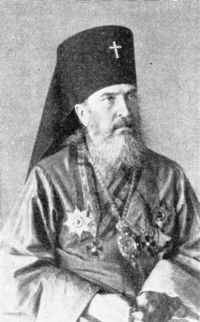
Abp. Platon (Rozhdestvensky), founding hierarch of the OCA.

As many of my readers know, earlier this month the Orthodox Chuch in America (OCA) announced the retirement of Met. HERMAN, with Abp. DMITRI of Dallas acting as locum tenens (assisted by Abp. SERAPHIM). On 9/11, they reported a new Metropolitan will be elected at the upcoming All-American Council in Pittsburgh this November.

As I noted in response to a question from a reader of this blog, the OCA presently has no Western Rite parishes. One knowledgeable source told me the OCA had given a definite (official or unofficial?) no to the idea quite a few years ago. At a minimum, there are some within the jurisdiction who oppose the idea. This is not only at odds with its history within Russian Orthodoxy, but (if true) it is at odds with its own history.

Archbishop Platon (Rozhdestvensky), the founding hierarch of the Metropolia (now the OCA), weighed in on the issue in a different way. Speaking to an Episcopalian audience, he told the group he longed to see a Western Orthodox Church in North America. Although his much later attempts to acquire ROCOR property via lawsuit (and other actions) made him an anti-hero, I present his words here for the benefit of those in the OCA who remain virulently opposed to the Western Rite — and those who would prefer the OCA have a Western Rite like that of the Antiochian Western Rite Vicariate. And this statement has significance for all North American Orthodox (see below). He spoke to the Church House in Philadelphia on February 27, 1911:
As long ago as 1904, the Committee of the Holy Synod for the furtherance of the question of Church Union published its Notes on the American Book of Common Prayer. These Notes may be taken as the Russian Orthodox view of your "wedding garment."

I do not know whether you are acquainted with these Notes. If so, you must certainly know how friendly and sincere is our feeling toward you; you must know what is our view of your "wedding garment," and how eagerly we wish they were not only like ours, but the same as ours; and yet that, at the same time, it should be becoming to your own Christian features.

How I wish that, at this moment, you not only understood me, but that your souls might be close to me. How I wish that we were sheep of the same Orthodox fold, and that it were impossible to apply to us the words oves non audiunt vocem alienorum.

My brethren in Christ, our life is moved by ideas, and not by exterior circumstances and interests, which also include both our national and our individual peculiarities. So our nearness will be realized only when our religious ideas are not only not alien, but are near and akin.

What is most important of all! Christ said: "If ye continue in my word...ye shall know the truth" (John viii, 31-32). In this rests the substance of our faith, and the substance of the question of the Union of the Churches. I find more religious significance in my Church, while you find more in yours. Why is this so? Because in my Church I want to pray, finding there alone the familiar conditions which best correspond to my mood of prayer. Why is this? For the reason that a Russian church is one thing, while an American church is another. You sit in your churches; we stand in ours. And in order to bring about union, it is not necessary to carry the pews from your Church to ours, forcing you to stand and us to sit. We shall not sit, and you, from lack of habit, could not remain standing through such long services as ours.

But Union does not demand this. Otherwise the pews might become the barrier over which the Orthodox could not step into your Church, or you into ours.

...It would be difficult to bring about a union which would enable you and ourselves to feel at home in each others' churches. It would be hard for you to transform yourselves into Russian Orthodox, and for the Orthodox to become Episcopalians.

But is this necessary? If until the eleventh century there existed an Orthodox Eastern Church and an Orthodox Western Church, why should this be impossible now, in our day?

Could we not think of the parallel existence of the two Churches, the Russian Orthodox and the Episcopal, if the former proclaims the latter its beloved sister, whose faith conforms to its own? This can take place, when your Church removes all the dogmatical differences separating it from the Orthodox Church, which has preserved pure, primitive Christianity. Until this happens, though I have friends among your Bishops whom I value highly and for whom I have a profound respect, as a faithful son of my Church, knowing its dogmas and devoted to its ritual with my whole soul, I cannot admit of any compromises which would entail the smallest and seemingly most insignificant belittling of our Orthodoxy. I am sure you yourselves could not wish this.

You will illumine your dogmatical digressions by the light of the science of history, and will see for yourselves what is to be done. When we agree concerning dogmas, there will be no need to speak of rites. They will not prevent us from being one in Christ and having the same belief in Christ. Only the more so, because both among you and among us there are many people who wish to do so.

...You already have an army ready and able to demolish the fortress of disagreement, the division which rends the seamless cloak of the Church of Christ. But this army still needs a fuller knowledge of the breadth and power of the Church of Christ in that epoch when it was not divided into factions. In my eyes, gentlemen, if you really possessed this knowledge, without any doubt you would have confessed in the face of all the world, with one mind and voice, that our Orthodox Eastern Church is the Church founded on earth by our Lord Jesus Christ "for us, men, and for our salvation." It is also beyond doubt that in that case you would have expressed the desire to be members of the Orthodox Western American Church.

May the Lord God grant to us the possibility to see the blessed day when we can give to you, Americans, the same name of Orthodox Christians. That would be a great mercy from God both for ourselves and for you. Let us believe that it will come, and let us pray that it may come soon. (Emphases added above.)

So, the founding hierarch of the OCA, Abp. Platon, prayed for the establishment of a Western Rite; he demanded only that the Episcopalians whom he addressed "remove all dogmatical differences separating it from the Orthodox Church" and modify their liturgy according to the Notes on the American Book of Common Prayer. (This has been accomplished in the Liturgy of St. Tikhon celebrated by some in the Antiochian Western Rite Vicariate.) In this, he is in line with St. Tikhon (Bellavin), St. Nicholas of Japan, St. Raphael of Brooklyn, and others. (Indeed, it appears St. Nicholas of Japan viewed the external rite of ordination as "valid" and merely opposed confused Anglican theology.) Note also Abp. Platon's allusion to the "parallel existence of two churches," meaning when these Western Christians accepted the full Orthodox faith and made necessary changes to their liturgical practice, they would retain their own Western Rite hierarchy.

To those outside the OCA, I note his words were spoken in 1911, during his first term in America, before the Bolshevik Revolution and 15 years before the split of the Metropolia and ROCOR. (In between, he had served as a member of the Holy Synod of Russia.) As such, his words were those of a bishop representing North American Orthodox regardless of later jurisdictional identity.

Now that the OCA is making other needed changes, it is time to follow the example of the 20th century saints listed above, as well as the founding hierarch of their own jurisdiction, and allow for a Western Rite like that already approved by her sister jurisdictions.

Labels: , , ,

Tuesday, June 17, 2008

Patriarch ALEXANDER III: Pray for Us

His Holiness Patriarch ALEXANDER III (Tahan) was translated to eternal life 50 years ago today. As noted, on May 31, 1958, His Holiness the Patriarch of Antioch authorized the celebration of the Western Rite throughout his patriarchate.

The 167th patriarch of Antioch became only the third Antiochian patriarch of Arabic descent in the last several centuries before his time. His Holiness ALEXANDER III served from 1928 to 1958. During that time he "enthusiastically set about to revitalize the parishes, monasteries and the theological seminary at Balamand. Perhaps the most important factor to consider in this spiritual renaissance is the Orthodox Youth Movement, which was founded in 1942 by a group of dedicated laymen."

His Holiness named the young deacon Philip Saliba his secretary; that deacon would go on to become Met. PHILIP of North America. (He also ordained another deacon, whom we now know as Bp. ANTOUN.) And just weeks before his death, he authorized the reintroduction of Western Rite liturgical worship into the Orthodox Church.

In both these ways, his glorious tradition continues and abides within the Antiochian Church today.

Patriarch Alexander III, pray for us!

From the Divine Office:

Antiphon at Vespers: Ecce sacérdos magnus, * qui in diébus suis plácuit Deo, et invéntus est justus. ("Behold a great priest * who in his days pleased the Lord, and was found righteous.")

The Hymn

This the Confessor of the Lord, whose triumph
Now through the wide world celebrate the faithful,
At his departure entered with rejoicing
Heavenly mansions.

Fervent and holy, prudent in his converse,
Humbly and chastely here on earth he sojourned,
Curbing all passions, and in peace and meekness,
Constant abiding.

What though the grave now hold his hallowed relicks?
He, ever living, ever interceding,
Reigns with the Blessed, nor from us his brethren
Is he divided.

Whence we in chorus gladly do him honour,
Chanting his praises with devout affection,
That in his merits we may have our portion,
Ever and ever.

Glory and virtue, honour and salvation,
Be unto him that, sitting in the highest,
Governeth all things, Lord and God Almighty,
Trinity blessed. Amen.

The Lesson is taken from a Sermon by St. Maximus, the Bishop of Turin
It is idle to strive to add anything to the praise of our holy and most blessed Father His Holiness Patriarch ALEXANDER III, whose Feast is this day kept. For verily, the beauty of his godliness must needs be set forth in our lives rather than on our lips. Now the Scripture saith : A wise son maketh a glad father. Thus, if very many do make glad this Saint by the wisdom and devotion wherewith they follow his example, how great will be his glory! For in Christ Jesus he will have begotten us through the Gospel.

Whatsoever, therefore, of virtue and grace there may be in this holy people, all the bright streams thereof do flow from him, as from a most clear fountain. By his manly chastity, by his sternly noble temperance, by the graceful courtesy which marked him, he drew all men's love to God : and by him eminent ministry in his bishoprick he hath left behind him in his disciples many heirs of his priesthood.

Very meet and right it is on this day which hath been made a holy day for us by the passage to paradise of our blessed Father, His Holiness Patriarch ALEXANDER III, that we should sing this verse of the Psalms : The righteous shall be had in everlasting remembrance. Right worthy is he to be had in remembrance amongst men who is at this present keeping holy-day amongst Angels. The word of God saith : Judge none blessed before his death, as though to say Judge a man blessed only when his life is ended ; praise him only when he is made perfect. For there is a two-fold reason why it is better to praise a dead man than a living ; to call a man holy and worthy after his death can never be participation in the sin of flattery on the part of him that praiseth, nor of vanity on the part of him that receiveth the praise.
Response to the First Lesson of Matins: Euge, serve bone * et fidélis, quia in pauca fuísti fidélis, supra multa te constítuam * Intra in gáudium Dómini tui. ("Well done, thou good and faithful servant; thou hast been faithful over a few things, I will make thee ruler over many things : * Enter thou into the joy of thy Lord.")

Response to the Sixth Lesson of Matins: Iste est, qui ante Deum magnas virtútes operátus est, et omnis terra doctrína ejus repléta est : * Ipse intercédat pro peccátis ómnium populórum.("This is he who wrought mighty deeds and valiant in the sight of God, and all the earth is filled with his doctrine: * May his intercession avail for the sins of all the people.")

Labels: ,

Saturday, May 31, 2008

The Western Rite Vicariate's Golden Anniversary

Fifty years ago today, the ancient patriarchate of Antioch reintroduced Western Rite worship at a patriarchate-wide level. His Holiness Patriarch ALEXANDER III (Tahan) authorized the Western Rite on May 31, 1958. He was translated on June 17, 1958.

In the intervening 50 years, we have seen his vision flower into the Antiochian Western Rite Vicariate, as well as the missionary efforts of Fr. Jack Witbrock in New Zealand. It has brought many into the Orthodox Church who may not have come otherwise. And it has testified, in the words of St. Tikhon (himself a contributor to the Western Rite), that "The light of Orthodoxy was not lit to shine only on a small number of men. The Orthodox Church is universal."

On this sacred occasion, let us sing a Te Deum in thanksgiving for this patriarch's insight and the fruition of the works and/or desires of many saints (including St. Tikhon, St. Raphael of Brooklyn, St. John of Shanghai (Maximovitch), St. Nicholas of Japan and undoubtedly some New Martyrs of Russia). Through their intercessions - and those of Patriarch ALEXANDER III, Dom Denis Chambault, and Fr. Alexander Turner - may the Western Rite, as approved and provided for by the saints, endure Ad multos annos - yea - usque ad consummationem saeculi!


Labels: ,

Wednesday, May 14, 2008

The KGB Still Persecutes Russia's New Martyrs

Belarusian KGB Discourages Veneration of Russian New Martyrs.

Even now, the Communists are trying to force their Christian victims down the memory hole:
Belarus discourages the commemoration of Orthodox Christians killed for their faith by the Soviet Union, Forum 18 News Service has found. Today's KGB secret police have sought to have icons of the New Martyrs, as they are known by the Orthodox Church, removed from Grodno Cathedral...

Bishop Artemi (Kishchenko) of Grodno and Volkovysk refused to take them down. "He told the KGB that he couldn't rewrite history." KGB officers also often monitor visitors to Kuropaty, where New Martyrs are probably among mass graves of Stalinist repression victims, a local Orthodox source told Forum 18. The act of going there - even to light candles - is "fraught with tension" with the current Belarusian regime, according to the source. An Orthodox chapel planned for the site has never been built.
The KGB has never learned its lesson. As the Psalmist and the Church services (both Eastern and Western Rite) declare, "The righteous shall be in everlasting remembrance." Doing our part to combat this, here is a beautiful, interactive icon of the New Martyrs.

Of course, undoubtedly among the many holy saints numbered with the New Martyrs would be those who provided for St. Tikhon's Liturgy just a decade before the Revolution. (They would join St. Tikhon, St. Raphael of Brooklyn, and St. Nicholas of Japan as saints who approved of, and actively sought to create, a Western Rite Orthodox liturgy adapted from the Book of Common Prayer.) In addition to their own sanctity, this is an another reason the New Martyrs are commemorated in the Antiochian Western Rite Vicariate's Orthodox Missal (on February 4). The Collect is as follows:
O God of unspeakable mercy, Who didst enable Thy holy Russian martyrs to overcome their enemies by dying for Thy name: deliver us, we beseech Thee, at their intercession from slavery to sin: that wtih them we may come to Thy perfect freedom in the heavenly fatherland. Through Jesus Christ, Thy Son, our Lord, Who liveth and reigneth with Thee in the unity of the Holy Spirit, ever one God, world without end. Amen.
New Martyrs of Russia, pray for the suffering faithful in Belarus, and for us! May their intercessions keep the faithful of Belarus safe. And if the Parousia does not intervene, may the faithful venerate the New Martyrs generations after the State's faceless thugs have been forgotten by history.

(Hat Tip: Mere Comments)


Labels: , ,

Saturday, May 03, 2008

Dom Denis Chambault

Dom Denis (Lucien) Chambault reposed on this date in 1963. He was "an acknowledged healer" and the abbot of an Orthodox Benedictine monastery in France that celebrated the Liturgy of St. Gregory (the "Tridentine" Mass). Although a Frechman, this holy man played a pivotal role in the development of the Western Rite Vicariate of the Antiochian Orthodox Church, in North America and throughout the patriarchate...

For more on Dom Denis, see our previous entry.

Dom Denis Chambault, ora pro nobis!

Labels: , ,

Saturday, March 22, 2008

St. Nicholas of Japan and the Western Rite

St. Nicholas of Japan, Equal-to-the-Apostles

Most of those conversant with the history of Western Rite Orthodoxy know of the approach American Episcopalians made to St. Tikhon (Bellavin) near the turn of the 20th century, asking to join the Orthodox Church while retaining some form of their liturgy. Most, too, know of the communication the Non-Jurors had with Orthodox hierarchy in the early 18th century. However, few knew that St. Nicholas of Japan, Equal-to-the-Apostles, had also responded to what he believed to be an overture from an Anglican church for unity.

I read with interest article entitled "An Attempt at Unity in Japan" by the Rev. Charles Filkins Sweet, which he wrote in 1912 about events that took place in 1909. Sweet served as secretary of the Anglican and Eastern-Orthodox Churches Union in Japan, where he represented the Nippon Sei Ko Kwai (The Anglican Episcopal Church in Japan). St. Nicholas of Japan became its vice president, representing the Haristos Sei Kyo Kwai (The Orthodox Church in Japan). At a meeting of the union, all members present, including St. Nicholas, vowed to pursue church unity, and Sweet wrote up an essay outlining the "variations and differences" between the two churches.

...And in time, an answer came from the Orthodox. By Sweet's account, St. Nicholas' judgment was "based upon the notion that I and my fellows sought for terms in order to make corporate submission--which was by no means our purpose." [1] However, thinking a corporate reunion were being proposed, it is worth noting the Rejoinder's disposition and terms.

Sweet writes that he prepared a paper on the subject of ministry, because:
[F]rom many conversations with Abp. Nicolai (St. Nicholas of Japan - BJ.) I was aware that the objections he made towards Anglican teaching gathered around the sacramental system; and they were quite practical, relating not so much to to the language or meaning of the English Prayer Book as to the practical apprehension in daily life by Anglicans of the need of sacramental grace.

...It is astonishing to see that the sole reason advanced for not making this recognition [of the "validity" of Anglican orders...and it was not necessarily the "sole" one - BJ] is the fact that the English Church does not teach unqualifiedly that there are seven sacraments. (Emphases added.)
In other words, St. Nicholas of Japan did not see the Book of Common Prayer as utterly corrupt and incapable of (some) use in the Orthodox Church, but he insisted those who join the Church share Her faith.

This spirit can be seen in the Orthodox response to Rev. Sweet's paper. A portion of the "Rejoinder on the Part of the Russian Ecclesiastical Mission to the Paper of Rev. Charles F. Sweet" is included, the section dealing with — wait for it — Ordination. The Rejoinder asks if Orthodox should "say that [Anglican ordination] is invalid because of its different wording? No; I believe that such a conclusion would not be free from blame as a hasty judgment." Instead, the Rejoinder examines both the Prayer Book ceremony (external form) and the Anglican doctrine of ministry expressed by the 39 Articles (doctrine, or intent). It noted, concerning the Prayer Book rite of ordination, "We do not find that according to this discussion upon the general subject that there is any reason to disapprove the Holy Orders of the Sei Ko Kwai from the point of the external aspect of anshurei [ordination], or as regards the outward ceremony, which is the first part of the fundamental or necessary property of Ordination."

The trouble, the Rejoinder stated, is Anglican doctrine:
[W]e cannot find any classifications of sacraments among all the 39 Articles, except the declaration to the effect that there are two sacraments. Consequently anshurei [ordination] is not called a sacrament. Therefore those who may wish to interpret this Article in the purely Protestant sense would have no difficulty in so doing. Until then we find enough reason for interpreting this article in the former [Orthodox] sense and not in the latter [Protestant], the 25th Article will be a cause, preventing us, the members of the Sei Kyo Kwai [Orthodox], from believing entirely in the Holy Orders of the Sei Ko Kwai [Anglicans].
The Rejoinder showed familiarity with the still-prevalent retort that the 39 Articles must be interpreted by the BCP, rather than vice-versa:
[S]ome theologians of the Sei Ko Kwai assert that we must try to find the true meaning of the 25th Article from the Book of Common Prayer. Yet on what ground ought we, even by putting all due emphasis on the Book of Common Prayer, to lower the value of the 39 Articles? We can find no reason for making light of the Articles.
The Rejoinder concluded on this point, "the Articles remain as an inviolable doctrinal book." Noting the contrast, St. Nicholas is quoted as saying, "Is it not the same as to establish Holy Orders with the right hand and destroy them with the left?"

Rather than heed his advice, the Anglican author Sweet decided to lecture the Orthodox saint on Orthodoxy:
[I]n the first six or seven centuries the Easterns made no attempts to number the sacraments, and there was no traditional teaching on the point, except that St. Theodore of the Studium, who died in the early part of the ninth century, held that Christ instituted six sacraments...It seems probable that the present list of Seven was taken over from the West to the East.
So, he ascribed the saint's profession of seven sacraments to the "Western captivity"! Like some overzealous Orthodox polemicists — who learn that historically the Orthodox Church did not limit sacramentality to "The Seven Sacraments," and thus insist the Orthodox Church rejects the teaching that there are seven historical sacraments/Mysteries of the Church — Rev. Sweet decided to prove he was more Orthodox than the Orthodox (and a saint, at that).

From the remainder of the article, it is clear St. Nicholas insisted any recognition of Anglican orders in a future reunion would be contingent upon their embracing "the whole faith of the Church." This would be the standard for some time. Eighteen years later, Met. ANTHONY (Khrapovitsky) of ROCOR wrote that Anglican clerics could be received "in existing orders"if they became Orthodox. (Lest any Anglicans rejoice, that was a different Anglican church — and Met. ANTHONY writes, by the same canons, the same treatment could be accorded to Nestorians.)

It is noteworthy that St. Nicholas of Japan, in his contemplation of what he believed to be an appeal for "corporate submission," did not utterly reject either the concept of a Western Rite nor one based upon some version of the Book of Common Prayer. He did not demand Western converts become Byzantine Orthodox. He did not breathe a word about returning to long-dead liturgical forms carbon-dated from 1054 A.D., nor encourage pet theories about liturgical development of the "old Sarum" this or "reconstructed Gallican" that. One sees not a hint of the supposed "two approaches" to the Western Rite in this saint's approach to, again, what he believed was an appeal for "corporate submission." By his response, it appears St. Nicholas of Japan encouraged the development of a Western Rite using some form of the BCP. He was undoubtedly aware of the recent 1904 Russian Observations Upon the American Prayer Book. It would be of great interest to see if rest of this Rejoinder, or additional correspondence, were available, and if he made any reference to the eventual shape of the liturgical life in a future Western Rite Orthodox Church in Japan.

In the end, this "attempt at unity" did not materialize for the same reason as the other examples mentioned above: the Anglicans could not bring themselves to believe in the Orthodox faith. At least in reflection Sweet recognized:
Anglican writers have pressed the objectivity of sacramental doctrine (e.g., that it has a "valid" priesthood - BJ) too hard, and have been dry and formal--even mechanical. Valid ordination alone does not make a Catholic Church. The life of the Catholic Church is something infinitely richer and more various than the Episcopate. We have fallen into the way of dealing with the doctrine of the ministry as if, in proving we have the episcopal succession we prove that we have all we need in order to be Catholics. This is pressing sacramental doctrine beyond all reason, and making the religion of Christ a mere system instead of a gospel.
Had his church taken St. Nicholas of Japan's plea to broaden and deepen its apprehension of the catholic faith, it may have ended up as the second Western Rite church in history.[2] But it appears the Western Rite as practiced in the Antiochian Orthodox Church and ROCOR may have yet another heavenly intercessor.

ENDNOTES:
1
. Sweet's essay is somewhat contradictory on this point, as he notes at his initial meeting with St. Nicholas, the Nippon Sei Ko Kwai agreed "our final purpose was unity, and...we all believed it was possible, possible even then." However, it seems the Anglicans envisioned "intercommunion" rather than unity on Orthodox terms. They also undoubtedly wished to receive another endorsement of the "validity" of their orders, recently denied by Pope Leo XIII in his encyclical Apostolicae Curae.

2. The first was Rene Joseph Vilatte's short-lived submission to Russian Orthodox Bp. VLADIMIR (Sokolovsky-Avtonomov) in 1890-1. That Western Rite Orthodoxy was ever associated with such unstable individuals as Vilatte and, later, Arnold Harris Matthews (and that both would apostasize shortly after their plea for "unity") is greatly to be lamented.


Labels: , ,

Thursday, July 12, 2007

AGAIN Magazine Mentions First Western Rite Liturgy in North America?

The newest issue of AGAIN Magazine includes an interview with Orthodox journalist and professor Terry Mattingly. Discussing the ancient faith of the West, he notes:
My own personal patron saint is St. Brendan of Ireland, and if you look at our wall behind the chanter's stand at the saints of America, you will find an icon of Brendan as well as the others because of the historical stories of his sea travels. There is archaeological evidence that if he didn't make it to the shores of America, his disciples certainly did. There are things written in the ancient Celtic writing called Ogham on rocks at sites in New England. . . There are rocks along Brendan's Trail in Ireland that have been carved with this same writing.

So, as radical as it may sound to some people, that would mean that the first Divine Liturgy on American shores would have been Western Rite.
If St. Brendan or his companions did not reach North America, as I've written elsewhere, there may have been other Western Rite Orthodox on these shores in the distant past. But "TMatt" presents more fodder for our Western Orthodox history, including the celebration of the Mass, in this continent.

(Hat tip: Virtue Online)


Labels: ,

Tuesday, February 20, 2007

The Irresistible Force and the Immovable Anglicans

The comments on the last post have driven home that this blog is blessed with some of the most perceptive readers anywhere. Richard brought up one (actually two) of the points I've always meant to cover but have not had time. (Eric Jobe brought up another.)

We in the Western Rite are often asked why, given its current in-fighting and fragmentation, we don't have more converts from the Episcopal Church and the continuing Anglican communion. As Fr. Michael Keiser has written, the premise seems to be since we "have not converted the House of Bishops of the Episcopal Church to Orthodox teaching, why bother to continue"?

Laying aside the fact that the Western Rite is a most fertile mission field, that is not its lone raison d'etre. As H.G. Bp. BASIL has said, "the worth and validity of the Western Rite do not depend on growth or numbers." However, let us be frank about why there aren't more Anglican converts (a point on which Richard hit on the head): many Anglicans are perfectly committed to being Anglicans.

For one thing, their ecclesiology, the Branch Theory, gives them no angst about their place in the Church. While Orthodoxy teaches the Church is One, constituting a theanthropic visible unity of Head and Body, Anglicans believe they are part of one of the three co-equal branches that parted ways, lo, in the misty fogs of the past. (They gloss over that this partition often came through harsh doctrinal disagreements, followed by mutual excommunications/anathemas, and occasion reprisals in which "leaves" of one "branch" had leaves of the other branches put to death.) Anglicans do not question the "validity" of Orthodoxy, but even if they come to believe Orthodoxy has preserved the apostolic fidei depositum sacrosanct from the patristic era, they do not feel they must leave their own communion or join the Orthodox Church to share in it. Since they believe they are already one "branch," they can simply bend the twigs of their doctrine eastward. Hence, the large number of well-meaning people (many of whom are friends) who consider themselves "Western Orthodox" in the Anglican communion.

Of greater consequence for the current TEC crack-up is this: not a few Anglicans are committed Protestants, even charismatics and evangelicals. Heading for alternate cover under the Global South, such groups as AMiA were never potential Orthodox Catholics. They would not be at home in Orthodoxy (and would not be ill-at-ease at Saddleback).

There is also, within the vestiges of the formal Anglican communion, an odd pathology bordering on spiritual masochism, in which some traditionalists believe they are actually triumphing by remaining under heretical bishops. These entrenched warriors have somehow managed to safeguard their own parish from the liturgical Revolution...and they're content with that. In fact, they believe they are showing valiant defiance in remaining in communion with Matriarch Kate Schori. "They can run the entire church," I have heard some Anglo-Orthodox say in this delusion, "but they can't force me to change!" They somehow believe by remaining in communion with, pledging obedience to, and financing heretical bishops, they are manning the forts in battle for TEC's soul. Little do they realize, they are...and that when their numbers sufficiently dwindle, their work, too, will be swept away like a grain of rice in an ocean of apostasy. Or, perhaps they will then attempt to jump ship...with their strength fruitlessly depleted.

Finally, as Fr. James Deschene has noted (and I've echoed), Anglicans always look to Rome. Fr. Michael of St. Petroc has added, this stems from the dirty word: orders. Some Anglicans point to individual statements of Orthodox bishops or churches that purport to recognize the "validity" of Anglicans orders. (Orthodoxy does not, and all the statements were at best tentative.) However, Rome maintains its position and hence, must be placated.

And many look Romeward because all they know of the Orthodox Church is the Byzantine liturgy. And as beautiful as it is, to us and even to many of them, they cannot bring themselves to jettison their western heritage, chant, and forms of piety (some of which, of course, are legitimately Orthodox, though Western). This is where the importance of the Western Rite comes in, and the its current obscurity discloses itself in its full tragedy.

What can Orthodox do to change this? For Anglo-Protestants, we must take the same tack as we would toward any other evangelical group, witnessing the ancient faith. For conservative Episcopalians rejecting TEC-cesses, we must applaud them where they are correct, offer our moral encouragement for their move outside TEC, and begin sharing with them our conception of the Church. For Continuing Anglicans and Anglo-Orthodox, we must continue to insist on our ecclesiology and bear witness to the inner life of grace that, we believe, makes our blessed communion distinct.

We must let all groups know the Orthodox communion has authorized Western forms of worship for use and not insist on a stumbling-block of one cultural expression of the faith.

When these groups, at various stages of growth, begin to explore Orthodoxy — because they at least know that we exist and present challenges to their epistemology they have not yet considered — we must encourage them in love, knowing that in their study will lie soul-searching, soul-deifying truths that, if accepted, will transform them and, though originally startling, will ultimately envelop them in the joy of Christ.

Labels: , ,

Wednesday, January 17, 2007

Why Anglicans Could (Have) Be(en) Received in their Orders

I don't want to get anyone's hopes up; it's not going to happen today. The idea that Anglicans could be received "in orders" is now considered out of the question. Indeed, Orthodoxy no longer assumes TEC baptisms of the last 30 years were performed with the correct form, as the so-called progressives have changed "Father, Son, and Holy Spirit" to "Creator, Savior, and Sanctifier," or even "Mother, Lover and Friend." However, there was a long period of consideration 80 years ago, resulting in this long-lost article by Metropolitan Anthony (Khrapovitsky) of ROCOR.

It originally appeared in the journal The Christian East (Vol. VIII, 1927, pp. 60-69). You can also download a slightly abridged PDF of the article here under the title "The Basis On Which Economy May Be Used In The Reception Of Converts." It's presented here for its historical interest.

A BULKY volume was written on this subject by V. A. Sokoloff, the very conservative professor of the Moscow Ecclesiastical Academy, who sets himself to prove that the Apostolic Succession has not been broken in the Anglican Church. The book was published more than thirty years ago.

We shall examine the matter from quite a different point of view, namely, by direct application of the Canons of the Holy Apostles, of the seven Holy Oecumenical Councils, and of the nine Local Councils confirmed by them.

The Canons which deal with the relation of bishops, and in general of all the children of the Church to those outside her, are the following:--Apostolic, Nos. 10, 12, 45, 46 and 65: Conciliar, Ist Oecumenical, Nos. 8 and 19; 2nd Oecumenical, No. 7; 6th Oecumenical, No. 95; Laodicaea, Nos. 7, 8 and 33; Carthage, Nos. 68 and 79; and the Canonical Rules of St. Basil the Great, Nos. I and 47.

Among these some Canons directly indicate by what rite which heretics and schismatics should be received into the Church if they desire it and request it, after renouncing their errors and confessing the Orthodox faith and their submission to the true Church.

Naturally, these Canons do not lessen the necessity of baptism by water for every man, although it must not be forgotten that very ancient instances in the Church give us examples of the descent of the Holy Spirit upon the yet unbaptized, so that the subsequent baptism had a supplementary and chiefly disciplinary significance, as uniting them to the earthly Church of Christ.

"While Peter yet spake these words, the Holy Ghost fell on all them which heard the word. And they of the circumcision which believed were astonished, as many as came with Peter, because that on the Gentiles also was poured out the gift of the Holy Ghost; for they heard them speak with tongues, and magnify God. Then answered Peter, Can any man forbid water, that these should not be baptized, which have received the Holy Ghost as well as we? And he commanded them to be baptized in the name of the Lord." (Acts x, 44-48.)

Of this event the Apostle Peter recalls further: "And as I began to speak, the Holy Ghost fell on them, as on us at the beginning. Then I remembered the word of the Lord, how that he said, John indeed baptized with water; but ye shall be baptized with the Holy Ghost. For as much then as God gave them the like gift as he did unto us, who believed on the Lord Jesus Christ; what was I, that I could withstand God?" (Acts xi, 15-17.)

Without dwelling further on the explanation of these utterances, we must, of course, also notice that the descent of the Holy Spirit, referred to in the words of the Acts which have been quoted, did not release the believers from the obligation of baptism by water, and this obligation many converted from heresy had to fulfil in accordance with the 46th Canon of the Holy Apostles, although they already had heretical baptism.

Later Councils, however, clearly distinguish which heretics should be "cleansed by true baptism" (95th Canon of the VIth Oecumenical Council and Ist of Basil the Great), and which should be received by the second sacrament, and which by the third sacrament and be left in their existing orders. All this is set forth in detail in the 9th Canon of the 2nd Oecumenical Council; in the 95th Canon of the 6th Oecumenical Council; in the Ist Rule of Basil the Great, and others.

However, they all issue from the same idea which lies behind the 68th Canon of the Carthagenian Council, namely, that heretics and schismatics are without grace, which is only received by them on their being united to the Church: there can be no half-grace, in spite of the Latin opinion. If we compare this thesis with other Canons of the Councils, we shall see that it entirely agrees with them.

For this we need only indicate the following characteristics of conciliar legislation on this subject:--

I. These Canons were changed (a) according to time, and (b) according to locality.

2. Their strictness or relaxation depended not so much on the character of the heresy or schism, as on the varying relationship of the heretics or schismatics to the Church; and they varied in the one direction or the other, according to changes in this relationship of the schismatics to the Church.

3. Sometimes the Oecumenical authorities declared their decisions not to be final, and sometimes even deferred their decisions while awaiting new Church Councils.

Let us turn first to the second point.

The Carthagenian Council, in its 79th Canon, decided: "to send letters to our brethren and fellow bishops, and especially to the Apostolic Throne, in which our revered brother and fellow-minister Anastasius presides, to the effect that by reason of the great need in Africa, which is known to him, for the sake of peace and for the good of the Church, even Donatist clergy should be received in their sacerdotal orders if they correct their disposition and desire to come to Catholic unity, in accord with the judgment and will of each Catholic Bishop ruling the Church in that place, if this will prove beneficial to the peace of Christians. It is well known that in former times also this schism was so treated, witness to which fact may be found in instances from many Churches and from almost all the African Churches in which this error arose."

So we see here an instance of the application of the principle we have already pointed out. The manner of admitting the various apostates depends not so much on the quality of the heresy, as on the spiritual disposition of the candidate, and on the expected benefit to Holy Church.

In this connection it is especially important to master the significance of the ist Canonical Rule of St. Basil the Great.

"The Cathari are of the number of the schismatics. Nevertheless, those of old, such as Cyprian and our own Firmilian, were pleased to bring them all under one and the same regulation: Cathari, Enkratites, Hydroparastatites and Apotactites.

For though the beginning of the apostasy arose through schism, yet those who fell away from the Church no longer had the grace of the Holy Spirit. For the power of imparting grace disappeared because the lawful succession was cut off. For those who first fell away had received consecration from the fathers, and through the laying on of their hands had the spiritual gift. But when they fell away, becoming laymen, they had power neither to baptize, nor to lay on hands, and could not confer on others the grace of the Holy Spirit, from which they had themselves fallen away. Therefore, those who came from them to the Church, being considered to have received baptism from laymen, were of old commanded to be cleansed anew by true ecclesiastical baptism."

It is clear that by this regulation the Church does not recognize in heretics and schismatics either the priesthood or the other sacraments, and considers them subject to ecclesiastical baptism in the nature of things. However, in this Rule of St. Basil, she admits the possibility of yet another manner of receiving them.

This is what we read further:

"But inasmuch as some in Asia have been resolutely desirous, for the sake of the edification of many, to accept their baptism, let it be accepted." St. Basil writes further, "the baptism of the Enkratites should be rejected and such, coming to the Church, should be baptized, but if this should be detrimental to the general well-being, then the usual custom should be adhered to, and the example of the fathers, who judiciously arranged our affairs, should be followed. For I fear lest in desiring to keep them from hasty baptism we should hinder those seeking salvation, by the severity of postponement."

Now let us attempt to generalize all these indications given at various times and reconcile them with apparent exceptions and relaxations.

Every sacrament has two sides--the visible and the invisible. The second is administered only within the true Church by faith and sincere prayer, according to the words of the Apostle Peter: "The like figure whereunto even baptism doth also now save us (not the putting away of the filth of the flesh, but the answer of a good conscience toward God) by the resurrection of Jesus Christ." (I Peter, in, 21). And the same is found also in the teaching of Saint John Damascene. For those who are baptized without faith "the water remains water" only. Heretics and schismatics, having the visible side of baptism, chrismation and holy order, are entirely devoid of those gifts of grace which are bound up with these sacraments for believers within the true Church. Therefore, certain of them, for the alleviation of the rupture in their spiritual life and for "the edification of many," are permitted to enter the Church without the visible side of the sacraments of baptism or holy order (that is by the second or third rite), but through the operation of another sacramental act in which they receive the grace of baptism, chrismation and holy order. (For example, for Roman Catholics, Nestorians and Donatists.)

Many are troubled by the question: Is it then possible to replace one sacrament by another? But we, that is, not we, but the Canons quoted above, are evidently founded on the words of the Gospel:

"God giveth not the Spirit by measure" (John, iii, 34). Or, in other words, those among heretics, whether clerical or lay, baptized and anointed (with chrism) by heretics, had only the empty sign (or outward form) of the sacrament, and it receives the complement of grace only through that sacrament which unites them with Holy Church (chrismation or penance). Moreover, in confirmation of this principle, should be added the custom, established in the Church, that the reception of heretics and schismatics "in their existing orders," may only be performed by a bishop; if a priest receive them, then they enter the Church as simple laymen. This means that a schismatic priest united to the Church receives true priesthood only through episcopal reception; but a priest cannot bestow this grace on the one received. It is only on such a conception of the sacraments of the Church that her regulations as to the applicability to heretics and schismatics of one or the other rite of reception can be accepted; only on such a conception can the decisions of the Holy Apostles about the baptism of heretics and schismatics, be reconciled with the further Canons of the Councils about not baptizing them, and about their reception by the second, or even by the third rite. And therefore it is futile for Roman Catholic theologians to blame the Orthodox for such diversity of practice.

As a condition of their reception in their existing orders the existence among schismatics, before their conversion to the Church, of hierarchical succession, is usually insisted upon; but from the canonical Rule of Basil the Great already quoted, we see that no schismatics have any succession and cannot have any; a hierarchy falling away from the Church "become laymen and cannot confer the grace of the Holy Spirit, of which they are themselves devoid." Therefore, in judging of one or the other rite of reception, the question of schismatical succession is in any case secondary if not quite irrelevant.

Besides the Canons of the Councils already quoted, and those of the Holy Fathers, we may refer to the words (also already quoted) St. Basil the Great, that each Church should keep the customs established in her, and be guided by considerations of benefit to the lurch, and the changing disposition of heretics (for the better or e worse). Thus special consideration was shown to the Nestorians, though their heresy was recognized as one of the worst, for it divided the One Mediator (I Tim., ii, 5) into two persons and refused to entitle the Most Holy Virgin, Mother of God. But by the time of the promulgation of the Canon they had forsaken their fanaticism and sought reunion with the true Church. That is why local Churches now increased and now relaxed strictness in the manner of reception.

Thus under the Patriarch Philaret, in 1620, the Latins were reunited through baptism by water, like the heathen, because then, that is at the time of the introduction of the Unia, a very seductive propaganda was carried on by them, but when the Russian Czar annexed Little Russia (1653) and the next year carried out a victorious expedition into Lithuania, and many Uniats began to ask to return to Orthodoxy, the Council of 1667, in spite of all its severity towards deserters from the Church, decreed the reception of Roman Catholics by the third rite. Under the Turkish yoke Holy Church was in a different position. There heresy and schism were stronger, just at the time when among Russians they were weaker, and therefore the practice of the Eastern Churches took a different direction from that of the Russian Church: when our forefathers baptized the Latins, the Greeks only anointed them with chrism, and when we were already keeping the regulation of 1667 and admitting them by the third rite, the Greeks in the Council of 1754, in which all the four Eastern Patriarchs took part, were decreeing the rebaptism of Latins and Protestants. (They have only of late revoked this decree, and that without a new conciliar decision, thereby yielding to the principle of opportunism.)

Another opinion is held by the estimable Russian Old Believers, whom I have always regarded with special respect and sympathy, although they consider us Orthodox " heretics of the second rite," and receive those entering their community by chrismation, even Bishops. (The last such case took place in Russia in 1925, and the first in Rumania in 1846, when they received Arsenius, the first Greek bishop to join their community.)

Apparently the Old Believers are imbued with Latin views on this question. For though the warmest opponents of the Latin heresy, of which they, as well as our other forefathers as far back as the seventeenth century, wrote: "of all the heresies the Latin is the most terrible," yet, by a misunderstanding they assimilated the doctrine of the sacraments according to the Greater and Lesser Catechisms of the seventeenth century, which only by a misapprehension are called Orthodox, and which set forth (in the section on the Sacraments and on the Atonement) purely Latin doctrine. However, as books in "the ancient printing," they are held by the Old Believers to be infallible. In reality these books, like the majority of the Greek and Slavonic books of that and the preceding epochs, were paraphrased from Latin books, only with the exclusion of such Latin errors as were exposed by the Patriarch Photius in his Circular Epistle of the ninth century. This is why, like the Lathis, our Old Believers have declared the Niconites (that is we) are "heretics of the second rite," and anoint with oil (they have no holy chrism), not only the laity who come to them, but also bishops and priests; at the same time receiving them in their orders--a matter for tears and laughter. Like them the Latin theologians also--those dull scholastics--make it an accusation against the Orthodox that they have changed the rite of the reception of schismatics and heretics at various times and places, which indeed is fully agreeable with the meaning of the Canons and with ancient ecclesiastical practice. A sacrament is not simply an opus operatum, but a pouring out of the grace of God preserved in the bosom of the Holy Orthodox Church.

Does this practice agree with our teaching about the Church and about grace, or with the Latin teaching and its understanding of the Sacraments, opere operato, as giving great grace to the faithful and a certain half-grace to heretics and schismatics? The latter is denied by the 68th Canon of the Carthagenian Council, which declares that in the true Church alone are the Sacraments administered, for she "is the dove, the one mother of Christians, in which all Sacraments, eternal and life-giving, are received to salvation; but by those remaining in heresy are received to great condemnation and punishment. That which in the truth would enlighten and assist them towards eternal life, in error becomes to them the more blinding and the greater condemnation."

From this Canon it is seen that heretics and schismatics have no grace whatever; it does not exist outside the one Church of Christ. And if in the same Canon, immediately before the words quoted, it is said that those heretics, on anathematizing their errors, "by the laying on of hands are received into the Church," it is clear that they obtain freedom from original sin, that is, from the taint of sin, precisely through this laying on of hands. That is to say, in this second Sacrament, the first is also given to them, namely, the grace of baptism.

Mechanical or purely formal understanding of the Sacraments and the Church leads even educated people into the most foolish beliefs, superstitions and actions. Thus devotion to the faith, though worthy of all respect, under the slavery of Western scholasticism was the cause of the following amusing episode:

In the eighties a Greek bishop, a speculative person (probably Bishop Lycurgus, but perhaps I am mistaken in the name), visited England. Certain English priests, doubting the validity of their orders (that means also of their Church?) asked him to reordain them, and this the traveller performed, of course for filthy lucre's sake (Titus, i, 11). But withal, remembering the canonical rule that bishops may not officiate in a strange diocese without the consent of the local ecclesiastical authority, they set forth with the said bishop to the open sea, and there on the vessel received "ordination" from him, still remaining afterwards clergymen of the Church of England. In this way, while straining at a gnat, they swallowed a camel, for it is clear that if the Greek Church is the one true Church, then after entering it, it is impossible to remain Anglican; and while remaining Anglican it is impossible to receive ordination from a bishop of the Greek Church, which is as yet alien from Anglicanism.

Contemporary practice in the matter of reception is denned along the following lines:--

There must be (i) Apostolic succession in the community to which the person to be received has belonged; (2) Baptism by the regular rite (that is by threefold immersion in the Name of the Father and of the Son and of the Holy Ghost).

When these conditions are fulfilled the rite of baptism is not repeated. And if his community has that sacrament which we call chrismation (or myrrh-anointing) the candidate for union with Orthodoxy is received into the Church by the third rite, that is by the sacrament of penance only. We proceed thus with Latins, Armenians and Nestorians; this is in accordance with Canon 95 of the 6th Oecumenical Council and others. Such reception is called "the third rite," and "in the existing orders," that is, if the candidate be a cleric, he remains such in Orthodoxy after his reception. Does it follow from this that the Church recognizes as means of grace and valid sacraments the baptism, chrismation and orders which the candidate received while yet outside the Church?

Contemporary practice, inherited from Latin teaching on the Sacraments and practised by them long before their secession from the Church (as is seen, for example, by reference to the 47th Rule of St. Basil the Great), is evidently founded on the view that heretics and schismatics have something like grace, some kind of half-grace.

Not without some foundation the Old Believers put to me, while I was still in Russia, this problem. If you consider all heretics and schismatics to be as devoid of grace as the heathen, why cannot you receive in his existing rank a baptized Jewish rabbi, or even a Lutheran pastor?

I answered thus: first, they themselves do not desire it; and secondly, and chiefly, they had not even the visible side of those sacraments which goes with the bestowal of invisible grace in the Church--at least in the interest of Church discipline, and perhaps also for other reasons.

The conditional nature of this aspect of the matter is so great that the holy Fathers, the canonists, left some questions (of a liturgical character) in an undecided state for a tune. Thus St. Basil the Great leaves many details regarding the manner of receiving schismatics and heretics into the Church, without definite decision, and, while fully recognizing the lawfulness of various attitudes towards them in different Churches, leaves open certain questions to be decided by new Councils and more definite opinions of ecclesiastical authorities (Rule 1).

We have already seen that the 79th Canon of the Carthagenian Council decrees the reception of Donatist bishops in their existing orders "according to the judgment and will of each Catholic bishop, ruling the Church in that place; if this should prove to further the peace of Christians."

Therefore, reception into the Orthodox Church, (I) is dependent on the pastoral discretion of the local bishop, and (2) this discretion is conditioned by the general good of the Church.

We may now add that the same Canon establishes our manner of reception in comparison with that of the Church of Rome and others. The same 79th Canon says further: "This is done, not in violation of the decisions of the Council held on this subject in lands beyond the sea, but for the good of those who desire to enter the Catholic Church on these terms, and in order that no barriers might be set up against their union with the Church."

Such decisions of the Church would be quite impossible if the mode of reception were conditioned by the same dogmatic point of view from which each sacrament is regarded by the Latins and contemporary Russian theologians, namely, that strict differentiation of the grace of the sacraments which is rooted in our own theological schools.

Even Basil the Great, dogmatic as he is in defence of ecclesiastical authority in that same classical first Rule regarding the manner of receiving the Cathari, expresses himself quite conditionally and hypothetically, and admits both practices. About the Enkratites he expresses himself thus: "inasmuch as nothing has been clearly declared about them, it were seemly for us to repudiate their baptism, but lest this should be detrimental to the general well-being," and so forth, as has already been quoted.

Continuing, St. Basil still further mitigates his pronouncement, and after decreeing their reception by chrismation he adds, "I am aware, moreover, that the brethren Zoin and Satorin, who belonged to their community, were received as bishops (that is by the third rite). And, therefore, those who belong to their community cannot now be estranged from the Church by severity of judgment after we have established a certain manner of reception in admitting their bishops."

From the point of view we have presented, all this is reasonable and consistent, but from the Latin scholastic point of view quite impossible. Thus the adoption of one or the other mode of reception for those of other confessions who enter the Church (that is, heretics or schismatics) depends on ecclesiastical economy, on the judgment of the local bishops and the Councils, and on the existence of the outward form of the sacraments of baptism, chrismation and orders in the communities from which the applicants come.

Therefore, in our opinion, Anglicans may be admitted by the third rite, especially in view of the sincere and humble aspiration of many of them to be united to our holy Church.

Labels: , , ,