Thursday, April 09, 2009

OCA's Met. JONAH Acknowledges the Western Rite

Some of you may be following the back-and-forth between the Ecumenical Patriarchate and North American Orthodox hierarchs; a representative of the Phanar invited all churches of the "diaspora" to "submit" to Constantinople, and His Eminence Metropolitan JONAH, Primate of the Orthodox Church in America (OCA), responded by citing the role of the Russian Orthodox Church in North American Orthodoxy. Others can focus on the political aspects of this tug-of-war (and have), but we must not pass over another passage of His Eminence's sermon last Sunday. Met. JONAH spoke at St. Seraphim Orthodox Cathedral in Dallas on April 5, 2009, where he said:
We are a single community of Orthodox Christians, and we are the local Church in Dallas, the local Church in Northeast Texas. It doesn't matter that we have all these various administrative jurisdictions, ultimately, because we gather together as one Body, to pray with one mind and one heart, to celebrate the same Eucharist, to come to the same chalice. It doesn't matter if we Eastern Rite or Western Rite, doesn't matter the language in the service is, but...we are one Church. We are one local Church, and I might add, we are one indigenous Church. (Emphasis added.)
That is, Met. JONAH specifically affirmed the authenticity of Western Rite Orthodoxy. More specifically, members of the Antiochian Western Rite Vicariate in northeast Texas were in attendance at this sermon. Thus, the head of the OCA said the Western Rite as presently practiced within the AWRV is Orthodox and a part of the indigenous Orthodox Church in North America.

This is significant, since some in the OCA may be ignorant of or antipathetic toward the Western Rite (and these are hardly mutually exclusive). However, affirming the Western Rite and specifically the approach of the AWRV is in keeping with the views — not only of some Russian New-Martyrs, St. Tikhon (Bellavin), St. Nicholas of Japan, and St. Raphael of Brooklyn — but of the OCA's own founding hierarch. Abp. Platon (Rozhdestvensky), who would go on to found the Metropolia, said to a group of Western Christians in 1911: "When we agree concerning dogmas, there will be no need to speak of rites. They will not prevent us from being one in Christ and having the same belief in Christ."

As I noted when he was ordained, Met. JONAH is a former Episcopalian, and may have some understanding of Western prayer and spirituality. Whatever his personal experience, he has made clear in his remarks that the Western Rite has a future in his vision of a unified Orthodox Church in North America, as it did in the original under the Russian Church. You can hear the whole sermon here:


(Hat tip: Dom James for calling attention to the speech, and Rod Dreher for running the full text)


Labels: , ,

Friday, November 14, 2008

Bp. HILARION, on Futile "Dialogue" and Meaningful Action

In a recent interview with Orthodoxy Today, Bp. HILARION (Alfeyev) of the Moscow Patriarchate noted the long and fruitless time Orthodoxy has spent (and is still wasting) on ecumenical dialogue with the most modernist, most radical of Protestants and proposes again proposes combatting modern anti-Christian forces around the world alongside Roman Catholics and Oriental (Non-Chalcedonian) Orthodox, while retaining our separate ecclesial identities. It is nothing new, but it is well worth a read:
After more than thirteen years of intensive ecumenical involvement I can declare my profound disappointment with the existing forms of “official” ecumenism as represented by the World Council of Churches, the Conference of European Churches, and other similar organizations. My impression is that they have exhausted their initial potential. Theologically they lead us nowhere. They produce texts that, for the most part, are pale and uninspiring. The reason for this is that these organizations include representatives of a wide variety of churches, from the most “conservative” to the most “liberal.” And the diversity of views is so great that they cannot say much in common except for a polite and politically correct talk about “common call to unity,” “mutual commitment” and “shared responsibility.”
This sounds very much like Met. HILARION of ROCOR, who said, "we can see that there is hardly any union reached, and this organization has lost its importance."
I see that there is now a deep-seated discrepancy between those churches which strive to preserve the Holy Tradition and those that constantly revise it to fit modern standards. This divergence is as evident at the level of religious teaching, including doctrine and ecclesiology, as it is at the level of church practice, such as worship and morality.

In my opinion, the recent liberalization of teaching and practice in many Protestant communities has greatly alienated them from both the Orthodox and the Roman Catholics. It has also undermined the common Christian witness to the secularized world. The voice of Christendom is nowadays deeply disunited: we preach contradictory moral standards, our doctrinal positions are divergent, and our social perspectives vary a great deal. One wonders whether we can still speak at all of “Christianity” or whether it would be more accurate to refer to “Christianities,” that is to say, markedly diverse versions of the Christian faith.
One may go so far as to say what Bp. HILARION leaves implicit: this is less about "Christianities" as Christianity vs. Non-Christianities, which masquerade as Christianity.
Under these circumstances I am not optimistic about the dialogue with the Protestant communities. I am also far less optimistic about the Anglican-Orthodox dialogue than my beloved teacher Metropolitan Kallistos Ware. In my opinion, the only two promising ecumenical dialogues are between the Orthodox and the Roman Catholics, and between the Eastern and Oriental Orthodox families. While there are well-known theological differences between these three traditions, there is also very much in common: we all believe in Christ as fully human and fully divine, we all uphold the apostolic succession of hierarchy and de facto recognize each others’ sacraments.
The use of the term "de facto" is of importance.
But even with regard to relations between the Roman Catholics and the Orthodox, both Eastern and Oriental, we need new forms of dialogue and cooperation. It is not sufficient to come once every two years for a theological discussion on a topic related to controversies that took place fifteen or ten centuries ago. We need to see whether we can form a common front for the defense of traditional Christianity without waiting until all our theological differences will disappear. I call this proposed common front a “strategic alliance” between the Roman Catholics and the Orthodox. I deliberately avoid calling it a “union” or a “council,” because I want to avoid any historical reminiscences and ecclesiastical connotations. Mine is not a call for yet another “union” on dogmatic and theological matters. I am rather proposing a new type of partnership based on the understanding that we are no longer enemies or competitors: we are allies and partners facing common challenges, such as militant secularism, aggressive Islam and many others. We can face these challenges together and unite our forces in order to protect traditional Christianity with its doctrinal and moral teaching.
His Grace has long proposed such a strategic alliance, whether formal or informal. At the risk of misinterpreting his comments by tying them together in my own shorthand, those being targeted by encroaching Secular Humanism may better spend their time discussing their defense of the faithful rather than humoring endless, hopeless "dialogue" with those Christians who have so clearly compromised with it. With the deteriorating state of Christendom in the West, especially in the culture of the nations in which Bp. HILARION's spiritual children reside (Western Europe), such an alliance (not "union," "reunion," or "ecumenical council") will come either through its constituent members' deliberate choice or of necessity, as they find themselves sharing a last, desperate foxhole, surrounded by impending darkness.

(Hat Tip: Ad Orientem)


Labels: ,

Sunday, September 21, 2008

The Founding Hierarch of the OCA on the Western Rite

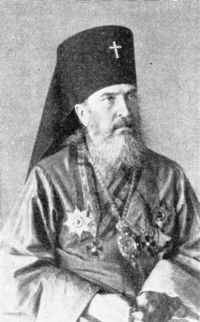
Abp. Platon (Rozhdestvensky), founding hierarch of the OCA.

As many of my readers know, earlier this month the Orthodox Chuch in America (OCA) announced the retirement of Met. HERMAN, with Abp. DMITRI of Dallas acting as locum tenens (assisted by Abp. SERAPHIM). On 9/11, they reported a new Metropolitan will be elected at the upcoming All-American Council in Pittsburgh this November.

As I noted in response to a question from a reader of this blog, the OCA presently has no Western Rite parishes. One knowledgeable source told me the OCA had given a definite (official or unofficial?) no to the idea quite a few years ago. At a minimum, there are some within the jurisdiction who oppose the idea. This is not only at odds with its history within Russian Orthodoxy, but (if true) it is at odds with its own history.

Archbishop Platon (Rozhdestvensky), the founding hierarch of the Metropolia (now the OCA), weighed in on the issue in a different way. Speaking to an Episcopalian audience, he told the group he longed to see a Western Orthodox Church in North America. Although his much later attempts to acquire ROCOR property via lawsuit (and other actions) made him an anti-hero, I present his words here for the benefit of those in the OCA who remain virulently opposed to the Western Rite — and those who would prefer the OCA have a Western Rite like that of the Antiochian Western Rite Vicariate. And this statement has significance for all North American Orthodox (see below). He spoke to the Church House in Philadelphia on February 27, 1911:
As long ago as 1904, the Committee of the Holy Synod for the furtherance of the question of Church Union published its Notes on the American Book of Common Prayer. These Notes may be taken as the Russian Orthodox view of your "wedding garment."

I do not know whether you are acquainted with these Notes. If so, you must certainly know how friendly and sincere is our feeling toward you; you must know what is our view of your "wedding garment," and how eagerly we wish they were not only like ours, but the same as ours; and yet that, at the same time, it should be becoming to your own Christian features.

How I wish that, at this moment, you not only understood me, but that your souls might be close to me. How I wish that we were sheep of the same Orthodox fold, and that it were impossible to apply to us the words oves non audiunt vocem alienorum.

My brethren in Christ, our life is moved by ideas, and not by exterior circumstances and interests, which also include both our national and our individual peculiarities. So our nearness will be realized only when our religious ideas are not only not alien, but are near and akin.

What is most important of all! Christ said: "If ye continue in my word...ye shall know the truth" (John viii, 31-32). In this rests the substance of our faith, and the substance of the question of the Union of the Churches. I find more religious significance in my Church, while you find more in yours. Why is this so? Because in my Church I want to pray, finding there alone the familiar conditions which best correspond to my mood of prayer. Why is this? For the reason that a Russian church is one thing, while an American church is another. You sit in your churches; we stand in ours. And in order to bring about union, it is not necessary to carry the pews from your Church to ours, forcing you to stand and us to sit. We shall not sit, and you, from lack of habit, could not remain standing through such long services as ours.

But Union does not demand this. Otherwise the pews might become the barrier over which the Orthodox could not step into your Church, or you into ours.

...It would be difficult to bring about a union which would enable you and ourselves to feel at home in each others' churches. It would be hard for you to transform yourselves into Russian Orthodox, and for the Orthodox to become Episcopalians.

But is this necessary? If until the eleventh century there existed an Orthodox Eastern Church and an Orthodox Western Church, why should this be impossible now, in our day?

Could we not think of the parallel existence of the two Churches, the Russian Orthodox and the Episcopal, if the former proclaims the latter its beloved sister, whose faith conforms to its own? This can take place, when your Church removes all the dogmatical differences separating it from the Orthodox Church, which has preserved pure, primitive Christianity. Until this happens, though I have friends among your Bishops whom I value highly and for whom I have a profound respect, as a faithful son of my Church, knowing its dogmas and devoted to its ritual with my whole soul, I cannot admit of any compromises which would entail the smallest and seemingly most insignificant belittling of our Orthodoxy. I am sure you yourselves could not wish this.

You will illumine your dogmatical digressions by the light of the science of history, and will see for yourselves what is to be done. When we agree concerning dogmas, there will be no need to speak of rites. They will not prevent us from being one in Christ and having the same belief in Christ. Only the more so, because both among you and among us there are many people who wish to do so.

...You already have an army ready and able to demolish the fortress of disagreement, the division which rends the seamless cloak of the Church of Christ. But this army still needs a fuller knowledge of the breadth and power of the Church of Christ in that epoch when it was not divided into factions. In my eyes, gentlemen, if you really possessed this knowledge, without any doubt you would have confessed in the face of all the world, with one mind and voice, that our Orthodox Eastern Church is the Church founded on earth by our Lord Jesus Christ "for us, men, and for our salvation." It is also beyond doubt that in that case you would have expressed the desire to be members of the Orthodox Western American Church.

May the Lord God grant to us the possibility to see the blessed day when we can give to you, Americans, the same name of Orthodox Christians. That would be a great mercy from God both for ourselves and for you. Let us believe that it will come, and let us pray that it may come soon. (Emphases added above.)

So, the founding hierarch of the OCA, Abp. Platon, prayed for the establishment of a Western Rite; he demanded only that the Episcopalians whom he addressed "remove all dogmatical differences separating it from the Orthodox Church" and modify their liturgy according to the Notes on the American Book of Common Prayer. (This has been accomplished in the Liturgy of St. Tikhon celebrated by some in the Antiochian Western Rite Vicariate.) In this, he is in line with St. Tikhon (Bellavin), St. Nicholas of Japan, St. Raphael of Brooklyn, and others. (Indeed, it appears St. Nicholas of Japan viewed the external rite of ordination as "valid" and merely opposed confused Anglican theology.) Note also Abp. Platon's allusion to the "parallel existence of two churches," meaning when these Western Christians accepted the full Orthodox faith and made necessary changes to their liturgical practice, they would retain their own Western Rite hierarchy.

To those outside the OCA, I note his words were spoken in 1911, during his first term in America, before the Bolshevik Revolution and 15 years before the split of the Metropolia and ROCOR. (In between, he had served as a member of the Holy Synod of Russia.) As such, his words were those of a bishop representing North American Orthodox regardless of later jurisdictional identity.

Now that the OCA is making other needed changes, it is time to follow the example of the 20th century saints listed above, as well as the founding hierarch of their own jurisdiction, and allow for a Western Rite like that already approved by her sister jurisdictions.

Labels: , , ,

Thursday, August 14, 2008

Met. PHILIP Responds to the Jerusalem Patriarchate Transfer

Here's Metropolitan PHILIP's letter on the topic:
August 7th, 2008

To: The Esteemed Hierarchs, Members of The Archdiocese Board of Trustees, Clergy and Faithftil of the Self-Ruled Antiochian Orthodox Christian Archdiocese of North America:

On August 5, 2008, The Greek Orthodox Archdiocese of America issued a press release which established a vicariate with the name 'Vicariate for Palestinian/Jordanian Communities in the USA'. The membership of this vicariate will consist of those communities in the USA which were originally part of the Patriarchate of Antioch, but most recently (since 1993) were uncanonically claimed by the Patriarchate of Jerusalem. From an historical perspective, it has been clear since the disintegration of Orthodox unity which existed in North America until 1917, that the Arabic-speaking Orthodox people in North America have been exclusively under the pastoral care of the Self-Ruled Antiochian Orthodox Christian Archdiocese of North America. Similarly, the Greek-speaking Orthodox people (e.g. Cypriot, Greek, Egyptian, Turkish, etc.) have always been under the pastoral care of the Greek Orthodox Archdiocese of America. What reaction would occur if the Antiochian Archdiocese were to establish a vicariate for Greek communities which separate themselves from the Greek Orthodox Archdiocese?!

These former "Jerusalem Patriarchate" communities separated themselves from the Antiochian Archdiocese without canonical releases, and in some cases are served by priests who are under canonical suspension. It is important to point out that since this separation occurred in 1993 we have taken extraordinary measures to reconcile these communities with The Antiochian Archdiocese and have appealed to both the Patriarchate of Constantinople and the Patriarchate of Antioch as well as others for their assistance. Unfortunately, none of our numerous appeals for intervention were answered.

As such, our directive of May 2, 2003 remains in force. To emphasize the main point or that directive, the clergy of The Antiochian Archdiocese are still forbidden from communing and/or concelebrating with any clergy who are a part of this newly-formed "Vicariate far Palestinian/Jordanian Communities in the USA" of the Greek Orthodox Archdiocese of America, whether in our parishes, their parishes, or as a part of pan-Orthodox gatherings.

We lament this action by the Ecumenical Patriarchate which further complicates the already uncanonical jurisdictional situation here and continues to undermine the efforts of all Orthodox hierarchs of SCOBA to achieve administrative unity and canonical normalcy in North America.

Praying that this urgent situation will be resolved in a spirit of peace, harmony and love, we remain

Yours In Christ,
Metropolitan PHILIP
Archbishop of New York and Metropolitan of All North America

Copy to:
His Beadtude IGNATIUS IV, Patriarch of Antioch and All The East
His Holiness ALEXY, Patriarch of Moscow and All Russia
His All-Holiness BARTHOLOMEW, Patriarch or Constantinople
His Beatitude THEOPHILOS, patriarch of Jerusalem
All Hierarchs of the Standing Conference of Canonical Orthodox Bishops in America (SCOBA)

Labels: , ,

Wednesday, August 06, 2008

Jerusalem Patriarchate Bows Out of North America

The Greek Orthodox Archdiocese has announced that the Jerusalem Patriarchate has relinquished its parishes in North America to Abp. DEMETRIOS.
Henceforth, the Patriarchate of Jerusalem no longer asserts any jurisdiction in the Western Hemisphere.
After an April 1 meeting between H.A-H. BARTHOLOMEW I and Patriarch THEOPHILUS III of Jerusalem:
His Eminence Archbishop Demetrios of America was directed to proceed with the implementation of the agreements by the creation of a Vicariate for the inclusion of the clergy and communities within the Archdiocese of America. The official name of the Vicariate is: “Vicariate for Palestinian/Jordanian Communities in the USA.”

The clergy and communities of the Vicariate will be directly under the Archbishop of America and will report to the Archdiocese through the Vicar. Through the Archdiocese, all of these clergy and communities will be able to participate in the programs and agencies of SCOBA.
I don't understand the church politics of this enough to know its significance; I just thought the news more than merited mention.

Labels: ,

Sunday, August 03, 2008

From the Mailbag: Western Rite Missions in England?

Q: Your Western Orthodoxy blog shows in its entry for July 16 a clergyman censing the congregation at a ROCOR Western-Rite liturgy in London.

On the assumption that the London in question is London the capital of the UK rather than London, Ontario, Canada, I should be interested to know if WR liturgies are a regular occurrence in London and who organises them.

I am an Anglican with a long-standing interest in Orthodoxy and who is needless to say unhappy with what is going on in Anglicanism at the moment.

I assume that you are the author of the blog, if not please congratulate him from me on splendid piece of work.

A: Thank you for your kind words about my poor, unofficial blog. The liturgy was, indeed, held in the UK rather than Ontario (although there is a ROCOR monastery not far from London, Ontario, as well). The celebrant of the Mass in London, Fr. Michael of St. Petroc Monastery, recently addressed the issue of Western Rite missions in Great Britain. Here's what he wrote:
In the aftermath of the Church of England's General Synod decision to go right ahead with bishopesses, and of the shambles that Rowan Williams has managed to make of Lambeth, it is timely to say out loud to Church of England laity, that there is an alternative to the pseudo-leadership of the papacy. The Pope is neither the only nor the best way for members of the Church of England to go!! How many Church of England people realise that the Western Rite was first authorised for Orthodox use specifically IN ENGLAND over a hundred and thirty years ago (just after the Primus of Scotland had visited Russia and discussed unity with Church authorities there - and reported his conversations to the Convocation of Canterbury)? How many realise that services extracted from the Book of Common Prayer were authorised for adaption for Orthodox use over a hundred years ago? How many realise that there have been Orthodox Benedictine monasteries for over sixty years? That the Church of England non-Jurors discussed joining with Orthodoxy in the eighteenth century? Or that the first Anglican parish joined Orthodoxy over thirty years ago? Embryo Western Rite parishes/missions can be formed immediately in England (or Scotland or Wales) and seek immediate Orthodox oversight while they prepare themselves for formal reception. A Western Rite Orthodox Prayer Book already exists - it is just a matter of them making contact with us.
Missions in the UK are dear to Father's heart. He is always searching for those who wish to live out their Orthodox theology in an approved Western liturgical form.

You can contact Fr. Michael here. You can also reach him through the St. Petroc Monastery website or through his online discussion site, Ely Forum.

Thank you for contacting me. I pray your correspondence is a fruitful one, and Godspeed to you on your journey home.

Labels: , , , ,

Thursday, July 31, 2008

Off-Topic: Abortionist Tiller Takes Communion at ELCA Church

Yes, the Evangelical Lutheran Church in America (ELCA) considers the partial birth abortionist "Dr." George Tiller, and his wife, members in good standing. His wife even wrote a devotional for the local church's newsletter at one point.

This website has a picture of the man taking communion.

God have mercy on him and the entire ELCA.

Labels: , , ,

Tuesday, May 13, 2008

Abp.HILARION: World Council of Churches Meaningless

From Interfax:
The new First Hierarch of the Russian Orthodox Church Outside of Russia (ROCOR) doubted the relevancy of the World Council of Churches.
"The Moscow Patriarchate participates in the World Council of Churches for the purposes of maintaining a dialogue among Christians, but we can see that there is hardly any union reached, and this organization has lost its importance," said the First Hierarch Hilarion in his interview published by the Komsomolskaya Pravda daily on Tuesday.
What's worse are the few "agreed" statements the WCC produces on holy orders, etc.

Labels: , ,

Monday, March 24, 2008

Interesting: Benedictine Byzantines?

I just discovered an interesting group: "Benedictine Sisters of the Byzantine Church." It looks like the group began in 1951, when a number of Byzantine Catholics entered a Benedictine convent but decided to remain Byzantine Rite Catholic ("Uniate"). I'm not sure exactly how they combine these two elements in practice; I just thought the combination interesting.

Labels: , ,

Saturday, March 22, 2008

St. Nicholas of Japan and the Western Rite

St. Nicholas of Japan, Equal-to-the-Apostles

Most of those conversant with the history of Western Rite Orthodoxy know of the approach American Episcopalians made to St. Tikhon (Bellavin) near the turn of the 20th century, asking to join the Orthodox Church while retaining some form of their liturgy. Most, too, know of the communication the Non-Jurors had with Orthodox hierarchy in the early 18th century. However, few knew that St. Nicholas of Japan, Equal-to-the-Apostles, had also responded to what he believed to be an overture from an Anglican church for unity.

I read with interest article entitled "An Attempt at Unity in Japan" by the Rev. Charles Filkins Sweet, which he wrote in 1912 about events that took place in 1909. Sweet served as secretary of the Anglican and Eastern-Orthodox Churches Union in Japan, where he represented the Nippon Sei Ko Kwai (The Anglican Episcopal Church in Japan). St. Nicholas of Japan became its vice president, representing the Haristos Sei Kyo Kwai (The Orthodox Church in Japan). At a meeting of the union, all members present, including St. Nicholas, vowed to pursue church unity, and Sweet wrote up an essay outlining the "variations and differences" between the two churches.

...And in time, an answer came from the Orthodox. By Sweet's account, St. Nicholas' judgment was "based upon the notion that I and my fellows sought for terms in order to make corporate submission--which was by no means our purpose." [1] However, thinking a corporate reunion were being proposed, it is worth noting the Rejoinder's disposition and terms.

Sweet writes that he prepared a paper on the subject of ministry, because:
[F]rom many conversations with Abp. Nicolai (St. Nicholas of Japan - BJ.) I was aware that the objections he made towards Anglican teaching gathered around the sacramental system; and they were quite practical, relating not so much to to the language or meaning of the English Prayer Book as to the practical apprehension in daily life by Anglicans of the need of sacramental grace.

...It is astonishing to see that the sole reason advanced for not making this recognition [of the "validity" of Anglican orders...and it was not necessarily the "sole" one - BJ] is the fact that the English Church does not teach unqualifiedly that there are seven sacraments. (Emphases added.)
In other words, St. Nicholas of Japan did not see the Book of Common Prayer as utterly corrupt and incapable of (some) use in the Orthodox Church, but he insisted those who join the Church share Her faith.

This spirit can be seen in the Orthodox response to Rev. Sweet's paper. A portion of the "Rejoinder on the Part of the Russian Ecclesiastical Mission to the Paper of Rev. Charles F. Sweet" is included, the section dealing with — wait for it — Ordination. The Rejoinder asks if Orthodox should "say that [Anglican ordination] is invalid because of its different wording? No; I believe that such a conclusion would not be free from blame as a hasty judgment." Instead, the Rejoinder examines both the Prayer Book ceremony (external form) and the Anglican doctrine of ministry expressed by the 39 Articles (doctrine, or intent). It noted, concerning the Prayer Book rite of ordination, "We do not find that according to this discussion upon the general subject that there is any reason to disapprove the Holy Orders of the Sei Ko Kwai from the point of the external aspect of anshurei [ordination], or as regards the outward ceremony, which is the first part of the fundamental or necessary property of Ordination."

The trouble, the Rejoinder stated, is Anglican doctrine:
[W]e cannot find any classifications of sacraments among all the 39 Articles, except the declaration to the effect that there are two sacraments. Consequently anshurei [ordination] is not called a sacrament. Therefore those who may wish to interpret this Article in the purely Protestant sense would have no difficulty in so doing. Until then we find enough reason for interpreting this article in the former [Orthodox] sense and not in the latter [Protestant], the 25th Article will be a cause, preventing us, the members of the Sei Kyo Kwai [Orthodox], from believing entirely in the Holy Orders of the Sei Ko Kwai [Anglicans].
The Rejoinder showed familiarity with the still-prevalent retort that the 39 Articles must be interpreted by the BCP, rather than vice-versa:
[S]ome theologians of the Sei Ko Kwai assert that we must try to find the true meaning of the 25th Article from the Book of Common Prayer. Yet on what ground ought we, even by putting all due emphasis on the Book of Common Prayer, to lower the value of the 39 Articles? We can find no reason for making light of the Articles.
The Rejoinder concluded on this point, "the Articles remain as an inviolable doctrinal book." Noting the contrast, St. Nicholas is quoted as saying, "Is it not the same as to establish Holy Orders with the right hand and destroy them with the left?"

Rather than heed his advice, the Anglican author Sweet decided to lecture the Orthodox saint on Orthodoxy:
[I]n the first six or seven centuries the Easterns made no attempts to number the sacraments, and there was no traditional teaching on the point, except that St. Theodore of the Studium, who died in the early part of the ninth century, held that Christ instituted six sacraments...It seems probable that the present list of Seven was taken over from the West to the East.
So, he ascribed the saint's profession of seven sacraments to the "Western captivity"! Like some overzealous Orthodox polemicists — who learn that historically the Orthodox Church did not limit sacramentality to "The Seven Sacraments," and thus insist the Orthodox Church rejects the teaching that there are seven historical sacraments/Mysteries of the Church — Rev. Sweet decided to prove he was more Orthodox than the Orthodox (and a saint, at that).

From the remainder of the article, it is clear St. Nicholas insisted any recognition of Anglican orders in a future reunion would be contingent upon their embracing "the whole faith of the Church." This would be the standard for some time. Eighteen years later, Met. ANTHONY (Khrapovitsky) of ROCOR wrote that Anglican clerics could be received "in existing orders" — if they became Orthodox. (Lest any Anglicans rejoice, that was a different Anglican church — and Met. ANTHONY writes, by the same canons, the same treatment could be accorded to Nestorians.)

It is noteworthy that St. Nicholas of Japan, in his contemplation of what he believed to be an appeal for "corporate submission," did not utterly reject either the concept of a Western Rite nor one based upon some version of the Book of Common Prayer. He did not demand Western converts become Byzantine Orthodox. He did not breathe a word about returning to long-dead liturgical forms carbon-dated from 1054 A.D., nor encourage pet theories about liturgical development of the "old Sarum" this or "reconstructed Gallican" that. One sees not a hint of the supposed "two approaches" to the Western Rite in this saint's approach to, again, what he believed was an appeal for "corporate submission." By his response, it appears St. Nicholas of Japan encouraged the development of a Western Rite using some form of the BCP. He was undoubtedly aware of the recent 1904 Russian Observations Upon the American Prayer Book. It would be of great interest to see if rest of this Rejoinder, or additional correspondence, were available, and if he made any reference to the eventual shape of the liturgical life in a future Western Rite Orthodox Church in Japan.

In the end, this "attempt at unity" did not materialize for the same reason as the other examples mentioned above: the Anglicans could not bring themselves to believe in the Orthodox faith. At least in reflection Sweet recognized:
Anglican writers have pressed the objectivity of sacramental doctrine (e.g., that it has a "valid" priesthood - BJ) too hard, and have been dry and formal--even mechanical. Valid ordination alone does not make a Catholic Church. The life of the Catholic Church is something infinitely richer and more various than the Episcopate. We have fallen into the way of dealing with the doctrine of the ministry as if, in proving we have the episcopal succession we prove that we have all we need in order to be Catholics. This is pressing sacramental doctrine beyond all reason, and making the religion of Christ a mere system instead of a gospel.
Had his church taken St. Nicholas of Japan's plea to broaden and deepen its apprehension of the catholic faith, it may have ended up as the second Western Rite church in history.[2] But it appears the Western Rite as practiced in the Antiochian Orthodox Church and ROCOR may have yet another heavenly intercessor.

ENDNOTES:
1
. Sweet's essay is somewhat contradictory on this point, as he notes at his initial meeting with St. Nicholas, the Nippon Sei Ko Kwai agreed "our final purpose was unity, and...we all believed it was possible, possible even then." However, it seems the Anglicans envisioned "intercommunion" rather than unity on Orthodox terms. They also undoubtedly wished to receive another endorsement of the "validity" of their orders, recently denied by Pope Leo XIII in his encyclical Apostolicae Curae.

2. The first was Rene Joseph Vilatte's short-lived submission to Russian Orthodox Bp. VLADIMIR (Sokolovsky-Avtonomov) in 1890-1. That Western Rite Orthodoxy was ever associated with such unstable individuals as Vilatte and, later, Arnold Harris Matthews (and that both would apostasize shortly after their plea for "unity") is greatly to be lamented.


Labels: , ,

Thursday, March 20, 2008

One Down...

The Latin Patriarch of Jerusalem, Michel Sabbah, is retiring after 20 years.

The Crusaders established the Latin Patriarchate of Jerusalem in 1099 as part of their self-imposed imperial kingdom. (Pope Urban II had launched the First Crusade to free Byzantines from Muslim rule, at the express request of Byzantine Emperor Alexius I Comnenus.) The Crusaders took the campaign as an opportunity to establish independent spheres of influence, complete with their own episcopacy. Their ecclesiology demanded the establishment of new patriarchates, as Orthodox bishops who did not recognize the Pope as head of the church and font of all holy orders were regarded as "schismatic." For centuries, most of the Latin "patriarchs" of Jerusalem were resident in Rome, but in the last 160 years, they have returned to the Holy Land.

Nowhere has this view of the episcopacy been taken to more extravagant lengths than in Antioch. The Crusaders established their own patriarchate a year before that of Jerusalem and appealed to the pope to personally take the throne. (What was to become of the current resident patriarch, H.H. JOHN IV, they didn't say.) Further schisms have fed the tangled web of overlapping Antiochian patriarchal claimants in communion with Rome. In the city where "they were first called Christians," one could find Roman Catholics under the leadership of:
  1. Melkite Patriarch Gregory III (Laham)
  2. Maronite Patriarch Nasrallah Sfeir
  3. Syrian Catholic Patriarch, formerly Ignace Pierre VIII (Abdel-Ahad). He resigned in February and has yet to be replaced (to my knowledge).
There had been a Latin Patriarch of Antioch since the time of the Crusades (est. 1098), but the office was allowed to expire in 1964, having been vacant for more than a decade. What bearing that happy example may have upon the current Jerusalem vacancy, I'll leave to my readers to draw.

Readers may also be interested in a related post: "Why Not an Orthodox Pope of Rome?" (For the record, I wrote that in favor of appointing one.)

Labels: , ,

Wednesday, May 30, 2007

An Excellent Assessment of the Western Rite

When someone asked for the blogs that make me think, I listed Julio Gurrea prominently. He has more than earned that title in three recent posts on the Western Rite. Together, they are an ecclesiological and liturgical, take-no-prisoners tour de force. Passionately written, with clarity and charity, he offers an excellent description of how those of Western ritual and piety can exist in an "Eastern" church. (I put "Eastern" in quotation marks, because the Orthodox Church is a catholic body for all believers, not an ethnic or cultural institution.) You must read the whole series (three parts, so far). Part I offers a wonderful assessment of Orthodox ecclesiology (which I'm greatly simplifying; again, please read it all):
All other ecclesiastical bodies which claim the title of the One True Church, the Catholic Church, etc. are not in fact the Holy Catholic Church...In some cases, [they] may be so painfully close that the fact that such a body is not in the Church is a source of much anguish and lack of sleep on my part. I hate the fact that a schism ever happened... [However] No amount of miracles, saints, and good works outside of the Orthodox Church disprove this belief. It only shows how merciful the Holy Spirit is and how He moves where He wills.
He adds, in Part II:
I am of the opinion that if the people who lived hundreds of years ago during some of these controversies did not see a way to reconcile two different beliefs, then we are being presumptuous by assuming that we “understand things better.”
I thank him for noting the Branch Theory is simply another form of modernism, which its advocates claim to oppose. It asks if we can't sweep aside all those untidy theological disputes and render "the Church" a spiritual non-entity, unmoored from any doctrinal components of Her essence. Historically, the theory was not accepted by Orthodox (who believe certain Roman doctrines were heretical), Roman Catholics (who believe Orthodox are Schismatics), or Protestants (who levied a pox against both houses, of "pagans" and "the anti-Christ"). In essence, it says, "Orthodox Christians; Vatican I Roman Catholics; Puritan Anglicans: What's the difference?" It is the theological equivalent of "Can't we all just get along?" (It also has the demerit of being false.) :)

If Western Rite Orthodoxy is not identical to other Western churches, does this make us somehow un-Western? Does subscription to Orthodox (which is to say, merely catholic) theology make us Byzantines light? He takes as an example St. Gregory Palamas:
The uncreated light is neither Eastern nor Western. It is a description of reality.
In other words, to rework a phrase of St. Augustine of Hippo, "All God's truth is our truth," wherever it may be found.

Julio's series is so good, I take a modicum of pride in seeing I may have had an influence on him. In Part III, he borrows an exact phrase of mine:
Little girls in America dream of growing up, meeting a nice boy, and saying their vows at the altar. Read it again. They do not dream of and will never dream of exchanging their crowns at the wedding table.
I think my exact words were, "Little girls in America growing up dreaming of saying 'I do,' not dancing around an altar three times." This is not to say anything negative about that beautiful rite, simply that the Byzantine custom is not part of our national consciousness, while exchanging vows is almost universally regarded as sacred. But I'm glad the truth is being repeated: Americans may be strangers to the Orthodox Church, but most are not entirely estranged from God. Our Western forefathers passed on to them a set of rituals and phrases that pervaded the whole of our culture. If the Orthodox Church recognizes these formulae as Her own, why would we not remove any unnecessary cultural stumbling blocks delaying those Westerners who love the Father from being reconciled with their Holy Mother, the Church?

Thus far, Julio has developed his themes magnificently; I look forward to see where he will go next.

Read all of Julio's posts (so far): Parts I, II, and III.

Labels:

The Young Fogey Fulminates Against Me

(Acknowledgement: I'd like to thank Logos for pointing this out to me, as I don't read Serge's blog.)

Mr. John "Serge" Beeler (who has appropriated for himself the title "The Young Fogey," apparently from Colleen Carroll Campbell's excellent book The New Faithful) has written a "response" to my post, "The Western Rite is Not 'Reverse Uniatism.'" Mr. Beeler and I crossed swords a number of years ago, which seems to have given him an interminable antipathy toward me — but then he seems to rage against anyone with the temerity to disagree with him. Mr. Beeler (who it seems cannot bear to call me by name), writes:
This blogger, trying to defend the Western Rite Orthodox experiment as not ‘reverse Uniatism’, seems to mirror the latinisers in the BC churches. Paraphrasing him: ‘We use Western externals but underneath are really Byzantine in our theology — the Eastern church fathers — because only that is really Orthodox’. What? [That's some paraphrase - BJ.]

IMO the best of the WRO, like Subdeacon Ben Andersen, no longer blogging, don’t talk like that. They don’t pretend everything they do is pre-schism nor try and rewrite history to fit byzantinocentrism. Like the high-church BCs use mostly Orthodox stuff and try and square it with today’s RC ecclesiology (papal prerogatives), these Orthodox openly use Roman and Anglican prayers, devotions and spiritual writing — dare I say theology as in ‘expression of dogma’, not the same as dogma in itself? — and find that this doesn’t contradict the Byzantine theology of other Orthodox. One set of dogma, different expressions. Sounds good.
Those who read my blog regularly know such accusations ("byzantinocentrism"?!? Maybe I really am "Ethnic Ben.") are misplaced. What really seems to frost Mr. Beeler is that he is an indefatigable (albeit usually indirect) exponent of the Branch Theory, and I, like all faithful Orthodox, reject that notion. I believe the faith of the Apostles is Orthodox, not an odd hybrid, by parts Orthodox, Roman Catholic, or Anglican (with High, Low, and Broad churchmen vying to define that ambiguous term). Between these three communions, we are dealing, not with "different expressions," but different dogmas. For the interest of those who do not frequent the blog, I reply more fully below.

Detailed Response:
Hmm, having re-read my own post a few dozen times, I find no reference wherein I claim everything in the Western Rite "is pre-schism" (though a great deal of it is), and my readers would agree it is a stretch to refer to this blog as "byzantinocentric." (!)

The vast bulk of my post, of course, is dedicated to the fact that WRO and "Uniates" are not identical because no political or economic favors were granted in the genesis of the Western Rite; because we do not use an identical rite to that of another Church; and because we do not deceptively label ourselves members of one communion when we are members of another. (e.g., some ByzCaths call themselves "Orthodox in communion with Rome," which is an oxymoron.) All of this escaped his notice.

I also can't seem to find any statement that only the Eastern Church Fathers are "really Orthodox," a view I frequently criticize. I do find these words in my post: "we look with understandable affection at forefathers like Pope St. Gregory the Great, St. Ambrose of Milan, the Venerable Bede, and St. Peter Chrysologos." I simply noted that we in the Western Rite do not ignore the Eastern Fathers. How radical.

I've rather made it a distinctive practice to point out the similarities of Eastern and Western Rite practice: see here, here, here, here, and here. In other words, "One set of dogma, different expressions. Sounds good."

Incidentally: Three times in his post, Mr. Beeler makes reference to an alleged "high-church minority" of Byzantine Catholics. Most Ruthenians and Melkites are now Evangelical Charismatic Megachurchers, presumably.

Labels: , ,

Thursday, May 17, 2007

In Communion!

Today is the day ROCOR and the Moscow Patriarchate healed the long and painful schism that separated them. They are now in communion once again. Deo gratias!

(Hat tip: Ad Orientem)

Labels: ,

Wednesday, May 16, 2007

A Welcome Rejoinder

"The ways of fools are right in their own eyes, but a wise man hearkens to counsel." - Proverbs 11:15.

Someone has forwarded this comment - from a blog on that seems no longer to exist. Its author originally intended it for Western Rite Orthodox:
The Orthodox Church into which you or your community within the past century or so were received is the same Orthodox Church which has been estranged from Western heterodoxy for nearly a millennium and which also has developed its own theological teaching in the meantime, expressing the faith once delivered to the saints in formulae appropriate to the time. You were received into this Church and not into the pre-Schism Western Church. That means that you can't pretend that people like St. Gregory Palamas aren't relevant to you. For one thing, there is no East-West dividing line for what is needful in the Church, and for another, those to whom you rightly look for inspiration in the ancient West absolutely had zero problem with adopting the "Eastern" language and theology of their time (where, quite frankly, most of the serious doctrinal work was being done, due to heresy). [and where most of the serious heresy was being developed, too. - BJ.] They even adopted liturgical customs! It's not a question of what's appropriate to "the East" or "the West," but what is Orthodox. Anything else is really a form of phyletism.

You do not have more in common with either the Roman Catholic or Anglican communions than you do with the Byzantine Rite Orthodox. Thinking or speaking as though you do is really just a schism waiting to happen.
In another entry, the same blogger termed certain currents in WRO (and "Orthodox blogdom" generally) Deconstructionist: they hear a certain doctrine being spoken of as "Orthodox" and immediately set out to find counter-examples that dovetail with Anglican/Roman Catholic theology (see also the last paragraph above).

It may surprise my readers, and the original author, to know that I appreciate the general sentiment (if, as the Geico caveman says, I'm not 100 percent in love with its tone). Both Fr. Fenton and I have recently reaffirmed there is no theological difference whatever between Western Rite Orthodox and "Eastern" Orthodox. We are all merely "Orthodox," and the modifiers refer only to the (approved) rituals with which we celebrate this shared faith. Thus, developments after the Great Schism are of vital importance to WRO. The Western rite employs only what is "proper to the West" liturgically, but theologically we venerate all the Eastern Fathers and regularly refer to their theology. (St. Gregory Palamas's theology of uncreated light is particularly inspirational to me.) Is it possible to say we are Orthodox but reject 1,000 years of Church theology? That would be a form of "historical reconstructionism" unimagined.

I'd take exception on one front: Often when WR bloggers - and I among them, on occasion - have discussed the affinity some figures outside Orthodoxy have for the Church, it has been, not to show how close Orthodox are to (e.g.,) Anglicanism, but to show them how close they are in heart and mind to Orthodox, whether Eastern or Western Rite. Non-Orthodox may turn a deaf ear to St. Symeon the New Theologian, but if you mention that John Mason Neale believed the same thing, or that Bp. Charles Grafton longed for corporate reunion with the East, they may give Orthodoxy a hearing. Under no circumstances, though, should we portray ourselves as closer to heterodox than to Orthodox.

Out of respect for some of those deemed "Deconstructionist," it is true that there is an "Only Legitimate Orthodoxy" school of internet-and-newsletter theology, whose Eastern proponents vastly overplay their hand to the disadvantage of the West. These are the people who seem to believe all the world's ills, from ethnic cleansing to halitosis, stem from the fact that St. Augustine's Bible said man was "born in sin" rather than "born in sins." Such Westernphobia is supposed to be a mark of how far the "convert" has come from his old home but is rather a sign of how far he has to go.

To be fair, it's certainly true there are differences of opinion, theologoumena, on non-dogmatic issues. I cherish this freedom, as distinct from fundamentalist sects. It is also true that not everything is a matter of opinion, as in modernist churches (TEC, PCUSA, ELCA, UCC, etc.).

However, it is most emphatically not true that all theologoumena are created equal. Some seem to give the impression that presenting "The Orthodox Position"TM on anything not settled by an Ecumenical Council is impossible - that all non-condemned views are equally vying for recognition as truth, and describing any belief as "Orthodox" outside dogmatic theology is like trying to find the Orthodox view of the Balanced Budget Amendment or "Tastes Great/Less Filling."

It is not impossible to establish a theologoumenon's underlying theological pedigree, and its acceptance (or lack of same) within the Church. Although we don't conduct theology by survey, how widely a belief has been held is of pivotal importance in a traditional Church.

We must be careful, in our freedom of theologoumena, not to become "cafeteria Orthodox." Just as it is possible for one to pluck singular and idiosyncratic phrases from putatively Western missals, one line at a time, and end up with a ridiculously Byzantized Mass not at all reflective of Western piety, so is it possible to pluck from Eastern theological sources, one essay at a time, a theology that is not reflective of how mainstream Orthodoxy has defined Herself throughout history. We do Western Rite Orthodoxy no favors by indulging either fantasy.

Ultimately, theologoumena are a matter of conscience, and the perimeters of debate will not be decided online. (Deo gratias!) That is the province of our Shepherds in Christ. But let us not unnecessarily tax them. Since our Holy Mother has offered us a loving home, we must become Her grateful, and obedient, children.

I thank this defunct blog and its author (whomever it was) for reminding us of this.

Labels: ,

Saturday, May 12, 2007

The Western Rite is Not "Reverse Uniatism"

One of the more challenging aspects of being Western Rite Orthodox is dealing with the number of misconceptions people harbor about the WR. One of these is that Western Rite Orthodox are merely "reverse Uniates." "Uniatism" is the process that created the Byzantine (or "Eastern Rite") Catholic Churches, hierarchies in communion with the Pope of Rome that formally accept Roman Catholic theology but retain their own liturgy and customs.

At first blush, the comparison of Western Orthodox with "Eastern" Catholics seems natural: both are minorities in a much larger church; both seek to preserve their liturgical patrimony from assimilation; both are often misunderstood by others in their church. However, these similarities mask a number of profound differences. This charge of "Reverse Uniatism," made by ethnic Orthodox and sometimes by Roman Catholic polemicists, is false for at least four reasons:
  • Western Rite Orthodoxy has never in any way influenced would-be converts with political, social, or economic considerations.
  • It did not bring the contemporary, unaltered liturgical practices of another communion into the Church.
  • It is not theologically distinct from "Eastern" Orthodoxy.
  • It does not believe it has a "unique role" or "special duty of promoting the unity of all Christians" beyond that enjoined upon all Christians.
It is worth examining each of these in some further detail.

Conversion Without Coercion
. The Orthodox Church's biggest complaint about Byzantine Catholic churches, both in their formation and today, is that these "proselytizing" bodies use economic, social, or political considerations to attract followers. Such factors played a driving role in the 1596 Union of Brest-Litovsk, which established a Byzantine Catholic Church in Ukraine. Polish royalty exerted pressure on the Orthodox to convert, and Jesuit missionaries emphasized the "political advantages which must accrue to the...Orthodox Church from union with Rome." Indeed, the Ukrainian bishops who petitioned Rome stated, "we have to do this for definite, serious reasons for harmony in the Christian republic [Poland] to avoid further confusion and discord." Internal church pressures also contributed to the decision. Thus, the "Uniates" came into subjection to the Papacy through a process that seems less rooted in theology than economics and politics. Moreover, according to the Orthodox, Eastern Catholics today offer educational benefits, reduced tuition, or less expensive medical care to their church members, a sore temptation for Orthodox to leave the Church.

Leaving aside the question of its propriety for the moment, let's conclude this is certainly unparalleled in the Western Rite. To put it mildly, Western Orthodox receive no financial, political, or social advancement as a result of joining the Church. There is not even a "Coming Home Network" job service for those wishing to join Orthodoxy (in either Rite). In fact, newly ordained Western Rite clergy often forfeit salaries, health insurance, ecclesiastical titles, or the respectability of their former country club colleagues for leaving well-to-do denominations and embracing the true Faith. As Christ said, "every one that hath forsaken houses, or brethren, or sisters, or father, or mother, or wife, or children, or lands, for my name's sake, shall receive an hundredfold, and shall inherit everlasting life" (St. Matt. 19:29). Though we pray fervently for blessings upon the Western Rite, its service remains a Way of the Cross, and we have nothing to offer those who undertake it but the purity of our faith and the fervor of our devotion.

Orthodox in Liturgy. When the Ukrainian bishops approached the Vatican in 1596, they demanded their "divine worship and all prayers and services of Orthros, Vespers, and the night services shall remain intact (without any change at all) for us according to the ancient custom of the Eastern Church" and that their Divine Liturgy be preserved "eternally the same and unchangeable." The promise was made, and the faithful were allowed to recite the Nicene Creed without filioque, ordain married priests, and celebrate their services as they always had. (This toleration was later abandoned, and intense latinization followed.) [1] Put another way, Eastern Rite Catholic practices were in no way different than Eastern Orthodox practices. In The Orthodox Church, Bp. KALLISTOS Ware wrote, "one wonders how far uneducated peasants in Little Russia understood what the quarrel was really about. Many of them, at any rate, explained the matter by saying that the Pope had now joined the Orthodox Church."

This cannot be said of the Western Rite, whose liturgical practices stand out from both the Roman Catholic Novus Ordo Mass and the 1979 Book of Common Prayer. (Ironically, we are often criticized for this, as well.) Our Liturgy of St. Gregory preserves the ancient heritage of the Latin tradition, while the Liturgy of St. Tikhon (text file) conforms completely to the 1904 Russian Observations Upon the American Prayer Book. Neither are contemporaneous with the practices of a mainline denomination. [2] Moreover, even before Vatican II, the Liturgy of St. Gregory had been edited to conform to Orthodox guidelines (most notably, with the insertion of a descending epiclesis and additional Pre-Communion Prayers). The Mass is also typically offered in the vernacular. Though visitors would find a great deal of familiarity with certain elements and the overall structure of our Mass, no one could walk in off the street and see a mirror image of another denomination's service (unless that denomination has been imitating us!).

Orthodox in Theology. Although Byzantine Catholics must officially accept all the dogmas and doctrines of the Roman Catholic Church, there has always been an understanding that ByzCaths would "emphasize" their own, Eastern theology. Byzantine Catholics have discussed the tensions they often feel as a result.

Western Rite Orthodox do not have a unique or different approach to theology from our Eastern Orthodox brethren. While we look with understandable affection at forefathers like Pope St. Gregory the Great, St. Ambrose of Milan, the Venerable Bede, and St. Peter Chrysologos, we also kneel at the feet of Sts. Symeon the New Theologian, Gregory Palamas, and John of Kronstadt. We differ in nothing. We are simply Orthodox Christians who worship according to an approved, Western liturgy that expresses both Orthodox theology and our Western heritage.

A Pillar, not a Bridge.
Eastern Rite Catholics long believed, as an Eastern church in the Roman Catholic communion, they enjoyed a special and "unique position" as a "bridge" to Orthodoxy. At its most hopeful and imaginative, this line of reasoning saw Byzantine Catholics as the first-fruits of a reunited Christendom, leading the way to undoing the Great Schism. More to the point, they often call themselves "Orthodox in communion with Rome," a phrase most misleading. However, this vision has since been abandoned by Roman Catholic hierarchy. More than a decade ago, The Balamand Statement declared flatly, "'uniatism' can no longer be accepted...as a model of the unity our Churches are seeking."

At our most hopeful, Western Orthodox dream of whole denominations accepting the Orthodox faith in either of our Eastern or approved Western rites. We pray for it. Yet we do not see ourselves as a "bridge" to the Papacy. (He just never calls anymore.) And we certainly do not see ourselves as "Roman Catholics [or Anglicans, or Old Catholics] in communion with Orthodoxy." We are simply Orthodox, and our appeal to other denominations will come only when they, too, have embraced the Orthodox Faith. We don't feel primarily that we have left our homeland so much as that we have found it. We do not wish to distinguish ourselves from it, and even though we celebrate different liturgies than others in our communion, they impart the same theology, often in the same way with nearly the same words. (See here, here, here, here, and here.) To put a fine point on this conversation: Byzantine Catholics seem to look primarily outside their communion to the Orthodox Church for inspiration (including saints after 1569, or the appropriate date of union with Rome); Western Rite Orthodox look primarily within our communion. We are not a bridge; we are a pillar of the Church that we love. As one who has many friends and acquaintances in Byzantine Catholicism, it saddens me to see them looking longingly at a Church to which they do not belong.

Others's arguments. It is true Western Rite Orthodox do not have separate bishops and hierarchies, as Byzantine Catholics do, and some have used this as an argument to distinguish us. Though I acknowledge the difference, I find this less than compelling. For one thing, the original Western Rite in this country had its own bishop: Ignatius Nichols. It would represent no enormous step backward were we to have one again. More importantly, not every group that has an extra-geographical hierarchy should be considered "uniate"; that logic leads to the ridiculous conclusion that Romanians, Bulgarians, and Albanians in the OCA would be considered "uniates," which they certainly are not. (And Abp. NATHANIEL is an inspiration to us all!)

Where We Are Similar. We do share one vital similarity with Byzantine Catholics: we, too, believe our witness to our faith's minority heritage (Western, in our case) enriches our Church by demonstrating that it was not intended for merely one group of people or ethnicity, nor has it historically been expressed in only one liturgical praxis. (More about this later, perhaps.) We believe the Orthodox Church is the true Church, and She is now reclaiming Her Western background. Byzantine Catholics believe the Pope is the successor of St. Peter, all must be in communion with him, and they express this theology in their own way. That is another matter for another day, but every Christian of every background can agree: Christ's Church was never intended to be merely Eastern or Western but Catholic and universal, from one end of the earth to the other.

An Important Addendum
. Finally, I am well aware the discussion above relates to the origins of the Greek Catholic churches, and perhaps incidents in other countries (where membership brings one, e.g., reduced tuition). Some extreme polemicists speak of today's "uniates" in Pittsburgh and Passaic as though they were all ignorant pawns of economic-political puppet-masters in Sixteenth Century Ukraine. Modern Byzantine Catholics consist of cradle families going back generations and, since Vatican II, no small number of former Latin Rite Catholics fleeing the liturgical anarchy fertilized during the "New Springtime." (Hence, the bounty of Irish Melkites and Italian Ruthenians.) That is to say, many are members of the Roman Catholic communion by volition.

May we all pray for the day when we shall all be part of the same Church, and petty bickering over who is or is not a "Uniate" will have subsided, melted away by the blinding light of His countenance.

ENDNOTES:
1.
The latinization occurred in the old country but intensified in North America. Open hostility to the existence of the Byzantine Rite inspired St. Alexis (Toth) of Wilkes-Barre to bring his people into Orthodoxy. Meanwhile among Eastern Rite Catholics, the promise of a married priesthood was discarded; a spoken "low Mass" was introduced; side altars were erected; Latin forms of confession replaced Byzantine; and recitation of the Rosary, Adoration of the Blessed Sacrament, and other Western practices sprang up.
2. This is also true of the Western Rite liturgies employed by ROCOR: The English Liturgy and the Sarum Liturgy. This latter should be distinguished from the so-called "Old Sarum Rite Missal," which originated in a non-canonical monastery with strong ties to the "Gnostic Orthodox Church" and a background in Theosophy.

Labels: ,

Wednesday, May 02, 2007

An Ecclesiological Pascal's Wager

Yes, this is firmly tongue-in-cheek:

I believe everyone could and should be firmly convinced by the Orthodox Church's ecclesiological claims: that She is the One True Church founded by Jesus Christ. If an Orthodox Christian becomes convinced the Roman Catholic Church is that Church, then I'd counsel him to reconsider and read our theology. If at last he could not accept our Church, then he should make an ecclesiological Pascal's Wager:

If he is right that the Papacy is all it claims to be, he is not excluded; since Vatican II, and particularly under the current Pontiff, the RCC considers Orthodoxy a "true particular church" with valid sacraments and orders. The Vatican has a view that Orthodox, in a nutshell, are too dumb to realize we're really part of their church.

If he is wrong (as I believe they are), he is renouncing the true Church and apostasizing. As St. Theophan the Recluse said, "You ask, will the heterodox be saved... Why do you worry about them? They have a Saviour Who desires the salvation of every human being. He will take care of them. You and I should not be burdened with such a concern. Study yourself and your own sins... I will tell you one thing, however: should you, being Orthodox and possessing the Truth in its fullness, betray Orthodoxy, and enter a different faith, you will lose your soul forever."

If nothing else, weigh those two outcomes in the balance, then make your decision.

(End naughty jesting.)

Labels: ,

An Ex-Orthodox on "The Journey Home"

I never watch the program, but my ears perked up last week when I heard the guest on EWTN's "The Journey Home" Monday night would be a former Orthodox Christian. Out of concern about what might make an Orthodox convert to Catholicism, I tuned in. As it turned out the man in question, Dn. Joseph Pasquella, is in fact a former Antiochian Orthodox deacon.

Baptized Roman Catholic, he joined The Way International before being inspired by the writings of the Evangelical Orthodox. He then took the St. Stephen's Course, became a deacon, and founded a Byzantine mission in Cape Cod. Then at some point, he felt he had to convert and, after being laicized, became a Ukrainian Catholic deacon — and ignorance about the Western Rite may have been a contributing factor.

I wasn't terribly impressed with his presentation. (E.g., he couldn't pronounce "Akathist." He appeared on camera wearing a business suit and a priest's pectoral cross, then gave a priest's benediction. Etc.) I was edified that during this program, aimed at stealing misleading converting Orthodox to the Roman church, many questions came in about Orthodox faith and practice: icons, the Jesus Prayer, our view of the Pope, facing liturgical East, etc. As the Bible says, "You thought evil against me: but God turned it into good, that he might exalt me, as at present you see." — Genesis 50:20 (Douay-Rheims).

However most importantly, after watching his testimony, I'm still not entirely certain why he felt he had to leave Orthodoxy and join the Roman church. At one point, he spoke highly of the book Jesus, Peter and the Keys. (I read it and left decidedly unconvinced.) He also alluded to his aversion to not having "a court of last appeal" at the Vatican. (Guess he never heard you could appeal to the Patriarch or the Holy Synod of Antioch; I actually know of someone who did so. Successfully.)

The pivotal moment in his leaving the church seemed to be an episode that occurred as he was lying in bed during an illness. He said he was moved during a televised Vatican service when Pope John Paul II looked at the camera — "I felt like he was looking directly at me," he said — and declared, "The Church must breathe with two lungs: East and West."

Which raises the question: was he motivated to leave the Orthodox Church because he believes it only celebrates one liturgy, an Eastern one, and a truly catholic Church must also be Western? What if he had known the Antiochian Church (and ROCOR) have a Western Rite? Should the Evangelical Orthodox who helped him form his mission have told him about the Western Rite? Would knowing about the Western Rite have changed his mind, or slowed him down enough that he might reconsider leaving the Orthodox Church (with all the consequences that brings)? And is he alone in his sentiments?

As I mentioned, he was too inarticulate to ascertain. But these are questions every Orthodox Christian, especially those in positions of leadership, should consider carefully.

Labels:

Saturday, April 28, 2007

Limbo, RIP

But where there's sickening heresy, there's also good news: Pope Benedict XVI has approved a theological study essentially doing away with the concept of Limbo.
After several years of study, the Vatican's International Theological Commission said there are good reasons to hope that babies who die without being baptized go to heaven.

In a document published April 20, the commission said the traditional concept of limbo -- as a place where unbaptized infants spend eternity but without communion with God -- seemed to reflect an "unduly restrictive view of salvation."

...Grace has priority over sin, and the exclusion of innocent babies from heaven does not seem to reflect Christ's special love for "the little ones," it said.

"Our conclusion is that the many factors that we have considered ... give serious theological and liturgical grounds for hope that unbaptized infants who die will be saved and enjoy the beatific vision," the document said.

"We emphasize that these are reasons for prayerful hope, rather than grounds for sure knowledge," it added.
I'm happy to see Limbo go the way of all flesh. As I wrote earlier, Limbo (thankfully) has no place in Orthodoxy. In our history:
St. Gregory of Nyssa "On Infants' Early Deaths" wrote "the innocent babe has no such plague before its soul's eyes obscuring its measure of light...it does not need the soundness which comes from purgation, because it never admitted the plague into its soul at all." Infants "partake only so far in that life beyond (which consists, according to our previous definition, in the knowing and being in God) as this nursling can receive; until the time comes that it has thriven on the contemplation of the truly Existent as on a congenial diet, and, becoming capable of receiving more, takes at will more from that abundant supply of the truly Existent which is offered." Thus, he says the infant begins at the level upon which he/she has experienced and responded to God (a low level, to be sure) but holds out the promise of eternal advancement — or as the Western Rite Liturgy of St. Tikhon says, "continual growth in Thy love and service."

Russian Orthodox Bishop HILARION (Alfeyev) weighed in on the subject, writing tersely that the historical Orthodox teaching on unbaptized babies "is opposite to the teaching of Thomas Aquinas." The Orthodox Office of Prayer and Supplication for the Victims of Abortion, prayed by H.G. Bp. BASIL, for instance, implores God, "[W]e humbly pray, according to Thy unfailing promise: grant the inheritance of Thy kingdom to the multitude of spotless infants who have been cruelly murdered."
Even Martin Luther understood and taught that infants had faith. With this move, the pope removed one of Orthodoxy's outstanding objections to RCC theology. (And brought his church into the 16th century. ) :) I'm happy for the change.

Labels: , ,

The Roman Catholic "Gay Mass"

A disgusting story -- and trust me, the picture in this story will make you sick:
The BBC is to relay a 'gay Mass' from San Francisco this Sunday, the first time such a service has been broadcast.

The 50-minute Mass at the Most Holy Redeemer Catholic Church in the predominantly gay Castro district of the city will feature prayers and readings tailored for the gay community.

The church has been described as an "inspiration" to gay and lesbian Christians around the world because of its ministry to homosexuals.

...Its parish priest, Father Stephen Meriweather, blesses participants in the San Francisco's annual gay pride march.

But it has also infuriated many Catholics in the U.S. who have complained about such activities as transvestite bingo nights during which sex toys and pornographic DVDs were handed out as prizes.

...However, Father Donal Godfrey, the U.S. Jesuit priest celebrating the Mass, said he was delighted the BBC was "exploring how gay people fit into the perspective of the Christian narrative".

"Being gay is not special," he said. "It's simply another gift from God who created us as rainbow people."

The preacher will be James Alison - a homosexual British Catholic theologian and author of 'Is it ethical to be Catholic? - Queer perspectives'.

...[L]ast October, it emerged that a transvestite group calling themselves the Sisters of Perpetual Indulgence regularly staged lewd and irreverent bingo nights on the church premises.

And such is the current state of the modern RCC.

(Hat tip: York Forum)

Labels: ,